
A few nights ago I had a profound dream. Today I’m haunted by its message.
Terror coursed through my veins as the dream sequence began. Hostile enemies had invaded my city, and I was busy gathering friends and family into a group to defend – or depart – depending on the outcome of the initial conflict.
I shouted from the Abrams tank I was driving: get out of your house! bring only what you need! we are under attack! People came out of their homes with whatever they could carry. Someone was passing out grenades, rifles, submachine guns, armored vests. Though I hate to admit it, there was a rush of adrenaline. Whatever was to come for us, terrifying as it might be, was also somehow exciting. After all, we had guns and tanks.
Eventually that sequence of events led us to direct, face-to-face conflict with our enemies. They looked different than us – perhaps they were Arab? – I couldn’t tell. I also noticed their faces held the same terror written on ours.
I shot my rifle into their midst, over and over, hoping desperately to get them to stop.
But the fighting ground on and on. Grenades flew in, exploding around us. I remember trying to lob one back at the enemy. The saying goes, war is hell.
This was hell indeed.
Then for no clear reason apart from our mutual desperation, we ceased our shooting. Through the chaos a white flag rose on the enemy’s side.
This part of the dream was the most lucid. I can remember the tears flooding my face as I ran out of the trench, leaving aside my weapons, making my way toward the people I had targeted just moments ago. I began to hug everyone I saw. We wept in one other’s arms.
The interaction I remember most was with a young man, who by this point definitely struck me as someone from the Arab world. Through his tears he was saying, “my brother, my brother, you are my brother.” All I could do was respond, “yes, we are brothers. How can I say brother in your language? We are brothers, we are family.” I can still see his dirty face, taste my tears. I felt the relief of having moved through trauma into shocking reconciliation.
The dream ended. I woke up in actual tears.
***
Whatever could all of this mean?
I hadn’t binged news about the conflicts happening around the world, though I am aware of recent unrest in Khartoum, Palestine/Israel, Ukraine, Ethiopia, and elsewhere. I don’t watch news at all, though I do listen to public radio and read a daily NYT newsletter. So I am aware of some of the news, I can’t possibly keep up with it all.
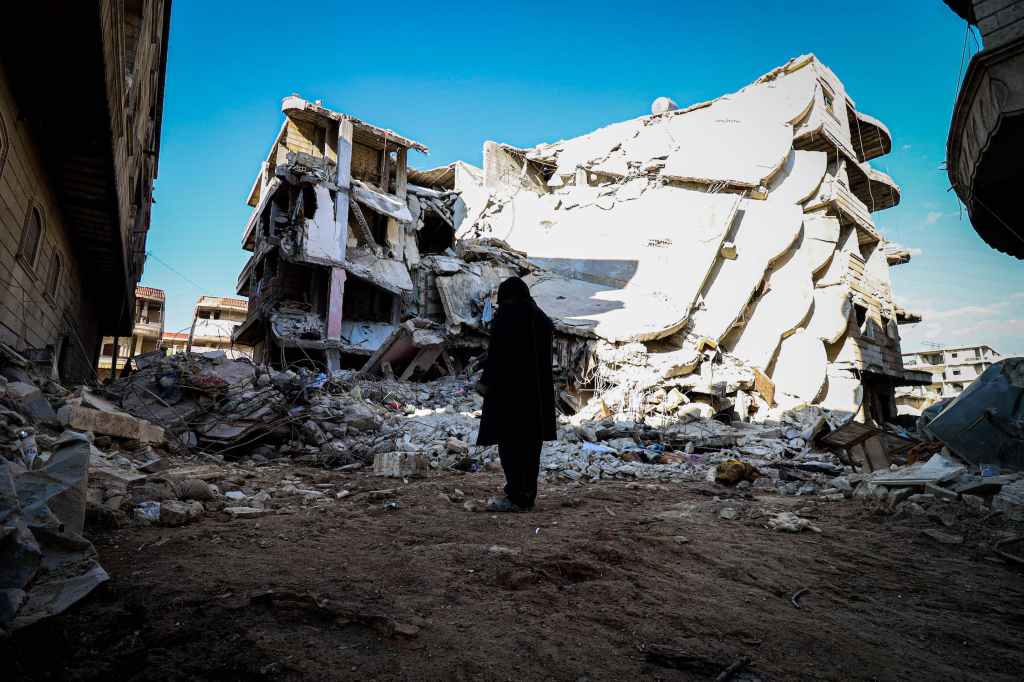
photo credit: Ahmed Akatcha via Pexels
The violence – or potential violence – hits close to home too. Grand Rapids Public Schools announced a backpack ban late this Spring after the fourth incident of a child taking a gun to school this year. No shootings at school transpired, but as an American who is aware of our proclivity to gun violence, it’s hard not to imagine an incident.
There’s always violence in the background. But perhaps my dream was more than a mere chemical process in my brain that helps regulate and compartmentalize memories. I believe it contained something profound, wisdom from beyond me.
***
At the center of the Christian faith – the traditional I’m part of – there is a person, Jesus of Nazareth, who we Christians by faith believe to be the Son of God. After living an incredible life, he suffered a horrific death at the hands of people who initially misunderstood him, then envied his influence, and finally became enraged at his claims. The religious leaders of Jerusalem went so far as to seek the death penalty, and asked the occupying Romans to carry out his execution.
When power is challenged, violence often ensues.
Perhaps this is why the Isaiaic prophesies referred to a suffering servant being crushed for our iniquities. Perhaps part of the reason Jesus was killed was to reveal the eventual ineffectiveness of violence. Wars have winners. But is it ever in humanity’s overall best interest? Nope. Never. Violence and war always leave scars.
***
Beyond the violence of war, murder, school shootings, and other well-known acts of aggression, there is the quiet other-ing that happens in the subtlety of a conversation. There is the violence of simply ignoring someone’s viewpoint, of misrepresenting someone, of not caring at all.
Violence comes in many forms.
***
Often we believe, deep in our souls, that through punitive measures we can fix someone or make a situation right again. Jail time, perhaps, or community service, or for some states, the death penalty. Though it may be appropriate to separate a wrongdoer from a community at certain times, I have come to believe restorative justice is the far more effective answer to crime.
It’s uncomplicated. It’s what I do when my son pushes his sister or brother. We sit down together and talk. “Maelin, what happened that made you want to hit Silas?” It’s what happened in South Africa and Ireland during Truth and Reconciliation talks. “Why did you attack a member of your community who was black?”
I get that there may well be limits to what restorative justice can accomplish. There are a host of situations where a person shouldn’t be subjected to even a conversation with their aggressor. This is why, as a practicing Christ, I understand God as the ultimate arbiter of justice.
***
For now, I pray and hope for reconciliation in all situations, not least of all in Grand Rapids Public Schools [several parents have been charged with counts related to negligence with firearms].
I won’t soon forget my recent dream, especially when I find myself at odds with someone else. For in that man’s face – a face so different than mine – I believe I saw the face of Jesus Christ. No longer am I a stranger to Jesus, and no longer am I a stranger to my human siblings. Whatever their background, we are siblings. And from my vantage point, because God has forgiven me much in and though Jesus, I owe my human siblings a debt of gratitude, for they too bear the divine image.
In his words, we are family. Amen.
***
 ben videtich