doubt: faith’s companion

I have been thinking for some time about how faith slowly wears, breaks-in, over the life journey. Much like a favorite piece of clothing that is well-loved, our faith in Jesus often grows as life causes our souls to fray and discolor. Throughout our life journey, we are constantly thrown about, fraught with frustrations that God simply isn’t hearing us, filled with fears about God abandoning us, upended by trials that overwhelm us.

This is the human story.

Then there’s the larger world God presents us with in the written word of Scripture, carried to us through generations of spiritual risk-takers and written on our hearts through the Spirit. Often, biblical writers have a way of making a case, then allowing us to be made by the case. It’s unforced, it’s genuine.

Luke’s studied account of the life of Jesus begins with this, just two verses in:

…I decided to write it all for you, most honorable Theophilus, so you can know beyond the shadow of a doubt the reliability of what you were taught [MSG].

So far, so good; our enlightened minds are happy to hear Luke’s intentions are we prepare for him to make his logical case. He then goes on to tell the winding tale of a man, born of a virgin and of God, who slowly comes into his own. Jesus is eventually propelled into healing ministry, fulfilling prophecies and making tangible the presence of the God who spun the universe from nothing at all.

Surprising newcomers to the Christian faith, at the very end of the Gospel of Luke, Jesus dies. Then we’re told how he rises from the dead. Soon, we’re taken to the story of how a couple folks who had known Jesus are walking along when Jesus suddenly appears. But they don’t recognize him-their eyes are closed to him.

What? Luke, didn’t you say you wanted to show us beyond the shadow of a doubt the reliability of this whole story? 

Didn’t they know what Jesus looked like?

Did he shed a beard? Or grow one in the grave?

Had resurrection changed his physical appearance?

Anyone honestly taking inventory of this biblical account must reckon with the strangeness of these purported events. And, quite honestly, with a lot of other things. Our Scriptures are utterly perplexing at times, perfectly suited for much questioning along with some appropriate pushback.

In Luke 24:36-41, we read how Jesus, now resurrected from death, appears to some of his most devoted followers:

Jesus appeared to them and said, “Peace be with you.” They thought they were seeing a ghost and were scared half to death. He continued with them, “Don’t be upset, and don’t let all these doubting questions take over. Look at my hands; look at my feet—it’s really me. Touch me. Look me over from head to toe. A ghost doesn’t have muscle and bone like this.” As he said this, he showed them his hands and feet. They still couldn’t believe what they were seeing. It was too much; it seemed too good to be true. 

I bolded the last two sentences. If you’re ever stuck doubting your faith, doubting the story of Jesus, doubting God’s good purposes for you, then you’re in good company!

The disciples who followed Jesus around for three years even doubted him, even when he was right in front of them. If this doesn’t strike us as bizarre, well, maybe we’d need to re-read.

And yet, these women and men who “still couldn’t believe what they were seeing” went on to tell the known world about Jesus. Now, in 2017, about 1 in 3 people worldwide adhered to the Christian faith.

Apparently they got past their doubts.

Or did they?

They certainly took Jesus pretty seriously, but we are left wondering what was the turning point for each person. Did they struggle in the moment then reconcile things later on? Did the Pentecost event in Acts 2 [Luke’s sequel to his Gospel account] convince them? Or were they ready for action by the close of the gospel’s final chapter, where Jesus led them away, blessing them before being carried into heaven?

We don’t really know.

All I know, at this point, is that we’ve got a lot of people that have some serious confidence in Jesus. These are the women and men who went on to carry the message of a risen Jesus to the known world.

But hold on. What about their doubts? And our doubts?

Well, I’ve come to see it like this: just like the earliest followers of Jesus who doubted, our own doubt reveals that our faith is functioning.

Think about it: what if they didn’t push back on this testimony? What if they didn’t ask the tough questions? What if Luke left out the details about their struggles-might that have pushed a powerful story into the realm of the mythical? What if we, reading in our own era, blithely pressed on, ignoring difficulties that stymie the faith of so many?

Doubt is a companion to faith, keeping us spiritually honed and grounded, preventing the kind of faith that forgets what it might be like not to believe-that forgets that at one time we ourselves didn’t believe.

When we acknowledge our doubt to ourselves and to others, no longer is the doubt left stirring within our souls, unheard within our community, but it’s brought out into the light and its latent toxicity can be abated.

Consider this honest dad in Mark 9:23-25. He wants his son to be healed, and desperately, but his faith is incomplete. The son has some kind of issues:

[Jesus] asked the boy’s father, “How long has this been going on?”

“Ever since he was a little boy. Many times it pitches him into fire or the river to do away with him. If you can do anything, do it. Have a heart and help us!”

Jesus said, “If? There are no ‘ifs’ among believers. Anything can happen.”

No sooner were the words out of his mouth than the father cried, “Then I believe. Help me with my doubts!” 

Jesus says here in the Message version of the Bible that there are no ‘ifs’ among believers. He also goes on to heal the boy after the father’s moment of pure and unadulterated honesty [help me with my doubts!].

Rather than ignoring the questioning that was happening within his soul, this father brings his doubts to God, seeking transformation and a renewed faith.

Snap back to the story about Jesus showing up in Luke’s gospel account. Might the disciples have also personally asked Jesus to help them with their doubts? What happens between verse 41, where they are caught in unbelief, and verse 53, where they are continually blessing God in the temple?

I’ll bet they got honest with Jesus.

I’ll bet they asked a lot of questions about why he had to die, how he was raised, and what they were supposed to make of it all.

In my last post, I talked about vintage faith-time tested commitment, resilient trust in a risen Savior that stands the test of suffering and loss. Here are some ways to broaden the picture I attempted to paint in that post.

If faith is a leather belt, doubt is its wearer, stretching and shaping it and causing it to fit more naturally and honestly, taking it from stiff and unyielding to flexible, broken-in.

IMG_5444
my favorite belt [I actually inherited it from my dad!]
If faith is muscle, doubt is the mountain journey that first makes the hiker sore, but later conditions that same muscle into steely resilience.

If faith is a vehicle, it’s less likely that brand new model with the new car smell and shiny paint and more likely that tried and tested station wagon that carried you across your city and country more than a few times. But you’ve come to trust it, scratches, spills and all.

If we are but willing, God is ready and able to take our doubting, prideful, recalcitrant spirits and breathe new life into us, revealing that we are indeed temples for God’s spirit [I Cor. 6], reflecting God’s very image [Genesis 1:26-28].

Psalms do a great job at shaping how our faith makes its way into the context of the real, and it’s not by ignoring our perceptions and feelings. Instead, as we pray the poetry of the Psalms, we find ourselves caught up with a host of human beings who have been faith-ing long before us, even as they continue their worship in the throne room of heaven.

Eventually, we take on a new kind of vision of the world in which our doubts and questions and difficulties with God are no longer enemies to faith, but helpers along the great journey with Jesus. May we imitate him in all we do, with his Spirit helping. And may our steps this Holy Week lead us closer to him with doubt as our companion in faith.

 

vintage faith.

If you know me, you know I probably care way too much about aesthetics. In the Videtich home, we argue far more about where to put our beloved art and how to set up [well designed] knick knacks on a shelf or credenza than we argue about politics or money.

But it’s more than aesthetics; it’s more of a lifestyle of paring down on things we don’t need while making sure the things we routinely need are appropriately priced according to their usefulness. I’m not about to spend money on a haircut [my hair often looks disheveled because I’ve cut it myself for the past several years] or get crazy with the latest gadgets on Amazon, but I’ll pay a bit more for a few select things.

I am not quite a minimalist; I feel like I want the *right* things, not too many of them, and they need to last. I only need a few pieces of clothing, but the *right* clothing-preferably well broken-in denim and cotton or flannel. I only need a few pairs of shoes, but they must be the *right* shoes. We only have one car, but.. well, you get the idea.

And it’s really bad when it comes to my bike.

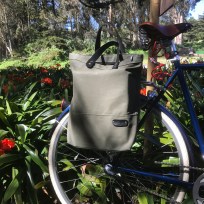
A while back I bought a beautiful navy blue 3-speed commuter bike complete with fenders, a bell, and a rack. Naturally, because I ride many miles per week, I felt compelled to complete the outfit and get a leather saddle-which is actually quite comfortable, and should last for decades. For my 30th birthday my parents bought me a pannier bag made of waxed military-grade British canvas, leather, and brass rivets. Hopefully it’ll last as well.

IMG_5403IMG_5405IMG_5404

Speaking of things that will last, I am reminded of my hymnal collection-some of my most treasured possessions.

I’ve got old Free Methodist, Lutheran, and Episcopalian hymnbooks dating back to the early 20th century, each containing songs from long before then. And each one was part of the order of worship for unique communities centered in Jesus, each serving a special role at a particular time in history. They remind me of the large communion of saints I’m part of worldwide, both in heaven and on earth. They also evoke a sense of the eternal aspect of hymnody, for we know not whether we’ll sing Be Still My Soul when heaven fully meets earth.

I guess you could say those hymnals are vintage.

Now, the turn: just like the material things that serve me, I want my spiritual life to consist of lasting, core ideas. Like my leather bike saddle, tested by time, I want to rest in vintage teachings that have stood the test of time and sustained other folks who have, over the centuries, taken Jesus seriously. I also want to continue to be challenged by the teachings of Scripture, to ultimately receive comfort and challenge according to God’s timing.

From my earliest growing up years, there are vintage concepts that stick with me that will forever shape how I approach God. These ideas won’t ever wear out:

Love your enemies; pray for those who seek to do harm against you. 

God works all things together for the good of those who love him and who are called according to his purpose. 

…continue to work out your salvation with fear and trembling, for it is God who works in you to will and to act in order to fulfill his good purpose. 

By grace you have been saved through faith-and this is not from yourselves, it is the gift of God-not by works, so that no one can boast. 

For God so loved the world that he gave his only son so that whoever believes in him will not perish but have eternal life. 

The Lord is my shepherd-I shall not be in want. 

For you created my inmost being;
    you knit me together in my mother’s womb. 
I praise you because I am fearfully and wonderfully made;
    your works are wonderful,
    I know that full well.

Look-I am making all things new! 

[When praying ] The Lord be with you [and also with you!] 

[When beginning a prayer] Strong God, through your Son and in the power of the Spirit… 

Be still my soul, the Lord is on your side! 

Be thou my vision O Lord of my heart. 

I could go on. So, in a world that fancies all things cutting-edge, I am increasingly of the mindset that a large majority the most important wisdom is already quite available for me, whether in the pages of Scripture or in the narratives of saints who took Jesus at his word long before I was around.

Not to sound like a luddite, but my canvas, leather, and denim seem to be performing sufficiently well; I don’t feel compelled to pursue the next new-wave thing. And yet, I’m not pining for a time when things were supposedly better [the ’50s?] and I don’t at all accept the mythology of Golden Age thinking. But I do want to live into an authentic, tactile, worn-yet-functional kind of faith.

I want my faith to be resilient. God loved us enough to send Jesus in the world to put to death the powers that continue to keep us in bondage, and he’s inviting us into a kingdom where our old and damaging patterns are insufficient. In response, I want a faith that’s as worn in as an old leather boot-and also as supportive when God doesn’t feel as close to me.

And yes, sure, if we take the analogy too far, I admit that I’m a total hypocrite as I preserve certain technologies. I admit that I enjoy my little fruit-branded computer, phone, and tablet. Maybe it’s the world we live in. Maybe I’m compromised.

Yes, I sometimes romanticize this ideal in my head that leans toward the timeless. Instead of typing on a Remington typewriter I’m typing on a keypad and watching its digital results on an LCD screen. But in my soul and in my gut I want, God helping, to embody a clean, genuine, time-worn yet glowing, vintage faith.

Of course the tough part is just that-living into these lofty ideas and living into our baptisms and communal professions of faith. It’s tough to follow through in my daily practices on this rich inheritance that has been given to me from God’s Spirit, through the church mothers and fathers, communicated over many generations to many people groups, that has resonated within me.

Here’s to living out a down-to-earth, connected life of *vintage* faith in the merciful Jesus who loved us before we knew ourselves.

***


Awkward Playground Confrontations: Learning to Share.

If you have ever been to a playground where a significant number of toddlers are present, you’ll understand the sheer volume of noise, snacks, snotty noses, and toys. 30 toddlers and kindergarteners sharing 3000 square feet makes for a lovely scene.

Such was the scene today at Julius Kahn playground here in San Francisco. It’s in the Presidio, a lovely former military encampment in the far turned enormous park. And Julius Kahn playground sits directly across the street from gleaming modern and historic properties each worth millions. And the sweeping view of standing eucalyptus and fir groves next to hilly fields keeps parents inspired and happy as they chase their tinies and mind their boo boos.

It was my first time, today, and I was pleased to watch Silas, our two year old, play as Kaile spent some time with friends playing tennis. I am terrible at tennis, you see. I didn’t get a picture of the scene at Julius Kahn, but here’s a little picture from another park of the star/villain of today’s story.

IMG_5349

Silas had been playing with some other toddlers in the dirt as I watched from a little way off. I was standing in the shade to keep the hot sun off Maelin’s head. Maelin is our almost-six month old. He was struggling and crying, so I was attempting to assuage his hiccup difficulties while keeping an eye on his older brother.

Suddenly a tall man appeared. “Excuse me, could you tell your son to give my son his toy back? He snatched it away from my son, and I can’t believe my son was so gracious about it, but he needs his toy back,” he asked/instructed me. He was a decade older, easily, and much taller than me. “Uh oh,” I managed, hoping he heard me over the crying infant on my chest.

I came over and instructed Silas to return the toy. Maelin’s screams forced me to pause my admonishment, and I planned to redouble my efforts in helping this gentleman in his crusade to heroically rescue his son from Silas’s plundering. To be fair to Silas, it was an awesome toy. I mean, I would play with this toy, pictured below. And I’m almost thirty.

yellow.crane.truck

Soon, Maelin was quiet. But Silas still had the toy, this deliciously intricate yellow crane truck. I looked up and saw the man glaring down at Silas, who appeared to be utilizing the crane truck for extensive sand mining operations. His son had started playing with the group of boys nearby who had access to a small fleet of vehicles. They also appeared to be in the sand mining business from what I could make out.

And then it happened.

The man swooped in and wrenched the toy from Silas’s hand. Ok ok, I’m overstating it a little, but he took the crane truck quite swiftly and returned it to his son, who may or may not have leveraged it for his sand mining operations.

Silas looked up at the man, perplexed. But he wasn’t as perplexed as me. I was aghast. Anytime parents bring their toddlers’ toys to a playground, they must expect either to share or to ward off a host of interested persons under three feet tall. These interested persons are all learning what it means to share, to learn the latent toxicity of the term “mine.”

I stopped myself from confronting the man, pausing to reflect briefly on my motives and to assess possible positive outcomes. Nothing good seemed likely to come from the conversation that I imagine would have gone something like this:

Ben: “Man, did you really just rip that toy out of my son’s hand?”

Guy: “Man, did you really just let your toddler steal my son’s toy?”

Ben: “He’s two years old, and I’m working on getting him to ask before using other people’s stuff.”

Guy: “He ought to know better.”

Ben: “Maybe your son could try sharing.”

Guy: “It’s his toy!”

Ben: “…”

I couldn’t get past that hypothetical dialogue in my head, so I observed the situation as it stood, allowing my anger to fade into sadness.

It was painful to watch Silas hang his head and wander off to another group of more accepting kids who let him load their little dump trucks with sand. He wasn’t wanted; he was cast out. In the car ride home, he mentioned it: “crane not mine,” he fumbled in his toddler fashion. Of all the events of the day, he remembered that one in particular; he remembered the feeling of having messed up and being very firmly scolded for it-and from a man much older than his own dad. Taller too. And, I’m guessing, wealthier, but who knows, can’t judge by the Patagonia shirt.

Sure, go ahead, hit me with that capitalist jargon from John Locke about the foundations of Western civilization and the right to private property. That’s great. But call me crazy, I want Silas and Maelin to share. Goodness, I want to get better at sharing my own resources. Our playground policy is essentially that Silas must share any toys he takes; and I have to at least hope that other kids-and parents!-to be gracious with the toys Silas wants to use. Only one other time ever have I seen such closed fistedness from another parent [and it was much milder].

If it’s too difficult to share a crane truck, I fancy it’ll be hard to share school snacks too in a couple years, or compare study notes in ten. It’ll be hard to be generous with time and money when he’s 40. It might be hard, even, to be generous with complements.

I’m taking this to the extreme because I have this belief that if we coach our kids well during the early years, the difficult lessons will soak into their little souls.

There’s a biblical Proverb that distills the concept:

Teach a child to choose the right path, and when he is older, he will remain upon it. Proverbs 22:6

I actually put serious faith into this idea. And I do it somewhat selfishly, for I do not want to live in a world where kids never learn to share. Too many of the problems in our country seem to stem from an inability to share. Like, I mean, immigration, health care, jobs, little things like that.

For now, I’m forced to just remind Silas to ask before he borrows toys and still hope for a little grace when he doesn’t. I can hope other parents coach their kids to share even when it might feel like the end of the world, but I can’t make them. And occasionally, I might have to swallow the legion counterarguments raging in my soul and just watch as my son has a truck taken from him by a tall, upper middle class white man who refuses to coach his son to share.

If you read my blog ever, you might have noticed that I rarely “get it right.” Most of the time I find myself writing about blunders I’ve made, failures and mistakes that I learn from. If there was a blunder on my part, it was in failing to coach Silas strongly enough in making sure to ask and say please before using another person’s toy.

But I’m not backing down on the other aspects of today’s events. I will continue to insist that Silas shares toys that he brings to the playground. Because, selfishly, I want Silas and all the other toddlers to grow up having learned to share. I really don’t think parents like the gentleman today need to reinforce their child’s concept of “mine.”

Selfishness comes pretty naturally to most of us, in my experience.

But so can selflessness. It feels good to give away your time without the expectation of something in return, to let go of material resources so someone else might flourish. Imagine a world where this genuinely was the norm, and I imagine it’s a place where you’d like to live.

Me too.

Humbled at the Social Security Office

Some reading this blog will know my sitz im leben, my “life setting,” others won’t. For those of you who don’t know me quite as well, I’m a follower of Jesus, a husband to Kaile, and a father to Silas and Maelin, 2 years old and 4 1/2 months old respectively.

Maelin is dreadfully sick at the moment, still recovering from his infants’ case of RSV [look it up]. Silas has a terrible rash on his back and legs, and he’s rather cranky on account of it.

Ok, so that’s the background. Oh, and for fun here’s a picture of them in one of their happier moments:

img_5250

Because it’s tax season, I recently became aware of the need to get Maelin’s social security card. It’s one of those chores that’s really hard to fit in amidst the busy and tiring stream of life. But on Monday, I had finally found time, and I took my documents to the social security office downtown here in San Francisco. We used to live in the building next to it, but it’s well out of the way now, even though I was headed to my office next.

Arriving at 9:10am, I took my tab at the kiosk: A465. The room was suffuse with the emotions one might expect: anger, boredom, nerves. After all, we were all waiting, all attempting to get the task done that we need done, be it social security payments, food stamp renewal, whatever.

It was close to 11am by the time my number was called. “A465, A465, window number 7,” came the voice over the PA system. I was there in an instant, reporting to the quiet Asian man who was there to serve all of us. “Do you have your insurance card?” “No, but I have a picture of it right here.”

Pause.

When we got Maelin’s birth certificate during another frenetic trip downtown, they put together a package of *everything* we needed. “Just take all this to the social security office,” they said, “and you’ll be all set.” Well, turns out that wasn’t the case. I wasn’t “all set.” Apparently I now needed original copies of the insurance card.

“Look, man,” I said, feeling that inner burn, “it’s right here on my phone. I took time off work to come down here and I’ve been in line for close to two hours, can we make this happen?” And there he was, quietly doing his job. “I’m sorry, sir, we have to have the original copy. If you come back tomorrow right at 9am the line shouldn’t be too long.”

After two hours of waiting, this isn’t what I wanted to hear.

I glared at him, stuffed all my documents back in the folder, and bolted out of there, overwhelmed with frustration at the wasted time. I may as well have been getting work for the week accomplished. Or I could have stayed with my family. Two hours, wasted!

The next day I returned, following the tip about coming at 9 sharp. A356 was my number. I glanced over to window 7, noticing it was the same gentleman. And, 40 minutes later, just like I dreaded, his voice came over the PA system: “A356, A356, window number 7.”

It was the same guy.

OF COURSE IT WAS THE SAME GUY!

For the first half of our conversation I was cordial. I tried to ignore the voice within. We Christians sometimes talk about the Holy Spirit speaking or comforting or challenging us. This time around, the Spirit was challenging me. I knew an apology was in order, yet I resisted for as long as I could.

Finally, toward the end of the conversation, I couldn’t resist any longer.

“Look man, I was rude yesterday. I’m really sorry,” I blurted. “It’s ok, it’s frustrating to wait for that long only to find out you’re missing a document.” Not having expected him to remember me, I shot back: “Yeah, but it was still rude. I’m really sorry.” “It’s ok, don’t worry about it!” he answered, smiling. “Take care!”

Almost every night I read a book about Jesus to our toddler, Silas, and one of the pages features Ephesians 4:32:

Be kind and compassionate to one another, forgiving each other, just as in Christ God forgave you. 

The illustration is really cute, two girls wearing clothing from bible times [because the book is about Jesus I guess?]. They are holding candles and smiling at each other.

Every night I read that book, yet in the grit and grind of life, those massive ideas are hard to embody. They are hard to live out. Saying sorry is hard for this proud, rushed, often-overwhelmed dad.

And yet, God is teaching me about the depth of his forgiveness for this [and all my other issues] not only in my family, my work relationships, my church, my memory, but also through a kind Asian social security office worker.

I’m humbled but thankful that God is patient with me, even when I’m not patient with his other children.

The Model Student

So.. I’m a youth pastor. With that comes a particular set of preconceived notions, at least for a lot of people. There is an archetype for who and how youth pastors are and how they act.

Annoying t-shirts.

Frosted tips [ok, in like.. 1999].

Bro-ey guilt-inducing talk: “yo, Jen, you should totally swing youth group tonight. Jesus is gonna be there, so, I mean..”

Ok, so maybe that’s somewhat of a start. Now let’s think for a second about the purpose of ministry that is specific to young people. We need to ask the question, “what is our goal?” 

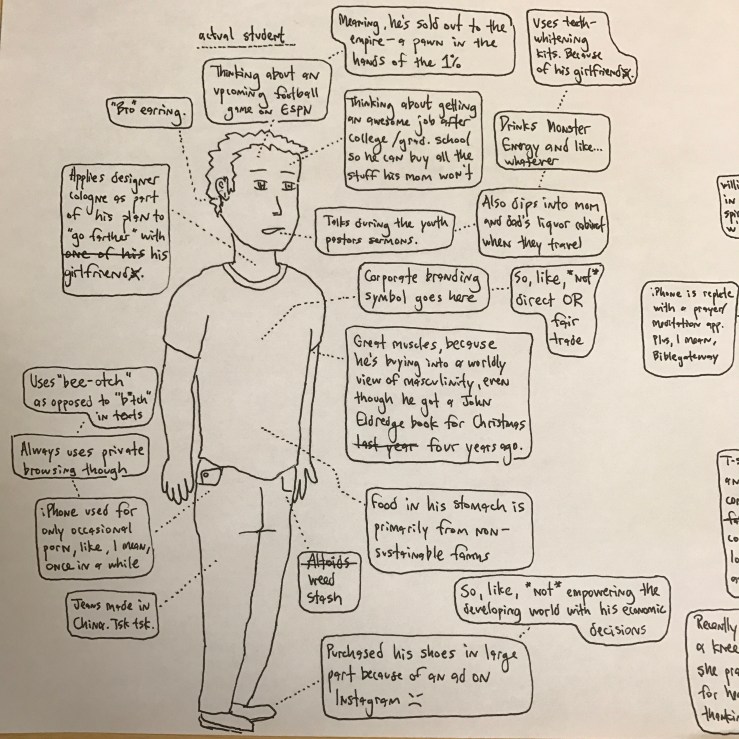
I’ve got some answers to that, but sometimes what happens in my brain is I imagine all the various ways a deep and resonant faith in Jesus can affect someone’s life. So, to allow you in on it, I created a diagram of what sometimes comes to mind as I think about work with students here in San Francisco.

First, the “Model Student.”

img_5221

Next, the “Actual Student.”

img_5220

You have now entered my brain. Thanks for coming. If you’re curious where this is going, finish up. If not, have a quick laugh if it tickles you then find something else to read. 

Ok, so there are some really impactful ways a genuine and authentic faith in the risen Jesus can change a person. I have written not a few blog posts on how my faith intersects with my life, and Christian practice is a subject that looms large in our culture.

Now, the point: is it really this simple? 

These silly comics point to actual truths, but I think what is most ridiculous is the thought that a model person or model student is actually as pure/spiritually wonderful as the comics suggest. In other words…

I’m afraid we’re all a bit more complicated. 

Right? I mean, come on. Yes, there are spiritual greats, there are saints. But each of us is internally mixed and our loves aren’t quite 100% pure. Do we all genuinely love our neighbors-and our enemies-as ourselves, like Jesus teaches? Or do we secretly harbor quiet judgment about folks who think [or vote?] differently than we d0?

People of faith fall into this trap.

People without faith do too.

And what’s the difference? I’d advocate that Christian faith does a pretty good amazing job at revealing the honest truth about our true selves. We’re all failing to fully love others-neighbors and enemies-as God loves us. We’re all failing to fully care for creation in all the ways we can [and yes, the Toyota Prius uses fossil fuel. And so do fully electric cars-they have to charge, after all].

The honesty about how we really are at the deepest level reveals that we are all a mixed bag. We do the right thing, we do something that compromises our values. We make progress, we relapse. This is the journey of faith.

But that Christian honesty is backed up with an action plan: repentance, forgiveness, and a lot of grace for when we don’t measure up to the high standard of loving God/others deeply.

God’s grace, shown in Jesus, floods the scene. Jesus models forgiveness to the folks gathered at his execution: “father forgive them; they don’t know what they’re doing [Luke 23:34 MSG].”

Following Jesus is no path for the faint of heart. Yes, Jesus comforts-but he challenges us too. That’s where my little “model student” diagram falls hopelessly short. All the things are important, but I left out the deepest aspects of faith: love for God and love for neighbor/enemy.” After all, you can’t really separate those two concepts anyway. 

That is what I yearn for in the model student.

And that is what I, though I so often fail to embody it, strive for as well.

Pastor King / MLK Connects. [More than Ever]

There’s this part of the 1963 I Have a Dream speech where Pastor King rolls into a lilting, homiletical refrain: “I have a dream…” He talks about a dream that “one day” his “four little children will live in a nation where they are not judged by the color of their skin but by the content of their character.” He finishes some of these refrains with biblical precision, tying ideas together by bookending phrases with “I have a dream today.”

mlk

Pastor King’s roots in the Baptist church become so apparent as his speaking verges on a kind of improvised singing. It’s not quite singing per se, but it’s certainly not mere speaking either. A few churches still exist that hold the “whooping” tradition as dear, and for that I’m thankful; it stirs the soul to hear the artistic convergence of Pastor King’s incarnational faith and political passion. The I Have a Dream speech is equal parts biblical homily and civic prophecy.

Appropriately, he closes with an old Negro spiritual:

“Free at last, free at last; thank God almighty, I’m free at last!”

As an American, I have been moved by the life, testimony, and legacy of Dr. Martin Luther King, Jr. During a turbulent political season, I am reminded why his contributions are so enduringly significant.

Pastor King’s speech continues a legacy that reaches back into the Bible’s Old Testament and forward into the now and even, I think, into the future of our world as we move deeper into the 21st century. His imagination was shaped by the likes of the prophet Amos, who confronted unjust rulers on their tax codes and court systems, calling for justice in unapologetically poetic fashion.

Another Jewish man, Jesus, who I believe to also be the Son of God, was the absolute height of the biblical prophetic tradition. He spoke truth to power in his Sermon on the Mount, recorded in Matthew chapters 5-7. Instead of merely prohibiting murder, Jesus [God’s Son] explains how God is even interested in our innermost attitudes toward one another. It’s not just about getting along! It’s about honoring one another deeply and from the heart.

This kind of religion gets to our motivations, to our core identity, reaching right into our attitudes toward one another.

In the recent political season, we are reminded that hateful words and actions are as common as the air we breathe. Politicians, pundits, reporters, and casual social media users seem freer than ever to let their opinions fly.

I came across an example of such vitriolic anger when I read a “comic” on Instagram related to the Black Lives Matter movement. It featured comic versions of various events specific to the movement such as brick throwing, cop shooting, and Trump voter assault.

I replied to the man who posted it, asking him to consider taking it down. First, he said a rude version of “no.” When I warned him that I might report him to Instagram, he told me off again, taking me as a religious nut of some kind. It was something along the lines of, “go read your f*****g Bible you [oblique gay reference].” I hadn’t mentioned anything about my faith or religious convictions, but I guess he was right about how this was my motivation.

Racism is alive, friends, along with the ravaging attitudes and predispositions that it carries with it, and it’s much closer to all of us than we sometimes realize. It’s on social media, on the lips of people around us, in quiet corners of the internet, in politics. But most jarringly, it’s often occupying space in the hiddenness of our hearts.

The smallness of my recent brush with racism paves a way for us to consider folks who are truly hurting. Blacks, the working poor, Muslims stuck in airports, religious minorities, marginalized groups of every kind. Surely you have heard the stories, as have I, and I pray we not only hear but also listen.

Back to Pastor King.

Dr. Martin Luther King, Jr. spoke in line with not only the explicitly biblical tradition, but also in line with the trajectory we all follow if we take the time to listen to the voice of God speaking to us within our souls [the Holy Spirit, to use biblical terms]. If we all search ourselves, quiet ourselves, then listen and imagine with our God-given imagination, we all yearn in our own way for a world that is free from hateful speech and violent actions. If we continue to listen, we learn that we are called to, in the words of Jesus, love our neighbor-and even our enemies. And in so doing, we love God, for every person bears God’s image.

I speak from a position of much privilege as I relay these ideas, and I acknowledge this freely. I was born into a ethnic group, nation, and individual family that received an enormous amount of vocational, educational, personal, and economic opportunity in large part because of injustices. Tracing the exact details is difficult, but our privilege comes from African Americans, Native Americans, and even to a far lesser degree from certain groups of European Americans.

As I write, I can almost hear the pushback: “but Ben, all of that is in the past!” “Come on Ben, none of that was your fault!” “Ben, guilt isn’t getting us anywhere!” Well, I get it. Yes, the systems preexisted us. But once we learn about the power of the systems, we are confronted with the choice of either perpetuating their heinous power or taking steps toward freedom. For our privileged selves this may mean leveraging our positions of power and influence and even our circles of friends and family to help one another know about said privilege.

Pastor King’s legacy helps impel even privileged imaginations to see a world free from the racism, bigotry, sexism, and prejudice that pervades every facet of life, from our personal conversations to our civic discourse.

Speaking alongside the law, the prophets, and also along the trajectory of the New Testament’s Christocentric pathway, Pastor King shows us what it means to be free:

Free.

Free to love;

Free to forgive;

Free to extend grace;

Free to heal divisions;

Free to practice generosity;

Free to exist as we were created to be.

And in the words of the old Negro spiritual:

“Free at last, free at last; thank God almighty, I’m free at last!”

Jesus. Showed. Up.

The message of Jesus spread to most of the world in an incredibly short period of time in the first three centuries, and without the use of violence. The message of Jesus has certainly been distorted over the centuries in many corners of the church, but his birth, life, ministry, death, and resurrection still stand at the center of Christian identity.

Historically, the event of Magi visiting Jesus from the far East happened significantly later than the visits of the shepherds and angels. Why would these scientist-philosophers show up with gifts? A lot of scholars have done their best to make sense of it all, and there is some fascinating literature on the subject. Clearly they were convinced that the baby was important, that Jesus would change world history. And he has, revealing the true nature of God-self.

The writer of the Gospel of Matthew really wanted his readers to know to what lengths the Magi went to find Jesus, and we are left with the question of what to make of it. Amidst all the things that can be written on the subject, I would posit one big idea: in Matthew, we discover, once again, God’s great concern not only for the people of Israel, but for the people of the whole world. 

Somehow, through a matrix of God’s active Holy Spirit, heartfelt evangelism, church planting, catechism, calculated missionary work, and lots of prayer, the message of Jesus got to many of us here in our 21st century world, right into the daily mix of our lives. We know Jesus through the testimony of all these generations of people who have been responding to him. And the Holy Spirit gives us strength to respond with our lives to this testimony seen not only in Scripture but in world history.

camille-flammarion
A cool 19th century wood engraving by Camille Flammarion: “L/Atmosphere”


Over the centuries, every generation of Christians have had their opportunity to respond well to the message of Jesus. His message to love our neighbors and our enemies; his message that when we treat a poor or needy stranger well, we treat Jesus himself well; his message that God loves the world a whole lot.

At Epiphany, the exciting reality is that we have received the good news of God made present in the Son, Jesus. We have learned the clearest picture of God, which is the Son, Jesus. We have been presented with who God tells us we are: sisters and brothers with Jesus, children of God.

This Epiphany [Friday, Jan. 6th] let’s behold the mystery of God made flesh [Jesus!] and live accordingly.

*


So.. I’m Ordained[!]

If you already know about it, maybe you’ll note something new here. If you don’t already know about it, well hey-here’s an opportunity to learn a little tidbit! There’s some content here that even may prove helpful in the normal course of life. For Christians, it could be good to know how ordination works. For folks outside the church, it could be of interest to see how the church commends each leader to their post.

To start, ordination is simply a faith community’s process to commission leaders for pastoral ministry.

I’m getting ordained in the Reformed Church in America, a Christian church network in the United States and Canada that has been continuously worshiping Jesus *stateside* for longer than any other denomination. Fun fact. It’s not a huge claim, but the church’s heritage is quite interesting. Dutch immigrant folks were meeting up for worship in New Amsterdam before the British came through, took over, and named it.. you know.. New York [City]. It’s a weathered yet stubbornly pioneering tradition that lives on in mission today, and throughout the world.

Notable members of the Reformed Church include:

Evel Knievel, Kyle Korver, Theodore Roosevelt, Martin Van Buren, and..

Geronimo.

[yes, *that* Geronimo!].

Enough about that. Back to ordination.

The best analogies that help us understand ordination are baptism and marriage. In baptism we are united with Christ-our old self is buried with him in the grave, and we are raised with him in his resurrection. Check out the first part of the New Testament book of Romans, chapter six, for more details on that. Or you can check out Colossians 2:11-15. Both books were written by the same guy, Paul, who as a Jew came to know the risen Jesus and gave his life [literally] to let others know about Him.

Important note: in both baptism and marriage we, the church, see God’s work and respond to it. The same goes with ordination; when someone is ordained, it’s people cooperation with something God has already been at work to accomplish.

Ordination is like marriage in that the pastor is committing her/himself to the church. Fortunately, the church commits herself to the pastor as well! My vows were quite serious, sort of like wedding vows. For example, one vow goes like this:

“I promise to walk in the Spirit of Christ, in love and fellowship within the church, seeking the things that make for unity, purity, and peace.”

That’s a tall order. And if I shared more of the vows, you’d notice that this was on par with a lot of other pretty serious vows. I’ll let you take my word for it.

Ok, so ordination shares some commonalities with marriage. But it’s also similar to baptism, and ordination vows grow out of a person’s baptismal covenant [promises] whether the person was an infant, younger person, or adult.

I was baptized as a believer back in the year 2000. I was 13. God worked through a community of believers to bring me to a saving faith, and baptism was God’s action of uniting me with his Son, Jesus, and connecting me to the church. I was lost, then found. I was adopted. I was washed. I was accepted. Now, sixteen years later, I’m also commissioned.

20161218_113038

If you’re getting ordained, you’re already baptized. You’ve already sensed a call toward vocational ministry, in my case, or maybe lay ministry for others. People who know you have also sensed the call within you, and encouraged you along the way. In ordination, the church affirms God’s already-existing call then commissions a pastor or lay leader to practice this ministry. Like baptism, there is submission to the authority of God as evident in Jesus through the Holy Spirit. But in ordination, the commission is more specific; instead of becoming part of the church, you take on a particular role within the church. 

My own process began in 2014, when I came under care of a Reformed Church classis back in Grand Rapids, Michigan [a classis is a group of connected congregations]. Some amazing people helped me understand how the network of Reformed churches work together to live out the mission of God. I took classes, went to meetings, talked to lots of people, and read plenty of books. Then, I moved across the country to San Francisco and transferred classes [not school classes, but I switched to a different classis/group of churches]. Finally, leaders at City Church San Francisco will affirm God’s call in my life and commission me to continue leading a specialized ministry for young people within this community. In my case, the pastors and elders at City Church are also adding some new responsibilities for me once I’m ordained.

Oh-and I’ll wear a collar.

About that. So.. Janitors wear coveralls. Presidents wear suits. Baseball players wear hats and cleats. Pastors wear collars-at least some do, anyway. It’s a way for folks to know who the pastors are, and it’s especially helpful if someone is new to Christian faith or to the church. Most people get that clergy often wear collars. In the fairly unchurched city of San Francisco, it’s extremely helpful for newcomers [and even folks who have been around sporadically] to know who the pastors are, so we wear a little white band around the neck.

Pastors who have been in ministry for a long time tell stories about just how helpful the collar can be. For example, I recently read a short blog post by a pastor whose denomination required him to wear his collar on flights and to any ecclesial/church-related meetings. He initially resisted the notion, but after he wore it on flights, at city meetings, and in normal life, he discovered the collar to be extremely helpful. There was an awareness of his role. If he visited someone at the hospital, they understood he was there as a spiritual support. If he was at a city council meeting, they grasped that he represented a congregation who cared about the city. He even told a story about offering last prayers with someone on a plane as they came close to death. All this because the guy was identified via collar; he was wearing a culturally identifiable uniform.

There’s a potential downside to wearing a collar, too, in that a pastor can be perceived as somehow inhabiting a different category of human being. I don’t think that needs to be a huge problem, especially with a brief apologetic for the purpose of a collar. And that can easily be provided!

All told, I’m excited about my ordination. I also had no idea it would happen this quickly in my life journey! There are a lot of meaningful life events that I didn’t know would happen at the time they did, as it turns out, but I continue to see God at work behind all of it; I celebrate his work in the cosmos, in the world, in the church, in Jesus.

And even within little old me.


Advent = Active Anticipation

The human story consists of lots of waiting:

Pregnancies.

Job opportunities.

Finding your soulmate.

Standing in line to get brunch.

For each of these, we can make use of our time in any number of different ways. We can either effectively use the time at hand or become impatient and even downright frustrated with all the time on our hands. Take it from me-I love my soulmate, my kids, and my job, but as I waited for all of these I cannot honestly say I always waited with active anticipation. Sometimes I did, sometimes not.

And what do I mean by active anticipation?

With our children, active anticipation meant lots of prayer, stroller research and procurement, parenting books, and talking to friends with kids. And, well, lots of other kinds of anticipation. At worst, I was just nervous about a baby in our family. But at our best, Kaile and I actively anticipated the birth of our two boys.

With my job, active anticipation meant prayer, listening, networking, possibly too much education, and genuine effort at all the jobs preceding my current ministry work. At worst, I was preoccupied and missed out on opportunities that were right in front of me. At best, I actively did these things in anticipation of God providing the right *next* job opportunity.

With my soulmate/wife, active anticipation meant prayer, *crafty* romance, discernment, and listening to the wisdom of friends, family, mentors, but most of all to God’s Spirit. I really do see God at work in the foundational months of our relationship. At worst, I compromised friendships because of my new relationship with Kaile [and did late-night walks with her when I should have been sleeping or studying!]. At best, our years dating helped each of us understand the other as we actively anticipated the challenges of married life and the rigor of the family life we hoped to have.

Now, the turn to Advent.

advent-downtown

Again, the human story in God’s world consists of waiting and anticipation:

The world waited for God to show up before He made promises to Abraham.

Israel, Abraham’s progeny, anticipated release from Egyptian captivity.

The people of Israel anticipated a Messiah [Jesus] to prove God faithful.

Israel’s expansion, the church, anticipate Messiah’s return.

For each of these, the people groups represented either made or currently make use of their time in various ways. In Exodus, we learn that the cries of the enslaved Israelites ascended to God, sort of like the smell of smoke rising up from a fire. They actively anticipated freedom, yet strangely wanted to return once set free. When the Jewish people settled along the eastern edge of the Mediterranean Sea, they actively anticipated a messiah-especially as they were feeling crushed under the heel of the oppressive Roman empire.

We hear this anticipation in the prophetic writings of the Old Testament, and most poignantly in the Songs of Isaiah.

And now, we Christians actively anticipate the return of Christ. He appeared on earth, ministered, died, rose again, ascended to heaven, then promised to return-and we take this very seriously! We actively anticipate/await his return by practicing our faith. God is made known in the natural world, in the cosmos, in Scripture, and in the church. That last bit-the church-is important!

I write this as a Christian, and with the purpose of offering the church [all folks who follow Jesus!] a thought on how to participate in Advent as we continue toward Christmas.

Here are a few very specific ways we can actively anticipate the return of Jesus during the waiting season known as Advent.

1. Be still and know that God is God. 

How often do we genuinely slow down and notice God? As well-known as this invitation from Psalm 46:10 is, it may well be equally ignored. We are sometimes so caught up in ourselves that we miss out on an awesome, meaningful conversation, a beautiful vista, or a small opportunity to help a stranger. The hand of God is at work within all of life, and he speaks; however, we need to listen [and yes, I’m speaking straight to myself here]!

2. Forgive someone. 

Send a message or write a letter to a friend or family member with whom you’re at odds. Have a real conversation with someone at your workplace. Open up that old memory of frustration toward someone far away who hurt you, and see if God used time to help heal-then make the human connection and let them know there is forgiveness.

Practicing forgiveness is hard work! But it’s necessary work. Providing motivation for us to forgive, we learn in Scripture that God’s goals for human interaction are so perfect

3. Love others by giving away your time/talent/treasures. 

Funny that we’re heading toward the end of the calendar year, a time when people often give to charity or to churches to save tax dollars! But giving money away is only one way to bless others like we have been blessed by God. There are a host of ways to give away our time: plug in to your church and serve in youth or childrens’ ministry. Mentor someone. Get involved in a local charity. Serve food at a shelter in your city. Prepare hygiene kits at a domestic abuse center. You know there’s something you can do to the least of these, as Jesus calls them in Matthew 25. And as you do good unto them, Jesus tells us it’s as if we’re doing it for him.

4. Honor the People Closest to You

For some reason, it’s easy to be extra mean to family members. Since we are comfortable with those closest to us, we are often also the meanest. As we long for all things to be right and good and made new through the work of Jesus, we can actively anticipate his arrival by doing the difficult daily work of nurturing relationships with our spouse, kids, sisters, brothers, and parents.

5. Get Creative

I can sit here making lists of ideas for you, but chances are you have some ideas of your own that might just work better for your situation. Don’t let me stand in the way of an incredible opportunity or world-shaking idea.  

Thanks, But No Thanks.

Maybe you remember O Brother Where Art Thou, a Cohen brothers film from 2000. Set during the depression in the American south, the plot follows a small group of inmates as they attempt to get their lives together.

Everett, played by George Clooney, is especially interesting to me. Unlike his two simple companions, he sees no need for religion, no need for God, no need to pray to a nameless and non-attentive character in the sky.

That is, however, until he suddenly needs divine help.

clooney-mustache

Our inmates, during the final scene, have been caught by a ruthless county sheriff and are about to be hanged for their crimes.

Suddenly, Everett’s atheism evaporates as he falls to his knees, searching the heavens and praying for rescue. It is a poignant moment in a film that can too easily be seen as a fun ride lacking any depth.

Soon a floor rushes through, sweeping away the gallows.

And, needless to say, sweeping away Everett’s concerns about God.

He quickly dismisses the flood scientifically, insisting it came because of a state hydroelectric project. And whether that’s the case or not matters little, because Everett believes it to be the case. He puts his faith in science and in himself, ignoring the possible link between God and the life-saving flood.

No need for me to draw connections between Everett’s tendency to draw near to God during distress and the human tendency to do the same. It’s a universal trait. If we are honest with ourselves, we will see parallels between our own actions and his.

Now, a brief story from Scripture.

You can read it in the Bible’s Old Testament book, Daniel, chapter 6.

So there’s this guy, Daniel, a Jewish man who has been taken into exile from his former home by a group of marauding Babylonians led by the well-documented leader Nebuchadnezzar [who long name has surely confounded Sunday school teachers ever since ever!].

Maybe you already know the story of Daniel and the lions’ den, but if not, I’ll summarize for you. The new king, Darius, has appointed advisors who have become jealous on account of Daniel; he is a foreigner, but he is wise and is appointed to a special leadership position within the kingdom.

And the other advisors can’t accept that.

Without much forward thought, they get Darius to sign a law that prohibits prayer to any god but him, Darius, the king. And they cleverly get him to sign.

Soon, Daniel is busted for praying to the God of Israel.

Following his typical daily routine of authentic prayer, he isn’t trying to be politically divisive or antagonize anyone, but he does feel convicted to pray to the God in whom he believes, and not to a human king.

Though Darius is sad and fairly upset about the situation, he has to follow through: after all, it was his law. He stays up all night, sleepless and wondering whether Daniel will make it in a den of lions.

And… Spoiler alert… Daniel makes it. He is found alive and unharmed.

Daniel and Everett from O Brother Where Art Thou strike an interesting contrast, do they not? Everett prays during the one time he is in genuine trouble. And after his rescue, he immediately discredits any possibility of God’s involvement.

The account of Daniel is altogether different. Here, we don’t even hear mention of him praying while he was in the lions’ den, only before. And after his night in the den of lions, he credits God for having rescued him from the vicious animals.

Friends, I want to be like Daniel.

I want my prayer life and spiritual practices to go on whether things are awesome or awful, to honor God with my time and talent [and treasures too!] whether or not everything is going well.

I want practice gratefulness, and not just at Thanksgiving.

As a side note, prayer and spiritual practices are widely regarded as healthy and life-giving. The Harvard Medical School acknowledges the research on the benefit of being thankful, and even of acknowledging God’s care. Check out the research they point to here if you’re curious.

In a sense, we shouldn’t be surprised that grateful people are happier and healthier. And of course, as a rule of thumb, it will generally be more difficult to be thankful when we are doing really well-for then we are distracted from God. It can also be difficult to pray after a painful loss or searing rejection.

And yet, practicing faith through these daily rhythms is what Christians are called to. These prayer habits of gratefulness and petition just happen to harmonize with our physical health. The theme of physical and spiritual health running a common course comes up more than I realize!

We must continue to pray, continue to believe, and continue to be open to God’s leading in every moment. And when we do these things, more and more we notice how God has been at work all along. Then, when difficult times come, we will have an established pattern of being attentive to God; we won’t have to awkwardly stumble back to God and re-learn who God is.

But if we do drift away, we have every reason to know that God still listens and receives us back. God demonstrates grace throughout Scripture, grace for people who forget about Him and grace for people that misunderstood Him.

And though we make every effort at being constant in our prayer and in our faith, our passions are still divided, mixed with some lingering pride or un-forgiveness or quiet hate. And yet, stubbornly, we pray, waiting with expectation for the day Christ makes all things new.