American Christians vs. Christian Americans

A number of years ago, I was chatting with a friend about the military. Even then, I was a pacifist, but I still admitted that if I were forced to enlist via a hypothetical draft, I’d comply. I’ve become even more of a pacifist since then, but I’ve been mulling over what it means to be an American Christian.

There’s a wide chasm, I think, between American Christians and Christian Americans. Recently someone I follow on Twitter compared the “America First” brand of American Nationalism to an alternative kind of worship, an alternative to the worship of Yahweh, the God who we know best through the Son, Jesus.

There are Americans who baptize their unwavering nationalism with Christianity, seeing at as a means to support American ideals. Conversely, there are Christians like me who try to somehow make sense of their nation-state in regards to their faith. I realize this is a gross oversimplification of the matter, but it’s a starting place nonetheless.

With the premise that every nation-state is merely a construct, an invention, and that the red/white/blue flag represents a narrative that means very different things to different people groups-allow me to attempt to navigate the intricate link between Christian faith and identity and one’s sense of place within the world as it is currently divided into continents, countries, and districts.

Screen Shot 2017-05-18 at 12.23.43 PM

I remember one Thanksgiving when we went around the table, naming one thing for which we’re thankful. Various siblings, aunts, and uncles, named things like freedom, enough food, a solid job, education.

When it got around to my  grandmother, her answer came without pause: “I’m thankful to be an American.”

I was not yet twenty at the time. Now I’m 30. And yet, as I relive the moment, her words strike me in a very similar way. How many people sacrificed for her to be able to be thankful to be an American?

Native Americans immediately think about a long history of displacement.

African Americans may think about slavery and the civil rights era, and maybe about police violence toward young black men, or about the centuries of marginalization that underlines their American experience.

Japanese Americans might think about the not-so-distant American internment camps where Japanese families were sent during WWII.

Mexican Americans may think about the 8 US states that were formerly territories of Mexico, then again about the irony of “crossing the border” to get “into” the United States. I’m typing this article in formerly Mexican land.

European Americans‘ thoughts might drift naturally and ethnocentrically toward Washington, Jefferson, JFK, Lincoln, or other celebrated American leaders who happen to be white.

Any one of these people groups could recall family members who served in the military at any stage of American history. This applies to my own family, and I’m thankful for the sacrifices both my grandfathers made to serve during WWII-an important war even from the vantage point of my pacifist sensibilities. But that is only one dimension of the multitudinous sacrifices made by numerous ethnic groups.

If we’re really honest, we might all be just a teensy bit ethnocentric-and that can be just fine or it can really fog our vision. But my point in bringing up the various ways various ethnic subgroups might understand American history is simply to note how much has happened in this swath of land over the millennia.

So many people have lost their rights, their dignity, their lives in the long journey toward America becoming the nation it is today. So many have gained unfathomable riches from the systems that exist in our nation-state. And yes, of course, the United States has participated in some very good things too-of this there is no doubt at all.

In full disclosure, I benefit greatly at a personal level from the personal and systemic losses of many other people groups. I benefit from the gains too. But at this point, I’m trying to figure out how to be thankful for what I have inherited while rejecting oversimplification and glamorization of the American story.

It’s in only seeing one side of the American story that we become complacent, self-righteous, and unhelpfully angry.

Now, I want to attempt to make a connection. How does allegiance not to country but to Jesus calls us out of this slough of ethnocentrism and national identity? How do we quell the tandem voices of racism and xenophobia? How can live and participate in the world’s unfolding narrative as Americans even as we’re confronted with the bloodshed that laces our history?

I believe transformation comes when we hear our deepest identity: we are sons and daughters of God [Galatians 3:26], made in God’s image [Genesis 1:26-28], sisters and brothers with Jesus himself [Hebrews 2:11]. More than Americans, more than members of a particular demographic, more than members of a particular orientation, we are united in Jesus. 

Whether or not we believe this matters, I think. It’s too easy to get swept up into the push and pull of nationalist political rhetoric if we lack a deeper spiritual foundation. We Christians believe God has extended us a massive amount of grace and that Jesus has paid an extremely high cost-his life-to conquer death, create reconciliation between God and humanity, and atone for sin.

If we genuinely believe God is at work in the world, and that God invites us to partner with him in renewing the earth, matters of American identity quickly fade in terms of importance.

This isn’t to say our national stories are unimportant or trivial. There are very meaningful narratives that can give Americans a sense of togetherness and build bridges of solidarity.

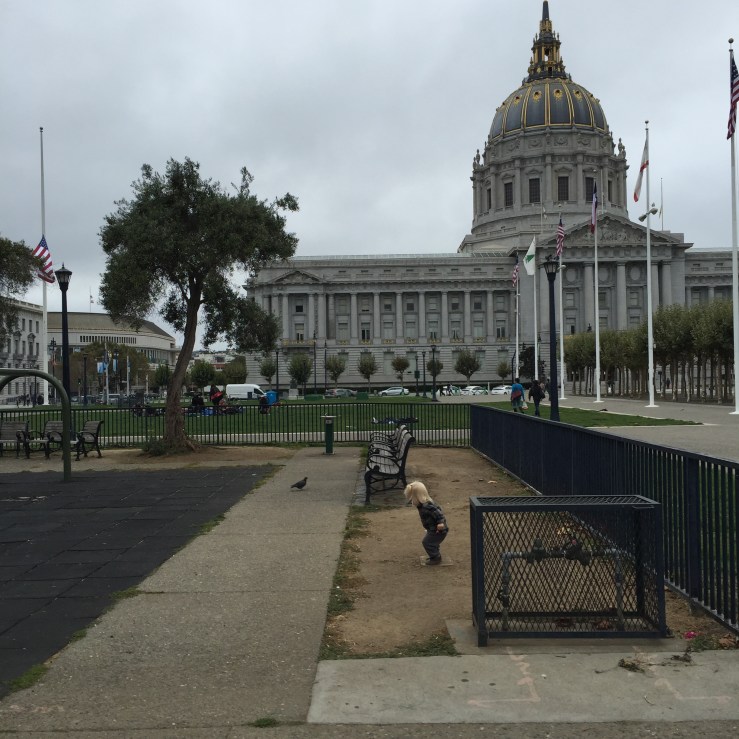
Just a couple weeks ago I was at the DeYoung museum here in San Francisco. On the second floor, there is a room filled with American art. One piece is especially moving to me. It features John Brown, a radical abolitionist who was on his way to execution for leading a slave rebellion, kissing a child, presumably his own.

That day a couple, presumably from another country [they were not speaking English], were observing the piece. I certainly could be wrong in my language-based assessment. Ostensibly, they misunderstood the gravity of the painting, for they proceeded to take smiling pictures in front of it. As they continued taking smiling pictures, the woman backed right into the painting, her hair and shoulders brushing up against it, moving its frame against the museum wall.

Soon, the museum security was on the scene, firmly admonishing her to maintain at least 24 inches between herself and the art.

Of course they gently complied.

The feeling within me as I observed was a mixture of incredulity and frustration. It seems that a middle-aged couple would know typical rules for an art museum. Much more, taking these kinds of pictures in front of a painting that features an execution is simply disrespectful. And the content of the painting made the picture-taking even more unnecessary.

All of that aside, the narrative of John Brown reminds us Americans of the suffering endured by generations of African American slaves. Yes, John Brown was violent, and we can sit comfortably and have a conversation about how he could have responded, but history is history and this is the desperation Brown felt. Some vilify him as an unthinking terrorist; some consider him a hero and martyr. But regardless, he is an important character in the drama of our nation-state.

In that moment, I felt very American. But I didn’t sense that American sentiment because I’m adoring the image of a country that stands as a shining beacon of hope for the rest of the world to see. I felt American because I have a unique personal connection to the people, places, and experiences of this country; I have lived here, loved here, and am raising my family here. And I don’t think I should be faulted for appreciated the country that has shaped me so deeply.

It’s romantic, this grouping of mountains, rivers, plains, fields, and deserts! The contours of my childhood included the vast forests, fields, and rivers of Northwest Michigan. I remember family trips to Colorado, Washington, Pennsylvania, and the Carolinas. I dated an African American for a couple years and felt the tangible difficulty of the American story as our relationship eventually faltered. I live in an area now where one can procure food from just about any remote corner of the world including Eritrea [and there are numerous Eritrean restaurants, not just one!]. This reminds all of us that America can indeed support and include people groups that differ from the earliest European settlers that have culturally and governmentally stayed in power.

As the current political season wanes on, as we do our best to shape our country into the kind of place we think it should be, I pray we remember our long and violent history. And there is no need to compare America’s violent history to other nations, this is unhelpful. Looking past our nation’s many sins can quickly lead us to an unchecked and one-dimensional nationalism that turns us into automatons who worship at the feet of the leader with the most braggadocio. Focusing too much on America’s many problems, on the other hand, can overwhelm us and turn us into self-righteous sidewalk prophets with no sense of gratitude for the good that is, by default, mixed with the bad.

It’s better to know the American stories of heartache and loss, of overcoming and transforming, commending them to honest, realistic memory while searching for true and lasting hope from our Lord, Savior, Brother, and Teacher: Jesus. 



My Post-Election Thoughts

Well, as it turns out, I’m a bit naïve. And apparently so is the media-no one warned me about this election’s possible results.

Wow.

Trump won.

Clinton, Trump pick up big wins

Photo credit: Nigel Perry

For as long as it appeared Mrs. Clinton and Mr. Trump would eventually square off, I’ve been calling it a win for Clinton. Yeah, naïve, probably. Yet I am not the only one; many of us are caught off-guard. Not all headlines, but many, seem to say similar things: “it’s a shocking victory” or “surprise win for Trump.”

I’m thankful for Mrs. Clinton’s graceful concession speech, and I’m doing my best to be optimistic about the potential upside of Mr. Trump’s transition to the White House. It’s just really difficult for me right now as a Christian, as a citizen, and as a dad to see much potential after listening to the debates and hearing about the rallies.

Over the past several months I’ve dedicated my fair share of time tracking polls, blogs, the Twitter feed, and chatting with others about the eventual outcome. Since the results are in, I am searching for us all to thoughtfully move forward. I’m absolutely rankled by Trump’s hateful speech, his recorded bus conversation degrading women, minorities, Muslims, and the host of other woes toward about every demographic I can think of.

As a white middle-class guy, I’m sad and disappointed, and I can only imagine the response of women, minorities, LGBTQ folks, anyone less privileged than myself. With a net worth of 3.7 billion, we now have the richest president-elect ever waiting to take office on January 20th, and he arrives in office with promises of helping the everyman. Maybe he will indeed make America great [again], though I am personally unsure of the era to which he refers and for whom he intends to make the nation great.

To be fair, I do think Hillary has some egregious issues and untruths that polluted her reputation. And her inability to apologize sincerely did not help her leading up to the election. But I, like quite a few Americans, saw her problems as less significant than Trump’s. It’s a good thing we are allowed to disagree here in America.

All of that said, and now that you’re either bored or incensed, I want to offer some thoughts that will hopefully unite and focus us as we move into a new political era.

Here are my thoughts for moving forward:

1. Listen well

My friend Chris said this yesterday on his Facebook feed:

As I see the results coming in, it’s clear to me that I do not understand the experiences, values, needs and ideals of the majority of my country(wo)men. I have failed to listen deeply enough to stories whose hopeful ending appears on the horizon. Time to open my ears and take better care of those with whom I disagree. 

Wow, Chris. You nailed it. He and I have similar reflections of the events, and wherever we fall on the political spectrum, we all have at least 60 million people who see things quite differently than we do, since that’s about how many people voted per side. In reality, the numbers are much higher and the political gap much greater than that seemingly large number. With each side feeling quite strongly about their own position, it’s that much more important to listen.

Progressives, listen to how Trump voters substantiate their vote. Conservatives, consider why a great many people are concerned about the president elect.

Listening doesn’t mean agreeing, but it does build empathy. Here’s a brief quote from an anonymous someone with whom I personally disagree:

Feeling pretty conflicted this morning. Extremely happy that Hillary lost, but pretty disappointed at the same time that Trump won. The left has gone so far left, that I could never vote for a Democrat at this point. However, now the right has shifted to a place where they no longer represent me. I woke up this morning with an easier life and a president that caters to me as a late 20s white male, but, did my wife, daughter, minorities, etc wake up with that same feeling? Like I said, I’m feeling very torn on this election… 

I personally take plenty of issues with, well, nearly everything Donald Trump stands for, but the hardest thing is understanding how other people have arrived at a different conclusion. But again, it builds empathy and allows for dialogue.

As a Christian, here is something I’m bound to, from the 1st century writer, James [who many scholars understand to be the brother of Jesus]:

My dear brothers and sisters, take note of this: Everyone should be quick to listen, slow to speak and slow to become angry, because human anger does not produce the righteousness that God desires. James 1:19-20

As a Christian, I need to get better at listening.

2. Pray

First, what I’m not talking about. I’m not talking about God-bless-America kinds of prayers. Clearly God is interested not only in blessing America, but in caring for all the people of the world, and nation-states are our invention. I would have to burst anyone’s bubble, but God is not American. Too often we conflate appreciation and support for our country with a sort of civic religion that subverts uniquely Christian concepts to praise soldiers that are serving the nation state. You’ve heard it before. “Their blood has made a way for us.” “Greater love has no one than this, than that a person would lay down their life for a friend; and these soldiers have done that…”

It is wonderful to be thankful for safety and grateful to soldiers for doing such difficult work, but let’s not conflate serving our country and serving God; those two things are often dramatically different, and they’re one of the factors dividing America internally.

When I say pray, I mean pray for people. Pray for people who are different than you. Pray for courage and strength for people who feel nervous and scared. Pray for renewed vision for people who are smug about election results and uncaring about how others may see the news. Pray for the peace and unity of all people, and certainly not just Americans. Pray for minority groups, whether you’re a significant part of one or not. If you are, pray for other marginalized people who share different concerns. If you’re white and male like me, pray that you can come to understand perspectives from other groups, then seek to live in solidarity with them, to give up power as Jesus gave up his power.

Pray.

3. Move Slowly, and Move Toward Those Who Hurt

I received timely wisdom on writing about the election and all its trauma. A friend encouraged pastors and other folks who want to write about recent events to pause and take some time before firing off a blog post or article.

I’m trying to take that advice. As I do, I look out the window, and thousands of high school students are pouring through the streets of downtown San Francisco in protest of the president-elect. It’s impossible to argue with their passion; they can’t even vote, as one of my colleagues noted, and they’re trying to live in solidarity with people groups who are struggling with what Trump represents. Surely there are other parts of the nation experiencing a far different response to the news, and that is part of the equation as well.

Wherever we find ourselves, my prayer is that we move slowly.

But we also have the opportunity in this season to move toward those who hurt.

I was speaking with one of my neighbors and her friend [they’re both 10 or 11] just before the election, and he was telling me that a young African American boy was crying at school that day. He was worried about the election and what it might mean for his family.

There were no words for that; no one can argue with a feeling.

I remember fumbling with my response, trying to be as optimistic as I could. Looking back, I realize I should have simply listened and sat with my 10 and 11 year old neighbors. I should have moved toward the hurt instead of trying to offer trite optimism. Oh, the things we learn as we look back.

Maybe you read about the young black child who cried about Trump being president and you think, “oh good grief, that’s preposterous.” Well, he was crying, and maybe he has some pretty good reasons to be crying. Maybe his sadness can be a reminder of how someone from a different demographic responds quite differently to the same results.

In the footsteps of Jesus, who moved toward pain in every step of his ministry and who advocates and prays to the Father on behalf of the hurting people of the world, may we too move toward those around us who hurt.

And, despite my many failures and foibles during this election cycle…

…may these changes start within me.

Two Powerful Questions [and Mike’s Profound Answers]

Recently I shared on Instagram about a guy I met at Civic Center Park here in San Francisco.

Mike.

Maybe you’ve met someone before who tugs at your heart strings. Earlier in life, I found it almost impossible to describe the feeling I get, and it’s still hard; but I’ll try. Mike was the kind of guy who, if he was being ridiculed or mistreated, I would want with all my heart to stand up for and defend. He’s the kind of guy who has clearly been through so much; no doubt he doesn’t have a place to hang his hat. Mike’s wrinkled skin, bad teeth, and dirty clothes masked a beautiful soul.

I was inspired to listen in to local wisdom and happenings in the wake of a “listening project” our church is doing. Find it on Twitter and Instagram with this hashtag: #wearelisteningsf. I’m not very good with chance or one-off encounters, to be quite clear, but my occasional personal awkwardness sometimes makes other people feel more comfortable. Our toddler son also helps, needless to say.

Whenever I’m out with Silas [19months] on a walk, I feel about 924.3 times bigger than I am. I’m not just another white 20something face-I’m tied to toddler, connected to a child with a bright and beautiful personality.

img_4296

Anyway, it required an intense mental dialogue, but I finally got myself to introduce myself to someone new, and I interacted with Mike quite a while, starting with a couple powerful questions. They’re not at all original to me. To be honest, I have no clue as to their provenance.

I ask my students [I’m a youth pastor] these kinds of questions all the time, and they work for just about any conversation:

What was the best thing about today? And what was the worst thing? 

Mike’s answers perplexed and astounded me. First, he told me the best thing about his day was how he was able to get up in the morning and see the beautiful world around him. Ok, wow. He’s already exploding everything one might imagine about the underprivileged.

His response to the next question was equally powerful. I had to repeat the question because he didn’t seem to have an answer. And, sure enough, he didn’t.

Ben: “Mike, what was the worst part about your day today?”

Mike: “Well you know, there isn’t really anything to say. It’s been a good day. I don’t have much, but I’m doing alright.”

As I listened, I realized how much I have to be thankful for, how I can creatively practice an attitude of contentment and thankfulness in my daily life. Mike’s words were a massive gift to me. His words put contemporary meaning to a piece of biblical wisdom found in I Timothy 6:6. It reads, “But godliness with contentment is great gain.”

Here, the author is writing to an audience who seems to be under the impression that religious practice leads to financial security [read I Timothy 6 for details!].

Mike gets it. He understands contentment. And he gets, at a deep level, the God-given wisdom of seeing everything as a gift.

And he’s helping me to get this concept too, as I listen to his experiences.

…Even though I’m not there yet.


Why I Love Zombie Shows

Ok, it feels a little strange to admit this, but here I go. I adore the zombie genre. For years now, I’ve been fascinated with the whole concept of human beings getting stuck in a world where they must fight for their lives against their formerly human brethren, banding together to preserve the human race.

Yes, I’m finally owning up to it. I love zombie shows

Darryl.Motorcycle
Darryl. Copyright The Walking Dead.

Why? Oh I’ll tell you-thanks for asking!

It has taken me a long time to discover this, but I think my passion for zombies stems from how every human being is wired: we want to lead meaningful, fulfilling lives. We want to see goodness triumph over the power of evil. We love stories about how the kid who was bullied about her acne ends up as the CEO of a really cool company. 

Ready for the segue to the journey of faith that I always infuse into my blog posts? Here goes! Hang on! Stick with me-I know zombies might feel like a stretch! 

The final book in the Bible’s New Testament-the Testament featuring the life of Jesus, God’s Son-is a book called Revelation. Not Revelations, just Revelation. It’s called that because it reveals the hope God has stored up for the world since its beginning. Through a course of wild events, the writer, John, has an epic encounter with the living God. The “one seated on the throne” [who I am pretty sure is Jesus, God’s Son] says this: “look! I am making all things new!”

Maybe my zombie thrills are such a draw because zombie movies epitomize the “making all things new” concept. We all desperately want to see things being made new, being made right. We feel every moment with the characters on the show, hoping against all hope that they’ll make it to some safe destination, away from the scary zombies and united as a community, bound together through their experiences. We all seek out the good life-strong friendships that last, enough time/resources for camping and good food, and a legacy that matters after our death. 

Even though it is hard to make sense of this sometimes, we want our lives to matter. We all have a picture of how life is meant to be lived, and we all seek to somehow make sense of things. We all long for something good. In zombie movies, the characters are forced to figure what life is for and whether they want to survive in a difficult and dangerous world.

In The Walking Dead, a rather intense yet well-executed show, Tyreese, a really cool black guy, loses his girlfriend [in part, at least] to a tragic sickness. Though stricken with grief, he finds a way to move forward with his other companions, and he realizes his life still matters, that people still count. He goes far out of his way to keep a tiny baby alive and return her to Rick, her father, and Carl, her brother. He discovers hope. He finds deep meaning in the companionship he discovers in the group of survivors who have banded together during a very dark and dangerous period. 

The screenwriters of The Walking Dead just can’t seem to keep religion out of their show. It just keeps showing up all over the place. So many of the characters struggle with faith and doubt. Some lose their sense of purpose and get angry at God. Some question whether God cares at all. Others, like Tyreese, seem to cling to the hope that God is giving them hope and strength to move forward.

In the show, they think of God in a lot of cliché sorts of ways. God, in The Walking Dead, is pretty much a one-dimensional force that weak people cling to for comfort. At least on the surface, that’s what you might see. But it’s deeper, more complex than that.

In another episode, zombies try to take over the barn in which our beloved characters are sleeping. The zombies push against the barn door. They are thirsty for blood, hungry for flesh, and bent on destruction [I could insert a great connection here to how our lust for money, promiscuous sex, and power can be like internal zombies waging war on our true and better selves, but I’ll refrain].

Turns out, the zombies don’t take over the barn. As the band of survivors push against the door, the gentle rain breaks into a thunderstorm. The scene cuts to the next morning, and two heroines step out to realize all the zombies were crushed by trees that had been struck by lightning. As they stare out at a beautiful sunrise over a field, they express deep sadness about their losses. But they also look at the rising of the sun and the serenity of the moment. They wonder if hope could really be out there.

I don’t know about you, but I have the same kinds of moments. I have my share of doubts about how God is at work. I wonder about how human relationships work, and why the earth is so filled with sadness, why I keep walking past people on the sidewalks here in San Francisco who are so angry with each other.

But I also have a sense of hope, a sense that God is making all things new. That’s my view of why the characters in The Walking Dead keep moving forward. Sometimes they have faith, sometimes it wavers, but they walk on with the mere idea that something better could exist.

And so much of the time, that’s what our faith looks like. So much of the time, those of us who don’t give much though to God in any typical way are actually giving our Creator all kinds of glory simply because they are acting as if there might be something better out there. There might just be a God who has revealed himself to the world, a God who has done things in history and who is working now in not-so-subtle ways to continue revealing himself to humanity. 

You probably wonder if something better exists. You probably even work toward it and invest yourself and your resources in this idea. Parents often believe this when they believe their child might have better opportunities than they did. Friends believe this for their friends when their friends can’t believe it for themselves. 

When you do exercise hope, even with the smallest portion of it, I’ll bet-if you look close enough-you’ll discover God at work in that moment. And that might just tease you into believing he created you, fills your lungs with air, and desires the best for you.

And you might just end up believing that he’s making all things new. 

And that could change everything.

Tel Dan: Ancient Insights May Lead to New Hope


After seeing pillboxes from the 1967 Israeli conquest that expanded southern Israel into the Sinai peninsula and northern Israel into the Golan Heights, I felt impelled to research the Six Day War, the conflict between Israel and her neighbors: Egypt, Lebanon, Jordan, and Syria that has political ramifications that certainly last even in our present day.

As I continued to read my little screen on those winding mountain roads, we soon found ourselves filing off the tour bus at Tel Dan, a hilltop fortress in the heart of the mountainous far north of Israel. Genuinely, what we discovered was even more compelling than I had hoped. First, we visited the temple complex. Here, our beloved professor Dr. Jonathan Greer guided us through these ancient places of cultic worship.

One may ask why they were worshiping here, for surely there was a magnificent temple available in Jerusalem. Indeed there was, and there was a time during which faithful Jewish worshippers who were able to make the long journey on foot would have made their pilgrimage to their city, Zion, the still-influential city “on a hill” (literally, it is on a hill!) in the south. 

Unfortunately, Tel Dan exists in part because the fabric that had held Israel together as a united nation soon ripped apart near the end of the 10th century BCE. I Kings 11 outlines the foibles of King Solomon, ruler of Israel, and his descent into impure worship. He sets up places of worship for his various wives and essentially appends other deities to the list that should have begun and ended with Yahweh alone. The next chapter of I Kings reveals how Jeroboam, inspired by Ahijah the priest, leads the ten northern tribes of Israel in direct rebellion against what became known as Judah, the southern kingdom. Rehoboam, the angry king of Judah, wanted to preserve his kingdom, and prepared to fight, teaming up with a contingency of Benjamites. But a prophet, Shemiah, spoke into the situation and assuaged concerns, helping the kingdom to divide peacefully. 

Soon after, around the end of the 10th century, the people in the northern kingdom, Israel, were worshiping at Bethel in the south of Israel and at Dan in the far north. They sought new ways to practice faith and to sacrifice to God in their newly formed kingdom, and in so doing they needed new priests. These they found, and this is where the archaeological findings at Tel Dan intersect with the literary contours of Scripture. 

Walking into what remains of the temple complex at Tel Dan, I found myself taken aback with the sheer size: the structure’s footprint is massive. Its design seems to have been almost entirely influenced by Pentateuchal instructions; the archaeology teams have unearthed a temple base that almost perfectly matches the Solomonic Jerusalem temple that Rehoboam inherited in the parallel yet rival kingdom of Judah. As we walked through the structure, we discovered one fascinating place for cultic practices after another. In front of the broad stairs that lead to the holy place, there was a massive altar where non-Levite priests prepared sacrifices to God. There were places for ritual washing, for placing animal skins, a garbage area for animal bones, and a well-organized design flow for all of it. Dr. Greer carefully detailed how some of the findings, including a full set of altar utensils, reveals rather orthodox Jewish worship. He even expected mixed worship before the dig, but the findings showed that these Israelites seemed to be following the ancient rites for Yahweh worship. One hope for the discoveries at Tel Dan is to help make sense of the cultic worship at Jerusalem. Not only is the larger Jerusalem temple obscured by several rebuilds and ensuing hypothetical archaeological confusion, it is presently buried under an enormous mosque. Political tensions will almost certainly prevent research efforts for generations to come. The Tel Dan explorations will shed light on how worship was simultaneously proceeding in Jerusalem. 

The temple was not on its own on the hilltop. The hilltop’s natural entry points were well reinforced with thick (10ft+) surrounding walls and watchtowers, all of which are in unbelievably great shape, especially when one considers their age-easily 2800 years. There is a massive gate that allowed in the residents and screened the wrong visitors, and the walls and gate worked in tandem with the natural defense the city’s hills provide. 

As we left the site, which many researchers believe was destroyed in 732BCE under the Assyrian king Tiglath Pileser III, my thoughts returned to my reading on the Six Day War of 1967. I was reminded that wars have cyclically consumed the people of this land for millennia. Kingdoms rise and fall. Throughout, the strategic places remain the same, for certain valleys and ridges offer superior regional defense. The instruments of war have changed, to be sure, but the patterns of human motive have not. And in the West in the 21st century, we are certainly not immune to these capricious impulses. America has its own skeletons in the closet: slavery, genocide, unjust wars and civilian casualties over several centuries. How does this ancient temple connect to our desire for peace and justice-the challenge of Israel’s prophets?

The temple at Tel Dan was a place originally meant to honor the true God, Yahweh, the God who revealed himself in the Patriarch and who reveals himself in creation and who sustains all things. Though flawed in many ways, God’s grace toward his covenant people, Israel, paved the way for his personal and incarnate entrance into the world through Jesus. At the right time, God sent his Son, Jesus, into our world, into the mess in which we have preserved it. Indeed, there are messy patterns I my own life that do not promote life and peace and hope and the greatest virtue, love. Even so, while we were sinners (a great biblical word for those who do things that harm others and our connection to God), yes, even as we continued in rebellion, God reached out: Christ died for us. For this reason, we are liberated to put our minds to work and do our best, God helping us, in making sense of the details and nuances that give shape to the narrative of our faith. Will the work being done at Tel Dan pave the way for deeper faith in the lives of Christians? This far in the dig, it clearly has that possibility. 

***

If you find yourself interested in the dig, whether from the funding standpoint or whether you discover an interest in personally helping with the dig, see more at http://www.teldanexcavations.com. 

An Open Letter to Grace Episcopal Church

IMG_0574

It was a sunny April afternoon four years ago that I received an email from Steve Argue with “youth ministry opportunity” in the subject line. At that point I was finishing my senior year at Spring Arbor University, and I had the written goal of serving in a historic urban or suburban church that was effectively rooted in its community. God was faithful in granting the desire in my heart; as I read the email I could not restrain my excitement, even though I had little assurance that anything real would come from this succinct email. However, events were lining up. Already I had been considering seminary here in Grand Rapids, and now I was presented with what was, at the time, at least a strong possibility. After an interview with Father Holmgren and Tina at Rose’s on Reeds Lake, it seemed even more possible. There was a genuine need for someone with experience working with young people, and I deeply desired to offer my gifts to a community seeking to follow the way of Jesus. Plus, I was interviewing alongside a good friend.

Before I knew it, I was headed to HoneyRock Camp in northern Wisconsin in a big van, seated next to Father Holmgren, wondering what the adventure would be like. Needless to say, that first trip was enjoyable. Exploring God’s creation on a kayak alongside fellow journeyers is a recipe for joy. Indeed, this trip was relational treasure. But the journey at Grace has been beyond my capacity to describe.

As one reflects on a four-year season in life, there is an abundance of material from which to pull. Though it’s tough to know where to begin, there are some unarguably hilarious moments – like every single one of Matt Olgren’s announcements – but powerful moments too. I remember my first Harvest Dinner Basket Auction in 2009. Dale Grogan won the [expensive!] bid on Steve Sweetland’s Michigan beer basket – and gave it to John and me. What a warm welcome to the community – it communicated, at once, both trust and generosity. I also remember leading trips to Mel Trotter with our students. We sorted clothing, serving in their massive warehouse. Sheila, one of the workers there, told her story of transformation. Through the power of God manifest in the support of her companions at Mel Trotter, she had forsaken a life of prostitution and brokenness. I remember when Jack Lennon taught us all a new word in Discipleship Formation: “retrograde.” It describes planetary movement, but also related directly to our lesson from the Gospel of Luke. I just can’t remember how right now. This spectrum of hilarious to heart-wrenching is emblematic of the dynamic that I have witnessed at Grace over these years.

My work at Grace has been most closely tied, of course, to ministry with a younger demographic. Gatherings with students have taken various forms: Sunday evening worship and teaching, morning formation, Saturday projects, Thursday evening hangouts at Schulers. Throughout, students have offered their insight, patience, honesty, presence, and trust. It is not easy, much of the time, to know exactly how to communicate the reality of God into the lives of young people. But they have listened, questioned, considered, and embodied so much of the Gospel of Jesus. I remember the time in the stairwell when Colin Grogan told me he was convinced God existed and that he had assurance God was working within his life. I remember sitting at a coffee shop, listening to Emily Batdorf consider the confluence of faith and science and pondering how God has arranged our universe. I know in my heart and from their testimony that many of our students are journeying faithfully with God. I remember quiet conversations, outlandish controversies, and plenty of squirminess during our two-week series on sexuality in early 2012. It has been a quite a time.

Working with the staff at Grace has also been life changing. Tina’s honesty and consistency has helped me grow. Her challenges have worked alongside encouraging feedback. Thanks to her, I understand what a calendar is. Just kidding. Seriously though, she is a blessing to me and to all of us. Father Holmgren has been supportive and gracious at every turn. He has carefully coached me in leadership, communication, pastoral care, and thoroughly enriched my comprehension of church history. Through his example, my insight has been expanded, and my spirituality has been deeply formed. And it is the kind of formation that will remain with me, even though I am sensing that God is gently drawing me out of the Episcopal tradition. God has worked greatly through this pioneer in faith, and I will be forever changed – and forever grateful. John Hamersma and Mary Baas have been such faithful servants, also. I remember making my way to the back of our crowded nave in April of 2013 for the oratorio they coordinated with Grace’s choir and Calvin’s Alumni choir. As we welcomed in brothers and sisters from the Reformed tradition, it reinforced how God had been present in our uniquely Anglican hymnody. Tears ran down my face as I attempted to join in singing “I am the Bread of Life” and “Lift High the Cross.” These songs, through the power of the Holy Spirit and the stewardship of faithful musicians, have soaked into my soul over these four years. I am indelibly changed.

During my time at Grace, our community has been warmly blessed as we have welcomed many new families and individuals. Many of these have been younger families and students. I had the privilege of serving God alongside Kyle Bos for an extended season that came to a necessary end when he left for seminary in 2012. I remember the Easter Vigil – Kyle does too. He was sick for a week after he stayed up all night. But we served, we sang, and we grew spiritually in the relational greenhouse of our church community. Kyle pioneered hospitality afternoons that have continued in his absence. God has been present as we have come together in homes after Sunday worship. Indeed, we have a blessed spiritual family.

Indeed, there is a host of memories. It is not possible to contain them in a letter, however long. And, as always, the Grace community is left the important question of what is to come in the future. According to Revelation 21 and 22, the Scripture I had the privilege of expounding on May 5th, we have an even more exciting hope ahead. What we have to anticipate – eternity with God in a transformed world – this hope shapes our participation in the present. We must continue to foster an attentiveness to how God is leading us to love others and show compassion. We must continue offering hope to the poor and broken. We must continue to advocate for freedom from addiction, confronting the powers that be. My prayers are with each of you as the seasons come and go. And because of the hope that lies ahead, may we continue to love and serve both God and people with faithfulness and singleness of heart, through Christ our Lord. Amen.

How the Christian Church Responds to the Adam Lanza Tragedy in Newtown

During this Advent season 2012, most of the Midwest is overcast and gray. Michigan is no exception. I was aware of this as I shuffled past Kindergartners on my way out of school at C.A. Frost Environmental Academy here in Grand Rapids. Looking forward to Science Fridays with Ira Flatow, I turned on the radio in my hatchback. Recalling a text message my girlfriend had sent me earlier during my lunch break, the shock was lessened.

The shock remained, pulsing through the minds of everyone I have been in contact with for the past several days. 26 persons, 20 of whom were young children, gone in an armed maelstrom. In presidential fashion, Obama announced, “God has called them all home. For those of us who remain, let us find the strength to carry on and make our country worthy of their memory.”

These words initially strike us as encouraging and thoughtful. I would like to deeper their meaning and do my best to speak to the situation theologically. The key question lies in discovering the response of the church, and subsequently of the faithful Christian, to the tragedy. Obama’s words help prime questioning hearts within people everywhere.

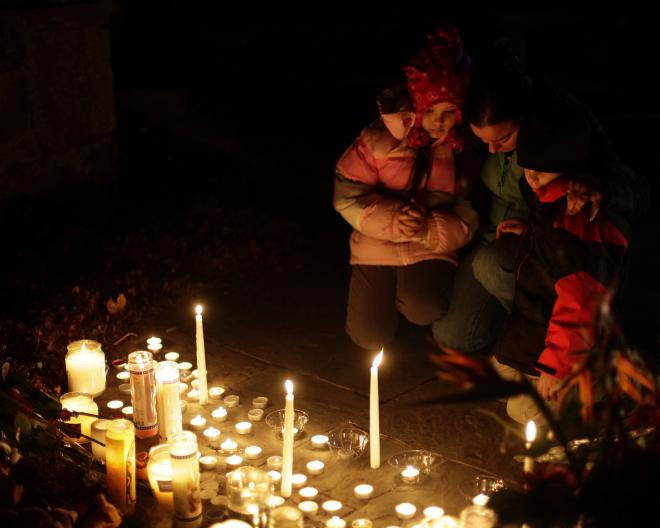
A family pauses at the vigil to remember and grieve.

Entering this quandary begins in framing how the church responds to tragedy. The church, and Israel, has always been defined by the community it consists of; Israel was identified by their communal decisions under God. The church is defined by Israel’s hope, the Messiah or Jesus, and our Christian hope is our identity. The New Testament intricately describes how the community of believers collaborates to embody the message of Jesus’s kingdom come [Acts 2:42-47]. All the while, we, the community of believers, anticipate the fullness of creation made new [Revelation 21].

Back to Obama’s words: “God has called them all home.” This statement implicitly presupposes a God who caused these deaths. A theodicy is not necessary here, but to be clear, God mourns these losses. The young man, Adam, was free to exact his own will on others, sadly, and we grieve the losses. So does God. Jesus, the Son of God, suffered with us [Isaiah 53, Gospels]. God is greatly grieved for loss of life and the wickedness that causes it [Genesis 6:5-6]. He knows the length of our days, but clearly he does not seek to shorten them.

Back to the response of the church. This past Sunday, at Grace Episcopal, the church in which I have served for going on four years, we lit a candle and prayed for the families and individuals in Newtown. We lifted up our concerns and cares before the God who comforts and heals. We did it first as a community of faith, collectively pleading for God to reach into lives. We did it also as families and individuals with varying opinions and emotions. We long for God to make all things new, and do our best to keep praying the prayer Jesus taught us, “on earth as it is in heaven.”

We desire things on earth to be as they are in heaven, but we simply do not understand the evils made explicit in the Newtown tragedy. Nor can we comprehend the systemic evils that beset the planet we share. We do what the church does best: we pray, encourage, grieve, listen, and repeat the cycle. For the children, the parents, the families, the extended families, for Adam and his mother who is also gone. May the grieving families in Newtown know that the church, the common people of faith in God throughout the nation and world, is praying. And may they know that the God of the universe is also grieving, but also making all things new in the end.

The names of the departed are below. May we continue in prayer.

The names and ages of the children are as follow:

Charlotte Bacon, 6
Daniel Barden, 7
Olivia Engel, 6
Josephine Gay, 7
Dylan Hockley, 6
Madeleine F. Hsu, 6
Catherine V. Hubbard, 6
Chase Kowalski, 7
Jesse Lewis, 6
Ana M. Marquez-Greene, 6
James Mattioli, 6
Grace McDonnell, 7
Emilie Parker, 6
Jack Pinto, 6
Noah Pozner, 6
Caroline Previdi, 6
Jessica Rekos, 6
Avielle Richman, 6
Benjamin Wheeler, 6
Allison N. Wyatt, 6

And the names, ages, and job titles of the adults are as follow:

Rachel Davino, 29, Teacher
Dawn Hochsprung, 47, Principal
Anne Marie Murphy, 52, Teacher
Lauren Rousseau, 30, Teacher

Credit for the list of people and the picture goes to International Business Times. Their article, from December 15th 2012, is here.