New Job, New City / Same Calling.

On May 22nd I wrote a post on how I had lost my job, but not my calling.

On June 22nd I accepted a new position at Palo Alto Vineyard Church, doing almost the same stuff I had been doing at City Church. I’ll be doing ministry with young people, plus some design/visual storytelling/social media/communications/outreach/fill-in-the-blank.

Below are a few of the folks I’ll be working with [though I’m replacing Matt-red shirt].

PA.Vineyard.Staff

My calling continues.

A lot has happened over the past 7 weeks, needless to say! On May 8th, I was laid off, and over the weeks since, there has been a lot of wondering going on in our home-and some stress for sure.

The peace I had been experiencing as I discovered my job was expiring was held right alongside the tensions stemming from the myriad concerns about possible transition. We had plans to consider the possibility of a move back to Michigan slated for July 15th, meaning we intentionally did not talk about this at all even though we planned to begin that conversation mid-summer.

But we are staying here, and it seems things are simply rearranged. We believe God is working through the din and confusion and change, bringing us through to something good and right, to a place where we will learn, contribute and lead.

That place is Palo Alto.

Palo Alto is rather unique in a number of ways. Similar to San Francisco, it has a fascinating history. But instead of the Summer of Love, cable cars, and sourdough [ok, I know there’s a lot more!], Palo Alto has a different edge. Palo Alto, Mountain View, Sunnyvale [where we will likely be living], and their surrounding towns are part of what is referred to locally as “the peninsula.”

Tesla is headquartered here.

The Googleplex, Google’s headquarters and largest campus, is in neighboring Mountain View, where our church office is located.

In Menlo Park, which is adjacent to Palo Alto to the northwest, sits a little [big] campus to a little company called Facebook.

Oh-and just slightly south of Sunnyvale in Cupertino you’ll find Apple’s headquarters. You know how iPhones have a default weather setting for Cupertino? Here’s why!

There are plenty more world-shaking companies around, lots of economic activity, and some strange things I’ll take plenty of time to get used to.

But within all the craziness, within the bubble that is Silicon Valley, people are still interested in Jesus. No matter how advanced the cars and phones and apps, there are still many who are drawn to this ancient Jewish peasant we believe to be God’s son.

It’s fascinating to find ourselves part of a new tradition of Jesus followers. So it’s a Vineyard church, which means they take the Holy Spirit pretty seriously. If you aren’t familiar with Christianity, it’s essentially a greater expectation for God to be at work, a great interest in finding God’s leading.

Coming down to brass tacks, my job will be a bit different than my role at City Church. With more volunteers and a history of lots of volunteer leadership, I’ll be doing far more collaborating and much less spearheading. At the same time, there is a bigger group of students, so I’ll be doing more guiding than building. Finally, the roles I’ll be taking on apart from student ministry will feel new and I think I’ll be challenged in good ways.

We are excited to be staying in the Bay Area; this is what we wanted, and I am pleased to see things unfolding as they are. There are plenty of new challenges, of course. The median income in Palo Alto is $127K [keeping all things in perspective, nearby Atherton’s median income is several times that]. We will be farther from Kaile’s graduate school. Though we found a good deal on a place to live [again, if it works out!], it’s still about 11% more per month.

And yet, we choose to trust that God is at work, bringing us forward in the right paths, walking with us through the ups and downs. Funny, I received this study book on the New Testament book of James right after I was laid off, and it emphasized the key text of the book, verses 2-4 of chapter 1, encouraging readers to commit these words to memory:

Consider it pure joy, my brothers and sisters, whenever you face trials of many kinds, because you know that the testing of your faith produces perseverance. Let perseverance finish its work so that you may be mature and complete, not lacking anything.

Weird, right? So was God the one who laid me off, testing me to see if I was faithful enough? If you read on, you’ll learn that the text emphasizes how trials teach us lessons; yet God isn’t some kind of weird cosmic puppet-master, tugging the strings of human existence and testing us. Instead, God walks with us through trials, challenges, temptations. God’s plan is not around pain, and God’s goal isn’t avoiding loss or grief.

James emphasizes in verse 17 how God gives good gifts:

Every good and perfect gift is from above, coming down from the Father of the heavenly lights, who does not change like shifting shadows.

Simply, when good things happen, we credit God.

When bad things happen, we search for God’s leading and healing.

And in all things, we give thanks. This is really hard for me-I’m the first to admit it. Yes, we have total permission to be frustrated about things, to be mad, to doubt, to get upset with God even [a great place to go for this is the Psalms!]. And yet, we are invited to trust, enjoined to search for the Spirit of God which is at work in us.

Today I’m on the other side of the crazy, floating feeling I had after being laid off; I’ve got a job to do and connections to make. Tomorrow holds, well, who knows what. I can’t be in control of that or worry about it, for I am alive right now.

And today, I say thank you to the Father of the heavenly lights, who does not change like shifting shadows.

***


An Open Letter to an Unknown Soldier

I came across a WWII helmet at a local shop here in San Francisco, and I bought it.

Then I gave it to someone I love. 

And today it’s July 4th, 2017, the United States’ 241st birthday. It seemed like a good time to write you.

Was this helmet yours?

[I know that would be wild, right? What are the chances?].

If not, does it at least bring back memories?  

Where did you fight? 

Did you live a post-war life filled with the painful memories that went unprocessed?

Did you struggle to reconnect with the civilian world when you go home from war?

Are you hispanic?

Are you descended from one of the people groups already living in this patch of land when Europeans showed up out east?

Are you descend from African parentage?

Are you white like me?

fullsizeoutput_774

Now I need to be honest for a minute.

I’m not the most patriotic American. For a long time I have been pretty critical of the United States. In fact, I have gone so far as to write, at length, on how I actually disapprove of a huge portion of our this nation-state’s decisions. I agree with some, sure, but I’m outraged by others. I have boldly critiqued the president, and spoken out using the rights and privileges that became my own when I was born into a American family in South Bend, Indiana.

And, getting honest, I’m a situational pacifist.

[There. I said it].

I grew up with guns, then sold my 12 gauge hunting piece a few years ago to buy baby gear.

[We have two tiny boys in our house whom we love dearly].

Actually, WWII is the only war I have found to be historically necessary amidst the many wars America has fought over the centuries. With the history I have studied, I can’t figure out another way around it.

If I had been forced to serve, I would have hoped to have served as a chaplain or medic. My training is within the world of Christianity; I went to a Christian college and completed a Master of Divinity program at an Evangelical seminary. During those years, I learned that my allegiance is not primarily to a nation, but to Jesus. And the call of Jesus is all-inclusive! It goes beyond the internal life of a person.

But that doesn’t mean at all that I don’t appreciate you, and I hope you understand that. You gave up so much. And it might not have been your idea at all to serve! You may have been just like me-a pacifist forced to do something they would never have wanted to do.

So… are you a pacifist?

Were you drafted?

Or did you sign up willingly?

And what did you do, sir, if I might ask?

Were you in the Pacific theatre, or Europe?

I guess if you’re still around you were probably in the Pacific.

Did you drive an amphibious tank?

Did you storm a beach and duck bullets?

Are you one of my two grandfathers?

I have so many mixed feelings about our country, I do; we have a deep history of oppression and segregation, of displacement and exclusion. Goodness, African Americans couldn’t even vote until my parents’ lifetimes, in the mid-20th century! And women only gained the right at the beginning of your lifetime.

Progress is slow!

And yes, other countries have plenty of maladies, and every nation-state has evils to renounce and genocides of their own to confess. The world is full of evil. Comparing the sins of the United States to other nations may have its place, but for now I guess we can conclude that we can critique our own because of the kind of democracy we set up in the beginning.

We can speak freely because we set up our system that way.

We can critique and protest because this is how our Constitution was designed.

A couple more questions for you, if I might.

Did you have to pull a trigger?

If so, did you regret it?

Are the memories painful?

[I’m so sorry if I’m digging too deep, I just want to know what you went through].

Did you wonder if God would forgive?

[My answer is a big *yes* to this one, even though I would never want to kill].

Did your kids suffer from post-war difficulties?

If so, was it hard to see that?

I’m sorry, I’m done. I know this is tough stuff to talk about.

You gave up a lot, and you may not have even signed up to be in the military. That’s wild. You sacrificed your time, energy, family [did you have a wife at home? kids? I do, and I’d never want to leave them].

Even more so, you sacrificed your God-given instinct that told you it isn’t right to kill. You set aside that intrinsic sense to preserve life because the world is a messed up place to be. Forces much bigger than you or I had joined hands, and you were part of an enormous resistance to the united Axis powers.

Was there another way? Maybe. Maybe not. It can’t be changed now, I guess.

Regardless, you still sacrificed-or were forced to sacrifice-a LOT.

I hate that the 20th century was soaked in blood, genocide, exclusion.

I hate that this new century contains the same.

I pray for a world that is different.

I am trying to be a part of that.

It’s often difficult.

Ok, anyway, I just wanted to say thanks. I know it’s a round-about way to say it, and I felt like I had to get honest about where I’m coming from. Again, please know that I’m not thankful that people died. I lament all of the loss. But from me to you, for all that happened that was or wasn’t right or good, you objectively gave up a lot.

I pray you find rest and contentment in your old age, that you find hope in the resurrection of Jesus and how God’s making all things new.

Jesus said there’s no great love than when someone lays down their life for a friend. Did another solider do that for you? Did they take a bullet for you-or shrapnel? I’m sorry, I’m doing it again-it’s a lot of questions. Forgive me. War is so absolutely hellish, yet you endured it, not knowing what would come in the years that would follow.

I’m done with my questions, and I’ve tried to make sure you know how it is that I’m saying this [as a pacifist Christian who isn’t super supportive of US policy and who is fairly critical of our history].

But all of that aside. Please hear me.

From me to you,

Thanks.

***

Don’t Ever Say These Three Words.

You. Just. Wait.

There you have it. If you stop reading now, you will have done yourself and the world an enormous favor.

Maybe you, like me, can quickly recall the last time someone said those words to you. I have heard that phrase so many times in my thirty years of life.

I still remember telling a guy who has no kids that it’s incredibly challenging to raise our son [now sons, and it hasn’t gotten easier!]. He was like, “you just wait until they’re in high school! It’s easy right now!” I was like…

squinty


Now I’ve written on ageism in the past, a really important topic for me; feel free to check out this post from a few months ago.

But today I’d like to zero in on general condescension, a close cousin to ageism, maybe more like an uncle or something. When we condescend, we project a smooth disdain for others, making ourselves appear superior, often stemming from a harsh criticism of their failures or mistakes.

Years ago my mother taught me that I had to laugh at ourselves, we can make others laugh. That said, when I freely admit my own foibles, I free myself from the fear of condescension. Conversely, when we condescend, we create needless enemies and mindlessly look past our own faults.

The account we have in Christian Scripture is suffuse with examples of people making foolish mistakes. A cursory peek reveals Abraham lying about his wife to Egyptians, telling them she is his sister; Moses disobeying God by striking a rock instead of speaking to it; David committing adultery then murder after desiring Bathsheba; Peter disowning the Jesus he had come to know so well-and right after promising to always follow, no matter the cost.

Indeed, if the measure of faithful Christian living is never making mistakes, then apart from Jesus himself, no biblical character holds up.

When we say, “you just wait,” what we really mean is, “it might be going well right now, but in my experience things will not always be like they are now.” And when is that not true? This is a throwaway three-word phrase that helps no one while also making others feel like they were born yesterday.

It’s spoken to kids after they come to a joyous though childlike conclusion [I’m always going to do my best!].

It’s spoken to young married couples [you just wait until your partner does x/y/z!].

It’s spoken to new parents when they celebrate how their child is cooperating [you just wait until they’re rebelling in high school!].

It’s spoken to kids as their parents get scared they will make mistakes [you just wait-life will throw you around, and won’t always be there to pick up the pieces!].

It’s spoken to middle-aged people as they enjoy physical health [you just wait until you age catches up with you!].

It’s spoken to every demographic and at every life stage.

This phrase is toxic!

Consider this. A 70 year old man in average health says to a 5 year old girl, “you’re complaining about some aches and pains now? You just wait, your age will catch up with you!” Now let’s say the the next day the girl goes with her parents to the doctor and discovers she has an advanced stage cancer, and her pain has a cause far beyond the scope of the 70 year old’s experience.

Hopefully you see in this unusual example the vastness of room that exists for the condescending person to find themselves not only wrong for condescending, but also wrong outright in their perception. In this case, the 70 year old man was wrong both for telling her to “just wait,” but also wrong about his perception of her pain. It was greater than any pain he had experienced.

We all fail in our various ways, we all fail to see what is ahead, and we all at times fail to realize that when we celebrate a daily victory, something troubling may be looming in the future. And so often, we project our experiences on others, presuming they will live into exactly the same experiences we have had, encountering the same difficulties.

And one of the central problems here is that by saying, “you just wait,” what we are really saying is this:

“I want to bring you down to my level.” 

Consider how, when the devil tempted Jesus, he so deeply desired to access his humanity-but did so by trying to subvert his divinity? He tries to access Jesus’s divinity first by asking him to turn stones into bread. He’s thinking, “you just wait Jesus, you think it’s rough now-just wait until you’re really struggling!”

Next, the devil tests Jesus’s ability to overcome nature by asking him to throw himself off a tall cliff. It’s like he’s thinking, “you just wait until people don’t believe you’re really God’s Son!

Finally, he offers Jesus all the kingdoms of the world if only Jesus worships him only. Maybe he’s thinking, “you just wait, Jesus, I’ll bet your plan to lead people falls apart; I’ll bet they turn on you! Why not just take this little offer? it’s so easy!” Turns out people did, in fact, turn on Jesus-and we don’t know whether or not he knew that was going to happen. It’s complicated being God and a man, depending on the Spirit for communion with the Father.

The devil is clearly looking to bring Jesus, who the Father, through the Holy Spirit, was still shaping Jesus into the divine yet human Son he was always meant to be, down to his level. He’s saying, “You just wait. Things will get nasty, Jesus, so why not listen to me and wise up a little?”

Friends, I contend that condescending to our fellow person by telling them that they should “just wait” places us in a place of pride. It’s a pride that tries to mask itself as humility [I’m just trying to help this young person see what’s ahead! I’m just speaking as someone who has seen a lot, and I’m trying to warn them!].

Now, an alternative. 

Writing as a 30 year old, I get that this little post can easily be cast off as the nonsense of someone who has no life experience. Yeah, I guess I’ve only seen what I’ve seen, and I can’t fast forward the years. But I can humbly submit another way to see things.

I wonder if, as opposed to saying “you just wait,” we could get more creative. What if we tried something along the lines of, “so I know it might just be my experience, but sometimes [insert your wisdom here] happens. Who knows if it’ll work this way for you, but that was what I experienced.”

I wonder if we could trade condescension in for humility, actually admitting our failures and mistakes as we gently offer a new insight to a fellow person. To a college student stoked about her new freedom though possibly unaware of the financial challenges: “yeah, I can tell you’re excited about college. It’s a pretty awesome experience! And yet, for me, it also had its share of difficulty, especially when it came to money! I felt like I never had any! What’s your thought on the job scenario for your time at university?”

Ok, my examples are probably not winning literary prizes anytime soon. And sure, I’ll bet we could probably find a case where “you just wait” might somehow be helpful to someone out there.

But we shouldn’t spend too much time thinking about that.

It’s a lot of needless work, and it may be more helpful to invest our time into the creativity that leads us to helpfully speak into the lives of others instead of alienating them with those three unhelpful words.

Or, keep doing it. See what happens.

You. Just. Wait.

***


I Lost My Job [But Not My Calling]

A number of months ago, I reflected on the intricate steps that led to my family’s first cross-country move. At that time, I was incredibly thankful, encouraged that while I had connected with a strong, mission-oriented church in San Francisco, Kaile was accepted at a very selective master’s program in clinical counseling. She would study and learn, I would lead and shepherd students, and we would together collaborate in raising our two tiny boys, Silas and Maelin. For a year, this is exactly what we did. We slowly learned about our new child, our new church, our new community, our new city; and having just passed our one-year anniversary of living in San Francisco [April 23rd], we both celebrate God’s goodness and God’s presence with us at every step of the journey. 

On Monday, May 8th, I learned that my job will not continue into the Fall. I am laid off. It was hard news, overwhelming news, news that I will surely still be processing for months to come. City Church is restructuring its staff roles, and after some serious discernment, my former pastoral role is becoming a part-time position. With the expenses of a family living in a major urban center, a part-time position simply doesn’t provide enough income to exist-or subsist.    

As I sat face-to-face hearing the bad news from Fred Harrell, the pastor who planted City Church in 1997 and who presently guides the community as its senior leader, I was shocked. But it wasn’t the news about my role as a youth pastor that shocked me, as difficult as this was to hear. Instead, I was shocked-surprised and taken in with a deep sense of peace that permeated my soul, my mind, even my body. The conversation was tangibly gracious; my heart rate was no quicker; my palms were dry; my words were slow and measured-and equally gracious as Fred’s, I hope. 

During our conversation, this moment that neither of us discovered to be easy or natural, I was pervaded by the same sense of peace that I sensed God giving me on October 15th, 2015 [read that story here if you haven’t]. Then, it was a 3am divine intervention, a wakeup call from God that quelled my burning anxieties that stemmed from facing an unknown future. This past Monday, it was a morning conversation with a trusted leader and coworker which featured some very tough news. But the same peace pervaded me, a peace that comes from God’s Spirit. I even mentioned this peace to Fred. I told him I was surprised by it, perplexed but thankful for the sense of centeredness that I was experiencing. 

Going forward, the same realities exist: when severance pay ends, I need new employment, and I don’t want to just do the next thing in front of me, to simply find something that works. Instead, I want to serve God using the very best of my abilities. During the challenge of transition, we need stability and support, and as we look forward, we require equal parts wisdom, courage, and perseverance. I’ve never been let go from a job before, and it’s a new feeling. Though my situation stemmed from budget changes and restructuring, it’s still difficult for me to sit with the reality of the leadership’s conclusion. 

IMG_2785

Sunday night I drove with my family to the home where our community group meets. After only a few minutes, the conversation turned to our situation. One of our church’s leaders was there, and she was closely involved with the difficult decisions that City Church has been forced to make over the past few months. Listening happened that night, and some really honest sharing of our burden. Hard as it is, I was reminded that evening how everyone in our group has challenges. One family is looking for more stable employment; another has a child with very pressing medical needs; yet another is recognizing the nuances of parenting are more difficult than they had imagined.

During our time with our community group, reflected on Psalm 31, especially the first five verses:

In you, Lord, I have taken refuge;
    let me never be put to shame;
    deliver me in your righteousness.
Turn your ear to me,
    come quickly to my rescue;
be my rock of refuge,
    a strong fortress to save me.
Since you are my rock and my fortress,
    for the sake of your name lead and guide me.
Keep me free from the trap that is set for me,
    for you are my refuge.
Into your hands I commit my spirit;
    deliver me, Lord, my faithful God. 

After reflecting on this Scripture, our group prayed for us. Hands were laid on; the scene reminded me of what I picture of the early church’s meetings in Asia minor. These people know us, at least as much as they are able to know us, and they are praying for us still.

All of this reminds me of how God has always been faithful to us, and we trust that this will continue to be the case as we plunge into whatever is next for our family and our livelihood. I say this to be true not as one who has found a new and meaningful job, as one a weary traveler wading through the muddy waters of unknowing.

During our transition, the same challenges that existed for us before the loss of my job continue in the present. Our two tiny boys are as energetic as ever, with just as many needs. They are sensing our stress, and we can see how it is affecting them. It hurts Kaile and me to know that the stresses that we are doing our best to hide from Maelin and Silas are having their effects on our infant and toddler.

Through these challenges, we are leaning into God’s direction for our life journey together. My days have turned to searching for employment, awaiting answers to email inquiries, and grooming my LinkedIn profile. Instead of commuting on my bike to an office, I work from my home office, investing the time I used to spend fostering direction for a ministry into something new: seeking a new place to serve. Since we have grown so deeply attached to our church community, this is especially difficult; it is not only my place of employment, it’s our people

As we walk on, our prayers are just as much with City Church as we perceive their prayers are with us. I lost my job, not my long-term call to pastoral ministry. And now, the elders and pastors are doing their very best to continue in the mission they sense God has directed them into, and I respect them immensely, even though things didn’t go my way. If I could resume my former work, I’d do it in a heartbeat. And yet, this is not how the story is unfolding, and it is time to allow space for the community to proceed in the next chapter.

When it’s hard and when it’s easy, we are resolved to take refuge in God, just like the Psalm says.

After all, we’ve been here all along. 

***

American Christians vs. Christian Americans

A number of years ago, I was chatting with a friend about the military. Even then, I was a pacifist, but I still admitted that if I were forced to enlist via a hypothetical draft, I’d comply. I’ve become even more of a pacifist since then, but I’ve been mulling over what it means to be an American Christian.

There’s a wide chasm, I think, between American Christians and Christian Americans. Recently someone I follow on Twitter compared the “America First” brand of American Nationalism to an alternative kind of worship, an alternative to the worship of Yahweh, the God who we know best through the Son, Jesus.

There are Americans who baptize their unwavering nationalism with Christianity, seeing at as a means to support American ideals. Conversely, there are Christians like me who try to somehow make sense of their nation-state in regards to their faith. I realize this is a gross oversimplification of the matter, but it’s a starting place nonetheless.

With the premise that every nation-state is merely a construct, an invention, and that the red/white/blue flag represents a narrative that means very different things to different people groups-allow me to attempt to navigate the intricate link between Christian faith and identity and one’s sense of place within the world as it is currently divided into continents, countries, and districts.

Screen Shot 2017-05-18 at 12.23.43 PM

I remember one Thanksgiving when we went around the table, naming one thing for which we’re thankful. Various siblings, aunts, and uncles, named things like freedom, enough food, a solid job, education.

When it got around to my  grandmother, her answer came without pause: “I’m thankful to be an American.”

I was not yet twenty at the time. Now I’m 30. And yet, as I relive the moment, her words strike me in a very similar way. How many people sacrificed for her to be able to be thankful to be an American?

Native Americans immediately think about a long history of displacement.

African Americans may think about slavery and the civil rights era, and maybe about police violence toward young black men, or about the centuries of marginalization that underlines their American experience.

Japanese Americans might think about the not-so-distant American internment camps where Japanese families were sent during WWII.

Mexican Americans may think about the 8 US states that were formerly territories of Mexico, then again about the irony of “crossing the border” to get “into” the United States. I’m typing this article in formerly Mexican land.

European Americans‘ thoughts might drift naturally and ethnocentrically toward Washington, Jefferson, JFK, Lincoln, or other celebrated American leaders who happen to be white.

Any one of these people groups could recall family members who served in the military at any stage of American history. This applies to my own family, and I’m thankful for the sacrifices both my grandfathers made to serve during WWII-an important war even from the vantage point of my pacifist sensibilities. But that is only one dimension of the multitudinous sacrifices made by numerous ethnic groups.

If we’re really honest, we might all be just a teensy bit ethnocentric-and that can be just fine or it can really fog our vision. But my point in bringing up the various ways various ethnic subgroups might understand American history is simply to note how much has happened in this swath of land over the millennia.

So many people have lost their rights, their dignity, their lives in the long journey toward America becoming the nation it is today. So many have gained unfathomable riches from the systems that exist in our nation-state. And yes, of course, the United States has participated in some very good things too-of this there is no doubt at all.

In full disclosure, I benefit greatly at a personal level from the personal and systemic losses of many other people groups. I benefit from the gains too. But at this point, I’m trying to figure out how to be thankful for what I have inherited while rejecting oversimplification and glamorization of the American story.

It’s in only seeing one side of the American story that we become complacent, self-righteous, and unhelpfully angry.

Now, I want to attempt to make a connection. How does allegiance not to country but to Jesus calls us out of this slough of ethnocentrism and national identity? How do we quell the tandem voices of racism and xenophobia? How can live and participate in the world’s unfolding narrative as Americans even as we’re confronted with the bloodshed that laces our history?

I believe transformation comes when we hear our deepest identity: we are sons and daughters of God [Galatians 3:26], made in God’s image [Genesis 1:26-28], sisters and brothers with Jesus himself [Hebrews 2:11]. More than Americans, more than members of a particular demographic, more than members of a particular orientation, we are united in Jesus. 

Whether or not we believe this matters, I think. It’s too easy to get swept up into the push and pull of nationalist political rhetoric if we lack a deeper spiritual foundation. We Christians believe God has extended us a massive amount of grace and that Jesus has paid an extremely high cost-his life-to conquer death, create reconciliation between God and humanity, and atone for sin.

If we genuinely believe God is at work in the world, and that God invites us to partner with him in renewing the earth, matters of American identity quickly fade in terms of importance.

This isn’t to say our national stories are unimportant or trivial. There are very meaningful narratives that can give Americans a sense of togetherness and build bridges of solidarity.

Just a couple weeks ago I was at the DeYoung museum here in San Francisco. On the second floor, there is a room filled with American art. One piece is especially moving to me. It features John Brown, a radical abolitionist who was on his way to execution for leading a slave rebellion, kissing a child, presumably his own.

That day a couple, presumably from another country [they were not speaking English], were observing the piece. I certainly could be wrong in my language-based assessment. Ostensibly, they misunderstood the gravity of the painting, for they proceeded to take smiling pictures in front of it. As they continued taking smiling pictures, the woman backed right into the painting, her hair and shoulders brushing up against it, moving its frame against the museum wall.

Soon, the museum security was on the scene, firmly admonishing her to maintain at least 24 inches between herself and the art.

Of course they gently complied.

The feeling within me as I observed was a mixture of incredulity and frustration. It seems that a middle-aged couple would know typical rules for an art museum. Much more, taking these kinds of pictures in front of a painting that features an execution is simply disrespectful. And the content of the painting made the picture-taking even more unnecessary.

All of that aside, the narrative of John Brown reminds us Americans of the suffering endured by generations of African American slaves. Yes, John Brown was violent, and we can sit comfortably and have a conversation about how he could have responded, but history is history and this is the desperation Brown felt. Some vilify him as an unthinking terrorist; some consider him a hero and martyr. But regardless, he is an important character in the drama of our nation-state.

In that moment, I felt very American. But I didn’t sense that American sentiment because I’m adoring the image of a country that stands as a shining beacon of hope for the rest of the world to see. I felt American because I have a unique personal connection to the people, places, and experiences of this country; I have lived here, loved here, and am raising my family here. And I don’t think I should be faulted for appreciated the country that has shaped me so deeply.

It’s romantic, this grouping of mountains, rivers, plains, fields, and deserts! The contours of my childhood included the vast forests, fields, and rivers of Northwest Michigan. I remember family trips to Colorado, Washington, Pennsylvania, and the Carolinas. I dated an African American for a couple years and felt the tangible difficulty of the American story as our relationship eventually faltered. I live in an area now where one can procure food from just about any remote corner of the world including Eritrea [and there are numerous Eritrean restaurants, not just one!]. This reminds all of us that America can indeed support and include people groups that differ from the earliest European settlers that have culturally and governmentally stayed in power.

As the current political season wanes on, as we do our best to shape our country into the kind of place we think it should be, I pray we remember our long and violent history. And there is no need to compare America’s violent history to other nations, this is unhelpful. Looking past our nation’s many sins can quickly lead us to an unchecked and one-dimensional nationalism that turns us into automatons who worship at the feet of the leader with the most braggadocio. Focusing too much on America’s many problems, on the other hand, can overwhelm us and turn us into self-righteous sidewalk prophets with no sense of gratitude for the good that is, by default, mixed with the bad.

It’s better to know the American stories of heartache and loss, of overcoming and transforming, commending them to honest, realistic memory while searching for true and lasting hope from our Lord, Savior, Brother, and Teacher: Jesus. 


doubt: faith’s companion

I have been thinking for some time about how faith slowly wears, breaks-in, over the life journey. Much like a favorite piece of clothing that is well-loved, our faith in Jesus often grows as life causes our souls to fray and discolor. Throughout our life journey, we are constantly thrown about, fraught with frustrations that God simply isn’t hearing us, filled with fears about God abandoning us, upended by trials that overwhelm us.

This is the human story.

Then there’s the larger world God presents us with in the written word of Scripture, carried to us through generations of spiritual risk-takers and written on our hearts through the Spirit. Often, biblical writers have a way of making a case, then allowing us to be made by the case. It’s unforced, it’s genuine.

Luke’s studied account of the life of Jesus begins with this, just two verses in:

…I decided to write it all for you, most honorable Theophilus, so you can know beyond the shadow of a doubt the reliability of what you were taught [MSG].

So far, so good; our enlightened minds are happy to hear Luke’s intentions are we prepare for him to make his logical case. He then goes on to tell the winding tale of a man, born of a virgin and of God, who slowly comes into his own. Jesus is eventually propelled into healing ministry, fulfilling prophecies and making tangible the presence of the God who spun the universe from nothing at all.

Surprising newcomers to the Christian faith, at the very end of the Gospel of Luke, Jesus dies. Then we’re told how he rises from the dead. Soon, we’re taken to the story of how a couple folks who had known Jesus are walking along when Jesus suddenly appears. But they don’t recognize him-their eyes are closed to him.

What? Luke, didn’t you say you wanted to show us beyond the shadow of a doubt the reliability of this whole story? 

Didn’t they know what Jesus looked like?

Did he shed a beard? Or grow one in the grave?

Had resurrection changed his physical appearance?

Anyone honestly taking inventory of this biblical account must reckon with the strangeness of these purported events. And, quite honestly, with a lot of other things. Our Scriptures are utterly perplexing at times, perfectly suited for much questioning along with some appropriate pushback.

In Luke 24:36-41, we read how Jesus, now resurrected from death, appears to some of his most devoted followers:

Jesus appeared to them and said, “Peace be with you.” They thought they were seeing a ghost and were scared half to death. He continued with them, “Don’t be upset, and don’t let all these doubting questions take over. Look at my hands; look at my feet—it’s really me. Touch me. Look me over from head to toe. A ghost doesn’t have muscle and bone like this.” As he said this, he showed them his hands and feet. They still couldn’t believe what they were seeing. It was too much; it seemed too good to be true. 

I bolded the last two sentences. If you’re ever stuck doubting your faith, doubting the story of Jesus, doubting God’s good purposes for you, then you’re in good company!

The disciples who followed Jesus around for three years even doubted him, even when he was right in front of them. If this doesn’t strike us as bizarre, well, maybe we’d need to re-read.

And yet, these women and men who “still couldn’t believe what they were seeing” went on to tell the known world about Jesus. Now, in 2017, about 1 in 3 people worldwide adhered to the Christian faith.

Apparently they got past their doubts.

Or did they?

They certainly took Jesus pretty seriously, but we are left wondering what was the turning point for each person. Did they struggle in the moment then reconcile things later on? Did the Pentecost event in Acts 2 [Luke’s sequel to his Gospel account] convince them? Or were they ready for action by the close of the gospel’s final chapter, where Jesus led them away, blessing them before being carried into heaven?

We don’t really know.

All I know, at this point, is that we’ve got a lot of people that have some serious confidence in Jesus. These are the women and men who went on to carry the message of a risen Jesus to the known world.

But hold on. What about their doubts? And our doubts?

Well, I’ve come to see it like this: just like the earliest followers of Jesus who doubted, our own doubt reveals that our faith is functioning.

Think about it: what if they didn’t push back on this testimony? What if they didn’t ask the tough questions? What if Luke left out the details about their struggles-might that have pushed a powerful story into the realm of the mythical? What if we, reading in our own era, blithely pressed on, ignoring difficulties that stymie the faith of so many?

Doubt is a companion to faith, keeping us spiritually honed and grounded, preventing the kind of faith that forgets what it might be like not to believe-that forgets that at one time we ourselves didn’t believe.

When we acknowledge our doubt to ourselves and to others, no longer is the doubt left stirring within our souls, unheard within our community, but it’s brought out into the light and its latent toxicity can be abated.

Consider this honest dad in Mark 9:23-25. He wants his son to be healed, and desperately, but his faith is incomplete. The son has some kind of issues:

[Jesus] asked the boy’s father, “How long has this been going on?”

“Ever since he was a little boy. Many times it pitches him into fire or the river to do away with him. If you can do anything, do it. Have a heart and help us!”

Jesus said, “If? There are no ‘ifs’ among believers. Anything can happen.”

No sooner were the words out of his mouth than the father cried, “Then I believe. Help me with my doubts!” 

Jesus says here in the Message version of the Bible that there are no ‘ifs’ among believers. He also goes on to heal the boy after the father’s moment of pure and unadulterated honesty [help me with my doubts!].

Rather than ignoring the questioning that was happening within his soul, this father brings his doubts to God, seeking transformation and a renewed faith.

Snap back to the story about Jesus showing up in Luke’s gospel account. Might the disciples have also personally asked Jesus to help them with their doubts? What happens between verse 41, where they are caught in unbelief, and verse 53, where they are continually blessing God in the temple?

I’ll bet they got honest with Jesus.

I’ll bet they asked a lot of questions about why he had to die, how he was raised, and what they were supposed to make of it all.

In my last post, I talked about vintage faith-time tested commitment, resilient trust in a risen Savior that stands the test of suffering and loss. Here are some ways to broaden the picture I attempted to paint in that post.

If faith is a leather belt, doubt is its wearer, stretching and shaping it and causing it to fit more naturally and honestly, taking it from stiff and unyielding to flexible, broken-in.

IMG_5444
my favorite belt [I actually inherited it from my dad!]
If faith is muscle, doubt is the mountain journey that first makes the hiker sore, but later conditions that same muscle into steely resilience.

If faith is a vehicle, it’s less likely that brand new model with the new car smell and shiny paint and more likely that tried and tested station wagon that carried you across your city and country more than a few times. But you’ve come to trust it, scratches, spills and all.

If we are but willing, God is ready and able to take our doubting, prideful, recalcitrant spirits and breathe new life into us, revealing that we are indeed temples for God’s spirit [I Cor. 6], reflecting God’s very image [Genesis 1:26-28].

Psalms do a great job at shaping how our faith makes its way into the context of the real, and it’s not by ignoring our perceptions and feelings. Instead, as we pray the poetry of the Psalms, we find ourselves caught up with a host of human beings who have been faith-ing long before us, even as they continue their worship in the throne room of heaven.

Eventually, we take on a new kind of vision of the world in which our doubts and questions and difficulties with God are no longer enemies to faith, but helpers along the great journey with Jesus. May we imitate him in all we do, with his Spirit helping. And may our steps this Holy Week lead us closer to him with doubt as our companion in faith.


Awkward Playground Confrontations: Learning to Share.

If you have ever been to a playground where a significant number of toddlers are present, you’ll understand the sheer volume of noise, snacks, snotty noses, and toys. 30 toddlers and kindergarteners sharing 3000 square feet makes for a lovely scene.

Such was the scene today at Julius Kahn playground here in San Francisco. It’s in the Presidio, a lovely former military encampment in the far turned enormous park. And Julius Kahn playground sits directly across the street from gleaming modern and historic properties each worth millions. And the sweeping view of standing eucalyptus and fir groves next to hilly fields keeps parents inspired and happy as they chase their tinies and mind their boo boos.

It was my first time, today, and I was pleased to watch Silas, our two year old, play as Kaile spent some time with friends playing tennis. I am terrible at tennis, you see. I didn’t get a picture of the scene at Julius Kahn, but here’s a little picture from another park of the star/villain of today’s story.

IMG_5349

Silas had been playing with some other toddlers in the dirt as I watched from a little way off. I was standing in the shade to keep the hot sun off Maelin’s head. Maelin is our almost-six month old. He was struggling and crying, so I was attempting to assuage his hiccup difficulties while keeping an eye on his older brother.

Suddenly a tall man appeared. “Excuse me, could you tell your son to give my son his toy back? He snatched it away from my son, and I can’t believe my son was so gracious about it, but he needs his toy back,” he asked/instructed me. He was a decade older, easily, and much taller than me. “Uh oh,” I managed, hoping he heard me over the crying infant on my chest.

I came over and instructed Silas to return the toy. Maelin’s screams forced me to pause my admonishment, and I planned to redouble my efforts in helping this gentleman in his crusade to heroically rescue his son from Silas’s plundering. To be fair to Silas, it was an awesome toy. I mean, I would play with this toy, pictured below. And I’m almost thirty.

yellow.crane.truck

Soon, Maelin was quiet. But Silas still had the toy, this deliciously intricate yellow crane truck. I looked up and saw the man glaring down at Silas, who appeared to be utilizing the crane truck for extensive sand mining operations. His son had started playing with the group of boys nearby who had access to a small fleet of vehicles. They also appeared to be in the sand mining business from what I could make out.

And then it happened.

The man swooped in and wrenched the toy from Silas’s hand. Ok ok, I’m overstating it a little, but he took the crane truck quite swiftly and returned it to his son, who may or may not have leveraged it for his sand mining operations.

Silas looked up at the man, perplexed. But he wasn’t as perplexed as me. I was aghast. Anytime parents bring their toddlers’ toys to a playground, they must expect either to share or to ward off a host of interested persons under three feet tall. These interested persons are all learning what it means to share, to learn the latent toxicity of the term “mine.”

I stopped myself from confronting the man, pausing to reflect briefly on my motives and to assess possible positive outcomes. Nothing good seemed likely to come from the conversation that I imagine would have gone something like this:

Ben: “Man, did you really just rip that toy out of my son’s hand?”

Guy: “Man, did you really just let your toddler steal my son’s toy?”

Ben: “He’s two years old, and I’m working on getting him to ask before using other people’s stuff.”

Guy: “He ought to know better.”

Ben: “Maybe your son could try sharing.”

Guy: “It’s his toy!”

Ben: “…”

I couldn’t get past that hypothetical dialogue in my head, so I observed the situation as it stood, allowing my anger to fade into sadness.

It was painful to watch Silas hang his head and wander off to another group of more accepting kids who let him load their little dump trucks with sand. He wasn’t wanted; he was cast out. In the car ride home, he mentioned it: “crane not mine,” he fumbled in his toddler fashion. Of all the events of the day, he remembered that one in particular; he remembered the feeling of having messed up and being very firmly scolded for it-and from a man much older than his own dad. Taller too. And, I’m guessing, wealthier, but who knows, can’t judge by the Patagonia shirt.

Sure, go ahead, hit me with that capitalist jargon from John Locke about the foundations of Western civilization and the right to private property. That’s great. But call me crazy, I want Silas and Maelin to share. Goodness, I want to get better at sharing my own resources. Our playground policy is essentially that Silas must share any toys he takes; and I have to at least hope that other kids-and parents!-to be gracious with the toys Silas wants to use. Only one other time ever have I seen such closed fistedness from another parent [and it was much milder].

If it’s too difficult to share a crane truck, I fancy it’ll be hard to share school snacks too in a couple years, or compare study notes in ten. It’ll be hard to be generous with time and money when he’s 40. It might be hard, even, to be generous with complements.

I’m taking this to the extreme because I have this belief that if we coach our kids well during the early years, the difficult lessons will soak into their little souls.

There’s a biblical Proverb that distills the concept:

Teach a child to choose the right path, and when he is older, he will remain upon it. Proverbs 22:6

I actually put serious faith into this idea. And I do it somewhat selfishly, for I do not want to live in a world where kids never learn to share. Too many of the problems in our country seem to stem from an inability to share. Like, I mean, immigration, health care, jobs, little things like that.

For now, I’m forced to just remind Silas to ask before he borrows toys and still hope for a little grace when he doesn’t. I can hope other parents coach their kids to share even when it might feel like the end of the world, but I can’t make them. And occasionally, I might have to swallow the legion counterarguments raging in my soul and just watch as my son has a truck taken from him by a tall, upper middle class white man who refuses to coach his son to share.

If you read my blog ever, you might have noticed that I rarely “get it right.” Most of the time I find myself writing about blunders I’ve made, failures and mistakes that I learn from. If there was a blunder on my part, it was in failing to coach Silas strongly enough in making sure to ask and say please before using another person’s toy.

But I’m not backing down on the other aspects of today’s events. I will continue to insist that Silas shares toys that he brings to the playground. Because, selfishly, I want Silas and all the other toddlers to grow up having learned to share. I really don’t think parents like the gentleman today need to reinforce their child’s concept of “mine.”

Selfishness comes pretty naturally to most of us, in my experience.

But so can selflessness. It feels good to give away your time without the expectation of something in return, to let go of material resources so someone else might flourish. Imagine a world where this genuinely was the norm, and I imagine it’s a place where you’d like to live.

Me too.

The Model Student

So.. I’m a youth pastor. With that comes a particular set of preconceived notions, at least for a lot of people. There is an archetype for who and how youth pastors are and how they act.

Annoying t-shirts.

Frosted tips [ok, in like.. 1999].

Bro-ey guilt-inducing talk: “yo, Jen, you should totally swing youth group tonight. Jesus is gonna be there, so, I mean..”

Ok, so maybe that’s somewhat of a start. Now let’s think for a second about the purpose of ministry that is specific to young people. We need to ask the question, “what is our goal?” 

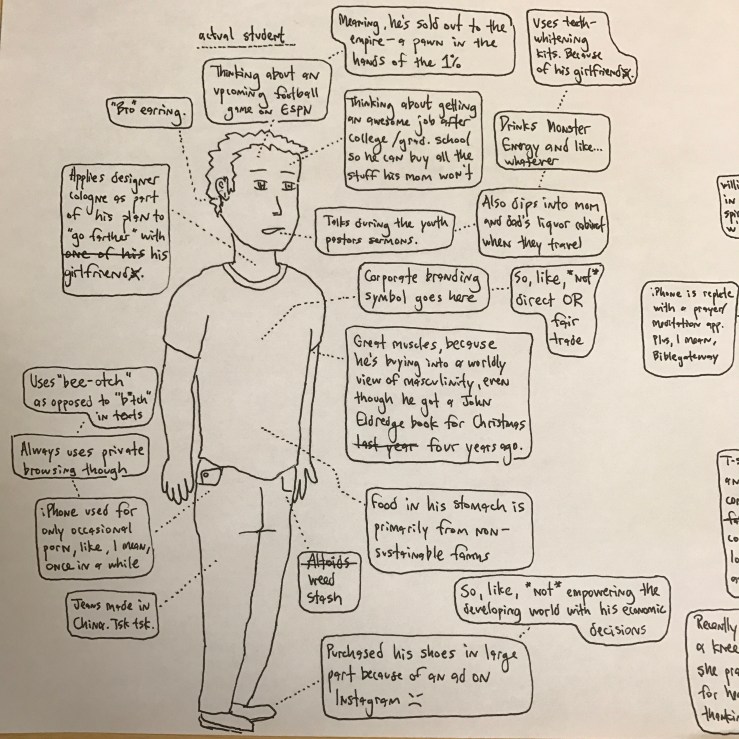
I’ve got some answers to that, but sometimes what happens in my brain is I imagine all the various ways a deep and resonant faith in Jesus can affect someone’s life. So, to allow you in on it, I created a diagram of what sometimes comes to mind as I think about work with students here in San Francisco.

First, the “Model Student.”

img_5221

Next, the “Actual Student.”

img_5220

You have now entered my brain. Thanks for coming. If you’re curious where this is going, finish up. If not, have a quick laugh if it tickles you then find something else to read. 

Ok, so there are some really impactful ways a genuine and authentic faith in the risen Jesus can change a person. I have written not a few blog posts on how my faith intersects with my life, and Christian practice is a subject that looms large in our culture.

Now, the point: is it really this simple? 

These silly comics point to actual truths, but I think what is most ridiculous is the thought that a model person or model student is actually as pure/spiritually wonderful as the comics suggest. In other words…

I’m afraid we’re all a bit more complicated. 

Right? I mean, come on. Yes, there are spiritual greats, there are saints. But each of us is internally mixed and our loves aren’t quite 100% pure. Do we all genuinely love our neighbors-and our enemies-as ourselves, like Jesus teaches? Or do we secretly harbor quiet judgment about folks who think [or vote?] differently than we d0?

People of faith fall into this trap.

People without faith do too.

And what’s the difference? I’d advocate that Christian faith does a pretty good amazing job at revealing the honest truth about our true selves. We’re all failing to fully love others-neighbors and enemies-as God loves us. We’re all failing to fully care for creation in all the ways we can [and yes, the Toyota Prius uses fossil fuel. And so do fully electric cars-they have to charge, after all].

The honesty about how we really are at the deepest level reveals that we are all a mixed bag. We do the right thing, we do something that compromises our values. We make progress, we relapse. This is the journey of faith.

But that Christian honesty is backed up with an action plan: repentance, forgiveness, and a lot of grace for when we don’t measure up to the high standard of loving God/others deeply.

God’s grace, shown in Jesus, floods the scene. Jesus models forgiveness to the folks gathered at his execution: “father forgive them; they don’t know what they’re doing [Luke 23:34 MSG].”

Following Jesus is no path for the faint of heart. Yes, Jesus comforts-but he challenges us too. That’s where my little “model student” diagram falls hopelessly short. All the things are important, but I left out the deepest aspects of faith: love for God and love for neighbor/enemy.” After all, you can’t really separate those two concepts anyway. 

That is what I yearn for in the model student.

And that is what I, though I so often fail to embody it, strive for as well.

Jesus. Showed. Up.

The message of Jesus spread to most of the world in an incredibly short period of time in the first three centuries, and without the use of violence. The message of Jesus has certainly been distorted over the centuries in many corners of the church, but his birth, life, ministry, death, and resurrection still stand at the center of Christian identity.

Historically, the event of Magi visiting Jesus from the far East happened significantly later than the visits of the shepherds and angels. Why would these scientist-philosophers show up with gifts? A lot of scholars have done their best to make sense of it all, and there is some fascinating literature on the subject. Clearly they were convinced that the baby was important, that Jesus would change world history. And he has, revealing the true nature of God-self.

The writer of the Gospel of Matthew really wanted his readers to know to what lengths the Magi went to find Jesus, and we are left with the question of what to make of it. Amidst all the things that can be written on the subject, I would posit one big idea: in Matthew, we discover, once again, God’s great concern not only for the people of Israel, but for the people of the whole world. 

Somehow, through a matrix of God’s active Holy Spirit, heartfelt evangelism, church planting, catechism, calculated missionary work, and lots of prayer, the message of Jesus got to many of us here in our 21st century world, right into the daily mix of our lives. We know Jesus through the testimony of all these generations of people who have been responding to him. And the Holy Spirit gives us strength to respond with our lives to this testimony seen not only in Scripture but in world history.

camille-flammarion
A cool 19th century wood engraving by Camille Flammarion: “L/Atmosphere”


Over the centuries, every generation of Christians have had their opportunity to respond well to the message of Jesus. His message to love our neighbors and our enemies; his message that when we treat a poor or needy stranger well, we treat Jesus himself well; his message that God loves the world a whole lot.

At Epiphany, the exciting reality is that we have received the good news of God made present in the Son, Jesus. We have learned the clearest picture of God, which is the Son, Jesus. We have been presented with who God tells us we are: sisters and brothers with Jesus, children of God.

This Epiphany [Friday, Jan. 6th] let’s behold the mystery of God made flesh [Jesus!] and live accordingly.

*


Top 10 Turntables [for Fun *and* Information]

I do not often write about gear. In fact, this is the first time. It’s simply not a significant part of the vision behind my blog. However, I have found a way to justify it. Within the world of theology and Christian practice there is this subcategory that I love called aesthetic theology.

While the phrase may sound complicated, it may not be so difficult to comprehend. Think back to a moment when your senses were overwhelmed with a surreal gratefulness and you just had to write or pray about it. Or maybe consider a time when you were at church worshiping and something about the hymn resonated with a deep part of your being and you simply felt at peace in God’s presence. If you’re someone like me who loves the outdoor world, think back to a time you saw a cascading waterfall or sweeping mountain vista, then think about the goosebumps. Love it or hate it, that powerful connection we feel to God through our senses and our imagination is called aesthetic theology.

For me, music is indeed a vital aspect of how I connect to God. I wouldn’t want to project this feeling on others, but I would certainly think plenty of folks would resonate with how I feel. Music, by its very existence, is a tiny clue, a step in the journey of understanding and trusting in the presence of our great God.

To justify writing about musical equipment, a guy needs reasons! Yes, vinyl happens to be one of my several hobbies, but I also need to keep my blog on point! Ok, on to the turntables.

The factors that go into my list are several, but in descending order they include quality, value, aesthetic appeal, and reasonable cost. Toward the end of the list, I compromised on the reasonable cost factor.

If you’re willing to put together a few hundred bucks, you can make one of these tables work long-term for your home audio situation.

1. Pro-Ject Debut

pro-ject-debut

Without a doubt, you’ll come across Pro-Ject when you take seriously the search for a quality turntable. The Debut series has been an enduring product line that has diverse options for any number of needs. Starting at $299 for the Debut III and ranging up from there, these Austrian-built ‘tables will suit the needs of most listeners and integrate well with any home audio system.

I personally own a Pro-Ject RM5 SE, another stellar performer in the sub-$1000 range, so you may consider my choice biased. However, thewirecutter.com, a respected  also loves the Pro-Ject as one of their best-rated options. A host of other reviewers agree, including Stereophile and UK-based HiFiChoice. It outperforms the other tables they review, and though thewirecutter.com selected another table as their “number 1” it was because of price, not sound quality.

Another fantastic choice if you like the Pro-Ject Debut is the Music Hall MMF 2.2. It’s made in the same factory but has some great features, even though it’s a bit more expensive. For the record [pun intended], years ago, when I first got into viniyl, Music Hall was my first love-but they led me to my soulmate, Pro-Ject.

I wanted to give a solid nod to Music Hall since I didn’t officially list one of their tables.

2. Rega RP1

rp1-titanium

The British are fanatics about vinyl. Made in southeast England, about 120 RP1 units are hand built daily to meet the demand of listeners around the world. This particular table is rather similar in design to Pro-Ject’s Debut, with a single plinth [the big square part of the turntable that everything is mounted on] and hidden motor. It’s $299, which is ragingly cheap for a solid product from a reputable company.

The Planar 1 is another great choice from Rega.

3. U-Turn Orbit

orbit-blue

I would be remiss not to mention U-Turn’s Orbit table.  Made in the greater Boston area, and again, with a single plinth, they utilize an exposed belt. This adds visual appeal while maintaining the isolation of the motor. Oh-if you aren’t sure what isolation means, no worries, I’m not some elitist. Motors makes a small amount of noise that can carry through to the needle, and since the needle vibrates to produce sound, you don’t want your motor interfering.

Starting at $179, this is probably the market’s cheapest ‘table that is a serious contender in terms of quality. The tonearm is the low point, in my opinion, but the overall design is solid and needle upgrades are always an option if you are looking for more nuanced sound.

4. Edwards Audio TT1

tt1

Reinforcing every stereotype [pun intended] about our British friends, this table is strikingly similar to the Rega RPM1’s no-frills design. That’s because the companies are related somehow. Unfortunately, I cannot tell exactly how. Go figure it out, I didn’t take the time.

Regardless, the TT1 is a great table. It comes with an acrylic platter, which is good both sonically and visually. The big issue with this ‘table is with its solid feet, it does not provide much sound isolation. Meaning, you’ll need to keep this thing on a heavy, solid table and away from any vibration.

5. Audio Technica AT-LP120-USB

 

audio-technica

To my eye and with all my biases, this ‘table is hideous. Really, it’s a table meant for DJs both in features and appearance. However, I wanted to include it on my list because of two reasons: it’s a direct-drive ‘table [the motor attaches straight to where the record sits] and it does USB recording. I’m not personally interested in either of these two options, but some folks want to spin/scratch and do DJ work. Others want to record and import their vinyl collection to their computer so they can stick the songs on their portable music player.

Indeed, there seem to exist two kinds of vinyl listeners: 1. those who enjoy the tactile aspect of having a hard copy of their favorite artists and 2. those who used to listen to vinyl back in the day who now want to combine the portability of an iPod with the nostalgia of their favorite tunes. I fit into the first of those two categories. It goes back to that aesthetic theology factor; when I take the time to dig out records and fire up my tube amp, I just love every little detail that composes the experience.

So, against my will, I’m including this hideous monstrosity on my list. At $249, it’s fairly cheap, and it gets the job done. For all you no-nonsense folks out there who aren’t concerned about appearance, this ‘table does come through. I can’t tell where it’s made, maybe Japan or somewhere in China. Not sure, the corporation is enormous. If you’re looking for something more attractive from Audio Technica, check out the AT-LP5. It’s a bit more expensive but a lot less hideous.

6. Gramovox Floating Turntable
fr_walnut_three_quarter

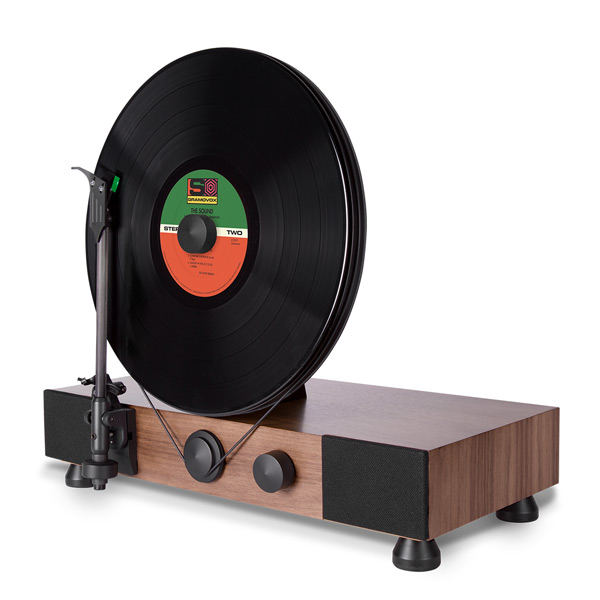
Made in Chicago, Gramovox prioritizes aesthetic appeal and simplicity. Yes, the ‘table sits upright, but that’s it’s one unnecessary-yet visually arresting-aspect. It’s purely minimalist design, very tactile, quite lovely with a walnut case. The other big thing about the Floating Turntable is that it is an integrated system, which means the speakers and pre-amp are all rolled into one. For $499, you get it all. 

For some, this is great. Others, however, want to upgrade these components. If you want to upgrade, you are in luck-the integrated system can be bypassed. But why would folks want to do such a thing?

Well.

The pre-amp in particular is an important part of a system because it boosts the tiny signal from the needle and makes it loud enough for the amplifier to boost to the speakers. In other words, it’s a bottle neck within the signal path [the signal path is the route from the needle, through cables, through a pre-amp, though an amp, through more cables, through speakers, and eventually to your ear].

People spend money on amps, speakers, cables, needles, and pre-amps because all of these matter for overall sound.

Fortunately, with its bypass feature, the Floating Turntable doesn’t force you to use its integrated speakers, pre-amp, and amp. This is one beautiful yet functional American designed and built ‘table.

7. Trntbl by Vnyl

trntbl

Ok, elites will hate me for listing this one, but hey-don’t hate, just read. This ‘table streams music. And it only streams music. Meaning, there are no cable outputs. To me personally, this is a big turnoff. But to others who prefer using Bluetooth speakers, it’s great.

The social features are where the Trntbl really shines. The unit identifies music it is playing-straight from the record-and allows the user to share this with friends or followers. Or, you can connect with others via Spotify and your friends can listen in to your music.

The Trntbl is available only for pre-order at $351, so it is yet to be tested extensively, but it appears to have decent components. Again, the quality will almost assuredly not compare with Pro-Ject or Rega, or even Audio Technica, but it has some interesting features that will surely stand out to certain listeners.

8. Pro-Ject RPM 10 Carbon

project-rpm10carbon

Twice I’m listing a ‘table from Pro-Ject. Why? It’s an incredible product. Yes, it’s $2999, and I get it, you have sticker shock. But this is one powerful and eye-catching means for spinning records. Look at that carbon fiber grain, the massive thick plinth, the belt, the sheer size. Plus it has an outboard motor which, just like an outboard boat motor, means the motor sits completely separate from the ‘table itself. The platter, where the record sits, is gorgeous and heavy. Gorgeous, because… well… people [like me, anyway!] love beauty. Heavy because it allows the records to play evenly without fluctuations in speed.

The RPM 10 comes with a heavy base to further isolate it from any sound or vibration in the room or neighborhood. Yes, jackhammers and construction equipment can indeed affect a needle. Plus, the base looks sick.

Oh-and did I mention? It’s tonearm is the carbon fiber Pro-Ject 10 cc. It’s essentially an upgraded version of the one that my RM 5.1 came with [props to me?].

9. VPI Classic

classic-002

A new old-stock Classic table is currently around $2800. Yes, paying close to three grand may seem like a lot, but I include this bad boy in my list because it’s a beautiful example of an enduring company that really cares about the details. Like the Pro-Ject RPM 10, it’s a true audiophile table. I mean, for goodness sake, it’s 65 pounds!  

Made in Cliffwood, New Jersey, VPI is a robustly American company using an old-school paradigm that prefers all-American components. They stick to their principles, and yes, they have expensive ‘tables. But the Classic is an enduring legend within the audiophile world.  My father in law, John, has sold [and loves] audio equipment professionally and recommends this ‘table for the price point. Yes, it costs as much as a used ’01 Toyota Corolla. But can that CD deck compare with this hoss?

I think not.

10. Origin Live Sovereign MKIII Turntable

origin-live-sovereign-mkiii-turntable-zoom

Don’t go buy one of these unless you’ve got way to much money-and no kids. It’s $7300, and that doesn’t even include a tonearm! But it’s one gorgeous, powerful machine. I won’t say a whole lot about it, but if you’re curious you can go learn more about it on your own. Once you’re into this $5,000+ category, there are a surprising abundance of options, and all of them probably have some great characteristics. Most of them look like something from the set of Alien or the new Halo movie. You half expect the tonearm on this one to morph into a laser or photon cannon. But, after reading the specs carefully, I’m afraid it does not.

Like fine wine, if you connect this ‘table to the same pre-amp, amp, and speakers, most of us couldn’t much of a difference between this and any of the budget models in my list. But then again, folks who buy this table are going to buy all of their gear commensurate with the turntable’s quality.

And they, unlike me, probably don’t have toddlers around. 

This is only one of many elite ‘tables out there that are visually and sonically arresting.

Summary 

Personally, I’ve hit my sweet spot. With a beyond-entry-level Pro-Ject RM 5.1, Jolida tube amp, and great inherited speakers and sub, my system is rocking. I doubt if I’ll change much, if anything. Maybe I’ll get a better pre-amp at some point or get fresh speakers, maybe a new set of tubes, but that’s way down the road.

img_4311

My system looks good, yeah? I’ll fish for a complement. I’m not above that. Not a good picture, but a great system. I hid the pre-amp and all wires underneath, naturally.

Now if I were someone out there with a few hundred bucks looking to get a solid system going, there are numerous choices in my list. I listed the Debut first because I really do think it’s the all-around best choice for the money, well ahead of the U-Turn on quality [see thewirecutter.com where the Debut strides far ahead of both U-Turn and Audio Technica]. I felt like I had to list models from Rega and Audio Technica because they’re perennial picks for good sound and enduring quality. The Floating Record player from Gramovox was a playful decision, as was the Trntbl, though they are both great for particular situations.

There may be a few folks out there with $5000-10,000 [or more] to sink in to a system, so I threw in a couple highlights from the very-high-end options that exist. There are so many out there, and it’s not really my area, so I only listed a couple.

A great many more ‘tables are out there that I didn’t list, spinning or maybe even scratching away. Can’t list ’em all, I suppose.

Anyway.

Enjoy music, folks, especially vinyl. May it, almost like a sacrament, remind you of the God who created the folks who creatively designed these machines, who created the folks who make the music that they faithfully reproduce. 

*