The Model Student

So.. I’m a youth pastor. With that comes a particular set of preconceived notions, at least for a lot of people. There is an archetype for who and how youth pastors are and how they act.

Annoying t-shirts.

Frosted tips [ok, in like.. 1999].

Bro-ey guilt-inducing talk: “yo, Jen, you should totally swing youth group tonight. Jesus is gonna be there, so, I mean..”

Ok, so maybe that’s somewhat of a start. Now let’s think for a second about the purpose of ministry that is specific to young people. We need to ask the question, “what is our goal?” 

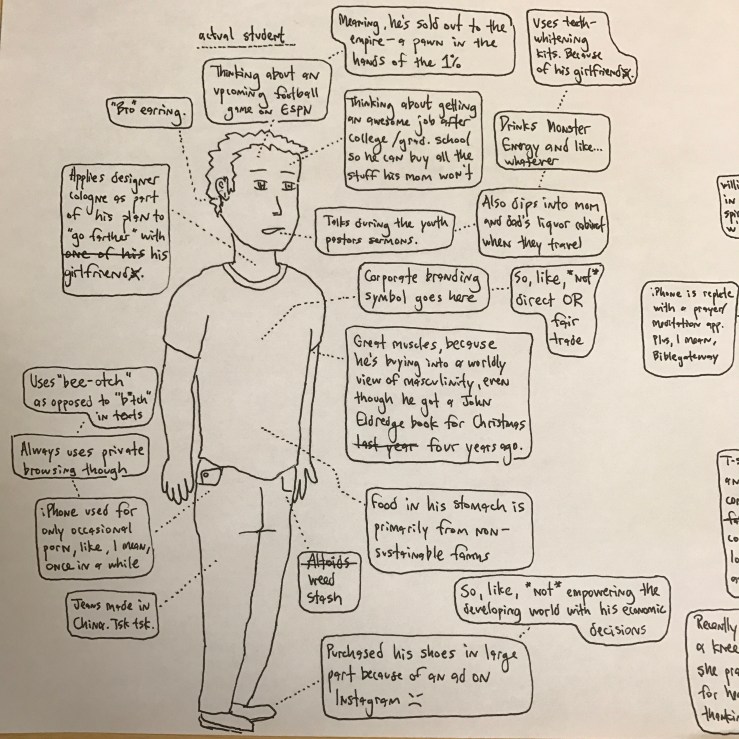
I’ve got some answers to that, but sometimes what happens in my brain is I imagine all the various ways a deep and resonant faith in Jesus can affect someone’s life. So, to allow you in on it, I created a diagram of what sometimes comes to mind as I think about work with students here in San Francisco.

First, the “Model Student.”

img_5221

Next, the “Actual Student.”

img_5220

You have now entered my brain. Thanks for coming. If you’re curious where this is going, finish up. If not, have a quick laugh if it tickles you then find something else to read. 

Ok, so there are some really impactful ways a genuine and authentic faith in the risen Jesus can change a person. I have written not a few blog posts on how my faith intersects with my life, and Christian practice is a subject that looms large in our culture.

Now, the point: is it really this simple? 

These silly comics point to actual truths, but I think what is most ridiculous is the thought that a model person or model student is actually as pure/spiritually wonderful as the comics suggest. In other words…

I’m afraid we’re all a bit more complicated. 

Right? I mean, come on. Yes, there are spiritual greats, there are saints. But each of us is internally mixed and our loves aren’t quite 100% pure. Do we all genuinely love our neighbors-and our enemies-as ourselves, like Jesus teaches? Or do we secretly harbor quiet judgment about folks who think [or vote?] differently than we d0?

People of faith fall into this trap.

People without faith do too.

And what’s the difference? I’d advocate that Christian faith does a pretty good amazing job at revealing the honest truth about our true selves. We’re all failing to fully love others-neighbors and enemies-as God loves us. We’re all failing to fully care for creation in all the ways we can [and yes, the Toyota Prius uses fossil fuel. And so do fully electric cars-they have to charge, after all].

The honesty about how we really are at the deepest level reveals that we are all a mixed bag. We do the right thing, we do something that compromises our values. We make progress, we relapse. This is the journey of faith.

But that Christian honesty is backed up with an action plan: repentance, forgiveness, and a lot of grace for when we don’t measure up to the high standard of loving God/others deeply.

God’s grace, shown in Jesus, floods the scene. Jesus models forgiveness to the folks gathered at his execution: “father forgive them; they don’t know what they’re doing [Luke 23:34 MSG].”

Following Jesus is no path for the faint of heart. Yes, Jesus comforts-but he challenges us too. That’s where my little “model student” diagram falls hopelessly short. All the things are important, but I left out the deepest aspects of faith: love for God and love for neighbor/enemy.” After all, you can’t really separate those two concepts anyway. 

That is what I yearn for in the model student.

And that is what I, though I so often fail to embody it, strive for as well.

Jesus. Showed. Up.

The message of Jesus spread to most of the world in an incredibly short period of time in the first three centuries, and without the use of violence. The message of Jesus has certainly been distorted over the centuries in many corners of the church, but his birth, life, ministry, death, and resurrection still stand at the center of Christian identity.

Historically, the event of Magi visiting Jesus from the far East happened significantly later than the visits of the shepherds and angels. Why would these scientist-philosophers show up with gifts? A lot of scholars have done their best to make sense of it all, and there is some fascinating literature on the subject. Clearly they were convinced that the baby was important, that Jesus would change world history. And he has, revealing the true nature of God-self.

The writer of the Gospel of Matthew really wanted his readers to know to what lengths the Magi went to find Jesus, and we are left with the question of what to make of it. Amidst all the things that can be written on the subject, I would posit one big idea: in Matthew, we discover, once again, God’s great concern not only for the people of Israel, but for the people of the whole world. 

Somehow, through a matrix of God’s active Holy Spirit, heartfelt evangelism, church planting, catechism, calculated missionary work, and lots of prayer, the message of Jesus got to many of us here in our 21st century world, right into the daily mix of our lives. We know Jesus through the testimony of all these generations of people who have been responding to him. And the Holy Spirit gives us strength to respond with our lives to this testimony seen not only in Scripture but in world history.

camille-flammarion
A cool 19th century wood engraving by Camille Flammarion: “L/Atmosphere”


Over the centuries, every generation of Christians have had their opportunity to respond well to the message of Jesus. His message to love our neighbors and our enemies; his message that when we treat a poor or needy stranger well, we treat Jesus himself well; his message that God loves the world a whole lot.

At Epiphany, the exciting reality is that we have received the good news of God made present in the Son, Jesus. We have learned the clearest picture of God, which is the Son, Jesus. We have been presented with who God tells us we are: sisters and brothers with Jesus, children of God.

This Epiphany [Friday, Jan. 6th] let’s behold the mystery of God made flesh [Jesus!] and live accordingly.

*


Advent = Active Anticipation

The human story consists of lots of waiting:

Pregnancies.

Job opportunities.

Finding your soulmate.

Standing in line to get brunch.

For each of these, we can make use of our time in any number of different ways. We can either effectively use the time at hand or become impatient and even downright frustrated with all the time on our hands. Take it from me-I love my soulmate, my kids, and my job, but as I waited for all of these I cannot honestly say I always waited with active anticipation. Sometimes I did, sometimes not.

And what do I mean by active anticipation?

With our children, active anticipation meant lots of prayer, stroller research and procurement, parenting books, and talking to friends with kids. And, well, lots of other kinds of anticipation. At worst, I was just nervous about a baby in our family. But at our best, Kaile and I actively anticipated the birth of our two boys.

With my job, active anticipation meant prayer, listening, networking, possibly too much education, and genuine effort at all the jobs preceding my current ministry work. At worst, I was preoccupied and missed out on opportunities that were right in front of me. At best, I actively did these things in anticipation of God providing the right *next* job opportunity.

With my soulmate/wife, active anticipation meant prayer, *crafty* romance, discernment, and listening to the wisdom of friends, family, mentors, but most of all to God’s Spirit. I really do see God at work in the foundational months of our relationship. At worst, I compromised friendships because of my new relationship with Kaile [and did late-night walks with her when I should have been sleeping or studying!]. At best, our years dating helped each of us understand the other as we actively anticipated the challenges of married life and the rigor of the family life we hoped to have.

Now, the turn to Advent.

advent-downtown

Again, the human story in God’s world consists of waiting and anticipation:

The world waited for God to show up before He made promises to Abraham.

Israel, Abraham’s progeny, anticipated release from Egyptian captivity.

The people of Israel anticipated a Messiah [Jesus] to prove God faithful.

Israel’s expansion, the church, anticipate Messiah’s return.

For each of these, the people groups represented either made or currently make use of their time in various ways. In Exodus, we learn that the cries of the enslaved Israelites ascended to God, sort of like the smell of smoke rising up from a fire. They actively anticipated freedom, yet strangely wanted to return once set free. When the Jewish people settled along the eastern edge of the Mediterranean Sea, they actively anticipated a messiah-especially as they were feeling crushed under the heel of the oppressive Roman empire.

We hear this anticipation in the prophetic writings of the Old Testament, and most poignantly in the Songs of Isaiah.

And now, we Christians actively anticipate the return of Christ. He appeared on earth, ministered, died, rose again, ascended to heaven, then promised to return-and we take this very seriously! We actively anticipate/await his return by practicing our faith. God is made known in the natural world, in the cosmos, in Scripture, and in the church. That last bit-the church-is important!

I write this as a Christian, and with the purpose of offering the church [all folks who follow Jesus!] a thought on how to participate in Advent as we continue toward Christmas.

Here are a few very specific ways we can actively anticipate the return of Jesus during the waiting season known as Advent.

1. Be still and know that God is God. 

How often do we genuinely slow down and notice God? As well-known as this invitation from Psalm 46:10 is, it may well be equally ignored. We are sometimes so caught up in ourselves that we miss out on an awesome, meaningful conversation, a beautiful vista, or a small opportunity to help a stranger. The hand of God is at work within all of life, and he speaks; however, we need to listen [and yes, I’m speaking straight to myself here]!

2. Forgive someone. 

Send a message or write a letter to a friend or family member with whom you’re at odds. Have a real conversation with someone at your workplace. Open up that old memory of frustration toward someone far away who hurt you, and see if God used time to help heal-then make the human connection and let them know there is forgiveness.

Practicing forgiveness is hard work! But it’s necessary work. Providing motivation for us to forgive, we learn in Scripture that God’s goals for human interaction are so perfect

3. Love others by giving away your time/talent/treasures. 

Funny that we’re heading toward the end of the calendar year, a time when people often give to charity or to churches to save tax dollars! But giving money away is only one way to bless others like we have been blessed by God. There are a host of ways to give away our time: plug in to your church and serve in youth or childrens’ ministry. Mentor someone. Get involved in a local charity. Serve food at a shelter in your city. Prepare hygiene kits at a domestic abuse center. You know there’s something you can do to the least of these, as Jesus calls them in Matthew 25. And as you do good unto them, Jesus tells us it’s as if we’re doing it for him.

4. Honor the People Closest to You

For some reason, it’s easy to be extra mean to family members. Since we are comfortable with those closest to us, we are often also the meanest. As we long for all things to be right and good and made new through the work of Jesus, we can actively anticipate his arrival by doing the difficult daily work of nurturing relationships with our spouse, kids, sisters, brothers, and parents.

5. Get Creative

I can sit here making lists of ideas for you, but chances are you have some ideas of your own that might just work better for your situation. Don’t let me stand in the way of an incredible opportunity or world-shaking idea.  

Thanks, But No Thanks.

Maybe you remember O Brother Where Art Thou, a Cohen brothers film from 2000. Set during the depression in the American south, the plot follows a small group of inmates as they attempt to get their lives together.

Everett, played by George Clooney, is especially interesting to me. Unlike his two simple companions, he sees no need for religion, no need for God, no need to pray to a nameless and non-attentive character in the sky.

That is, however, until he suddenly needs divine help.

clooney-mustache

Our inmates, during the final scene, have been caught by a ruthless county sheriff and are about to be hanged for their crimes.

Suddenly, Everett’s atheism evaporates as he falls to his knees, searching the heavens and praying for rescue. It is a poignant moment in a film that can too easily be seen as a fun ride lacking any depth.

Soon a floor rushes through, sweeping away the gallows.

And, needless to say, sweeping away Everett’s concerns about God.

He quickly dismisses the flood scientifically, insisting it came because of a state hydroelectric project. And whether that’s the case or not matters little, because Everett believes it to be the case. He puts his faith in science and in himself, ignoring the possible link between God and the life-saving flood.

No need for me to draw connections between Everett’s tendency to draw near to God during distress and the human tendency to do the same. It’s a universal trait. If we are honest with ourselves, we will see parallels between our own actions and his.

Now, a brief story from Scripture.

You can read it in the Bible’s Old Testament book, Daniel, chapter 6.

So there’s this guy, Daniel, a Jewish man who has been taken into exile from his former home by a group of marauding Babylonians led by the well-documented leader Nebuchadnezzar [who long name has surely confounded Sunday school teachers ever since ever!].

Maybe you already know the story of Daniel and the lions’ den, but if not, I’ll summarize for you. The new king, Darius, has appointed advisors who have become jealous on account of Daniel; he is a foreigner, but he is wise and is appointed to a special leadership position within the kingdom.

And the other advisors can’t accept that.

Without much forward thought, they get Darius to sign a law that prohibits prayer to any god but him, Darius, the king. And they cleverly get him to sign.

Soon, Daniel is busted for praying to the God of Israel.

Following his typical daily routine of authentic prayer, he isn’t trying to be politically divisive or antagonize anyone, but he does feel convicted to pray to the God in whom he believes, and not to a human king.

Though Darius is sad and fairly upset about the situation, he has to follow through: after all, it was his law. He stays up all night, sleepless and wondering whether Daniel will make it in a den of lions.

And… Spoiler alert… Daniel makes it. He is found alive and unharmed.

Daniel and Everett from O Brother Where Art Thou strike an interesting contrast, do they not? Everett prays during the one time he is in genuine trouble. And after his rescue, he immediately discredits any possibility of God’s involvement.

The account of Daniel is altogether different. Here, we don’t even hear mention of him praying while he was in the lions’ den, only before. And after his night in the den of lions, he credits God for having rescued him from the vicious animals.

Friends, I want to be like Daniel.

I want my prayer life and spiritual practices to go on whether things are awesome or awful, to honor God with my time and talent [and treasures too!] whether or not everything is going well.

I want practice gratefulness, and not just at Thanksgiving.

As a side note, prayer and spiritual practices are widely regarded as healthy and life-giving. The Harvard Medical School acknowledges the research on the benefit of being thankful, and even of acknowledging God’s care. Check out the research they point to here if you’re curious.

In a sense, we shouldn’t be surprised that grateful people are happier and healthier. And of course, as a rule of thumb, it will generally be more difficult to be thankful when we are doing really well-for then we are distracted from God. It can also be difficult to pray after a painful loss or searing rejection.

And yet, practicing faith through these daily rhythms is what Christians are called to. These prayer habits of gratefulness and petition just happen to harmonize with our physical health. The theme of physical and spiritual health running a common course comes up more than I realize!

We must continue to pray, continue to believe, and continue to be open to God’s leading in every moment. And when we do these things, more and more we notice how God has been at work all along. Then, when difficult times come, we will have an established pattern of being attentive to God; we won’t have to awkwardly stumble back to God and re-learn who God is.

But if we do drift away, we have every reason to know that God still listens and receives us back. God demonstrates grace throughout Scripture, grace for people who forget about Him and grace for people that misunderstood Him.

And though we make every effort at being constant in our prayer and in our faith, our passions are still divided, mixed with some lingering pride or un-forgiveness or quiet hate. And yet, stubbornly, we pray, waiting with expectation for the day Christ makes all things new.


It’s Hard Being 13: Thoughts on Ageism.

When was the last time you heard something positive about junior high?

Or, more broadly, about anyone who is even associated with junior high, like teachers, parents, or youth pastors?

As a youth pastor, I hear this all the time. Most recently, it was from a fellow pastor. At a church network gathering, he asked me how I serve at City Church. After I told him I work in student ministry, he replied with a very typical comment, eyebrows up: “pray for this guy.” He made sure to look over at a colleague for affirmation.

I get it. And I know firsthand that teens and tweens can be annoying or downright difficult. Though our boys are still quite tiny, I’ll eventually also know what it’s like to parent a teen.

awkward-adolescents

But I tell you what, I’ve heard all the derogatory comments enough times that I almost don’t notice it. Like water spots and grime on the windshield, most of us don’t even notice how severely we speak of young people. We just keep on keeping on, oblivious to what we’re saying and what difference it makes.

Two days ago I overheard a woman complain to her friend regarding some kind of incident with young teens, “the more junior high boys there are, the lower the brainpower; it’s a mathematical formula!” I’m sure it’s much different for us adults as we struggle with generosity, honesty, addictions. I’m sure it’s an entirely different for adults throughout history who have cheated their company in cahoots with a team of other sane adults. I’m sure it’s also a different story for the many adults throughout history who have collaborated to lead genocide.

You get the point.

People at any age can do some pretty selfish, damaging, detestable things. And yes, I could list bad things that teens have done throughout history. Or I suppose I could list atrocities older adults have committed.

And yet, we routinely speak so disparagingly to other adults about the irritating nature of tweens or teens.

Now I want you to imagine something. What if instead of talking about tweens we were talking about blacks? Or someone within the LGBTQ community?

Maybe you’re thinking, gosh Ben, you’re way too sensitive. Read on.

I recently attended an event our church sponsored confronting single-ism. Our group of mostly singles listened to a compelling and theologically rich lecture on the systematic neglect and marginalization of singles. For example, single men [and women, if I remember correctly] apparently earn less money than married guys. That’s clearly a justice issue.

Now I don’t hold in my hands the research to support my case than teenagers are systematically marginalized, but I [and most of us, I’d think] have the anecdotal evidence of this reality. And I’m not placing ageism-discrimination based on a person’s age-at the same level as other kinds of injustice, I’m simply saying it needs to be considered more deeply.

We also need to ask tougher questions of our own systems and prejudices, and extend our concerns to the young. Neuroscience has revealed how the teenage brain is uniquely poised for risk. And yes, it can be really bad-or really good. Or, plain annoying.

Allow me to remind you that you-yes, you-were once a teenager yourself. Yep. At one point you were probably difficult to parent, difficult to teach, socially awkward, academically unmotivated. Maybe none of those things apply, though, and you were the perfect adolescent. If so, my apologies.

I know I was a handful during my early teens. To this day I preserve memories of incessant talking during class-the second my teachers turned the other way. I remember refusing to wear a hoody in Chicago during October, a decision that didn’t make my youth pastor all that happy with me. I remember forgetting my uniform on more than one away soccer game. I got in a few fights even, believe it or not [very uncool]. I persecuted other kids in plenty of ways and created my share of havoc.

Chances are that all of us struggled in certain ways during adolescence, some worse than others.

My goal in this brief article is to stimulate deeper thinking on the issue of how we treat adolescents and, ultimately, to prompt small changes in our adult approach to teens and tweens.

If you’re a Christian reading this article, here’s something for you. In one of the New Testament’s smaller epistles [letters], Christians listen in on a note to a young man named Timothy. He’s a younger leader in the church, and his older mentor, Paul the Apostle, is encouraging and directing him in his vocation. He says this:

Don’t let anyone look down on you because you are young, but set an example for the believers in speech, in conduct, in love, in faith and in purity.” 

I could write pages upon pages about young people who have set an example for me in speech, conduct, love, faith, and purity. But I won’t. I’ll leave it to you to try a new practice in noticing young people who, though they are sometimes bothersome, are also examples to the rest of us in the ways they can be.

A final thought that strikes me as I move to a close is this: sometimes the way we treat people informs how they act. Yes, if we treat junior high students like incomplete human beings with no sense of how life is, they will likely act that way. But if we show patience and forbearance, if we listen, and if don’t look down on them, we might just impact someone’s life in a big way.

Or, I suppose we could keep up our old habits and go on making the same tired comments about junior high-ers.


My Life Was Threatened.

It’s true.

Just a week ago Kaile, Silas, and I sat down with my parents, Ann and Greg. We were in the Richmond near Geary and 19th at a little Indian place. Moments after we had settled in with our naan, chai tea, and tikka masala, I heard the man behind me speaking.

His voice grew louder.

And louder.

I’ll kill each one of you. But I will spare the mother because of the baby inside. I’ll f*cking kill all of you with my bare hands. You’ll bleed out instantly. You don’t deserve to live another day.

I looked across the table at my father, whose now-graven face and hazel eyes were locked on the non-gentle man issuing threats. I mouthed the words, “is he talking to us?” Since my back was to the crazed man, it seemed that turning or standing to confront him would do more harm than good. “I don’t trust that guy in the least,” came my dad’s whispered reply, still making eye contact with the man who had now stood to his feet, continuing the threats.

As my palms began to sweat, I thought through a list of possible outcomes: would he attack? Would I literally risk my life for my wife, toddler son, and 60-something parents? Am I really the pacifist I profess to be? Does self-defense count?

As the threats continued, my dad slipped out of his seat and quickly went to speak with the owner of the restaurant. In an instant he was there to gently ask the man to go about his day. My dad’s experience working in an urban pharmacy helped reinforce the wisdom of seeking a local expert, the restaurant owner.

Still breathing threats of violence, he walked out of the restaurant and down the street.

Phew.

Unsurprisingly, the fellow who threatened the four earthly people who know me the most was one of San Francisco’s numerous mentally unstable denizens: likely homeless, probably addicted, surely lacking in needs that most of us take for granted.

Yes, it was startling, but no, this incident is not typical in my life. I can count with one finger the number of times this kind of thing has happened [yes, once is all].

The experience made me think of certain Psalms that I’ve never quite been able to comprehend. Take for example Psalm 140. In the NRSV verses 10-11 read like this:

Let burning coals fall on them! Let them be flung into pits, no more to rise! Do not let the slanderer be established in the land; let evil speedily hunt down the violent! 

Whoa whoa whoa.

That’s a little much, isn’t it David*?

These verses and others like them are picked over by skeptics: the Bible incites violence! How is this good advice for anyone-much less the word of God? Yeah, I get the reaction. Much ink has been spilled as an attempt to discredit Jewish and Christian faith on account of the anger found in the Psalms [and elsewhere, but that is another story].

Is it really too much? Should we toss out these angry imprecatory** Psalms and keep the nice ones that talk about quiet streams and shepherds and mountains?

I’d say no. In fact, I wonder how much violence has ceased because of these Psalms. Here’s the twist. The anger in these Psalms could just as easily be directed to the writer’s enemy. But look! It’s not directed at the Psalmist’s enemy; the anger is directed straight to God.

Indeed, many of the Bible’s Psalms came during dark times of loss. Some have come from very specific situations in individual lives. The angry emotion contained in these poetic phrases comes from lived experience, not from abstract or existential feelings.

As I write, I can almost hear a response: “good grief, Ben, most people don’t have that kind of anger, and if they do it’s just a mental instability and they probably need therapy.”

I don’t buy that for one second.

What if the anger came from a terrible loss? From genocide? From having lost a child to abduction or murder? From having seen family members shot or tortured? When human beings go through upheaval of this nature, anger is an inescapable response. You bet therapy is in order, but any therapist understands and counsels the wisdom of effectively coming to grips with one’s emotion and finding the best way to move through it.

These Psalms encourage those experiencing rage to find its proper channel: prayer.

Only in connecting to God can we become open to the true darkness within our own souls. Only in connecting to our Savior, Jesus, can we find someone who truly identifies with human loss-yet who also communes with the Father and the Spirit.

Ignoring our anger leads us nowhere, and acting on it will surely lead to further destruction. Consider the Truth and Reconciliation Commission. Desmond Tutu and other leaders helped the citizens of South Africa move forward after countless acts of murder, racism, inexcusable and unspeakable hatred carried out under the banner of apartheid. Little doubt some seriously angry pray-ers sought solace in a God who is concerned for justice yet allows humankind to be his agents.

Going back to my opening story, I’ve thought more about the situation. No, I’m not praying imprecatory Psalms and asking God to avenge me. The man at the Indian restaurant probably needs some antipsychotic medications, a meaningful community, and a sense of self-worth; he needs hope; he needs Jesus.

homeless
Photo Credit: Susan Ragan of Reuters

But the experience is also teaching me to empathize, in small ways, with folks, rather unlike my middle class self, who do in fact have reason to pray their anger to God. Take for example the family and friends of Alejandro Nieto, shot numerous times by San Francisco police in 2014 at Bernal Heights Park. He was armed only with his licensed tazer that he was legally carrying for work [he was a full-time security guard]. An example from a different perspective comes from the grieving family and friends of police officers Liu and Ramos of the NYPD who were killed the same year, 2014, in their police vehicle. Neither had any connection to acts of police brutality.

There are a great many situations that lead our hearts to a pure and unadulterated anger. Resonating with the heart of God, we desire justice and for the law to do its strong work.

And yet, Scripture insists we pray our anger to God. As we do, we remain honest to the depth of our emotions yet also to the hope we have in his justice. After all, Jesus was unjustly accused and killed on account of it. And yes, in his desperate hour, he prayed that God would allow for another way, but eventually his prayer went unanswered as it turned into, “not my will but yours be done.”

God hears, yet even Jesus, the Son, did not always receive the answer he desired. But, with Jesus as our advocate, whether we are ecstatic, underwhelmed, or incensed, we still pray.

And why not start with the Psalms?


Footnotes

*Biblical scholarship has opened up our modern view toward the authorship of the Psalms. Some are certainly traced to David, but certainly not all. King David most likely wrote some, but assuredly not all of these artfully-crafted poems.

**Imprecatory or its noun format, imprecation, are words used in biblical studies to describe Psalms or other passages that espouse anger and violence toward the writer’s enemy.


Religion Controls People [Quick Read]

The title of this post is a complaint I’ve heard from atheist friends. To be sure, there are many instances in human history when powerful people have taken the teachings of Scripture and used them to abuse others and gain power for themselves.

I lament that my own Christian faith has been abused for purposes of control.

I lament that atheism [Mao, Stalin, Pol Pot] is abused for purposes of control.

I lament that Islam [ISIS, Al-Quaeda] is abused for purposes of control.

The common denominator here is not faith. Nor is it the systematized rejection of faith we know as atheism. The common denominator is people. Scripture teaches that though we are created in God’s image [Genesis 1:26-28] we also rebel [Genesis 3] from God. This ancient narrative finds contemporary support in the everyday: why are some people so angry? Why are some people so gracious? Why do some people seek power and wreak havoc on the earth? Why, when I look in my own life, am I such a mixture of good feelings and frustration? How can a crime boss plan and manage a complex system of drug distribution and murder then come home to his family with smiles and hugs, remaining faithful to his spouse?

Pablo Escobar. William Wilberforce. Hitler. Mother Teresa. Kim Jong II. Isaac Newton. Idi Amin. Martin Luther King Jr.; these were all humans with capacity for good, bad or mediocre lives-yet some did so much good while others worked or work for such destruction. What controlled these people? What controls me? 

img_4149
Student by Wayne Thiebaud, 1968

My wife and I enjoy the San Francisco Museum of Modern Art, and we find ourselves returing to Wayne Thiebaud’s fascinating work. Student is one of my favorites, and much better in person. I continue to wonder how this representation of a student is absorbing the world around her. She reminds me of my mother at that age, though of course I’ve only seen pictures. How is she processing the teaching for that day? Is she just waiting to be released from class? Does she hope to someday be a teacher herself? Do her textbooks do justice to American history or are they grossly one-sided? Does she feel controlled by others?

The South of Market neighborhood of San Francisco consists of lots of control. The economy in our city is controlled by marketers and purveyors of technology. Apple, Maserati, Coach, North Face, and H&M do a great job controlling where our money goes. People are controlled by the small smoldering tubes of tobacco or marijuana they inhale hourly. I walk by desperate souls every day lying next to a pile of needles, eyes rolled back, controlled by the powerful chemicals surging through their frail, undernourished bodies.

It’s my conclusion that we are all controlled by something, by someone, by factors we hesitate to name or by forces we comprehend all too well. Thing is, we need to discern how we are being controlled and who we want to control us. When we take a close look at our lives we see patterns of health and patterns of destruction, large or small; and these are informed by the factors that control us.

Looking to my faith/religion, it does indeed control me. My faith confronts and challenges me. It flies in the face of logic to love my enemy, something Jesus was adamant about, or to pray for those who want to harm me. Jesus redefines adultery by telling me that even secretly desiring a woman besides Kaile is the same as literal cheating. These are Jesus’s commands-is it control? He says some strong stuff! Give away my money, my possessions? My time? Ouch, Jesus; can’t I just keep it all?

I’m not great at doing all these things-just ask someone who knows me for an honest account of my foibles and failures. But I’ll bet people who have known me for a long time will be able to note how much I’ve changed over my years. I regress too, but do think there’s some overall forward motion. Maybe you relate to the pattern of ups and down that a critical look at our lives can reveal.


Attempting to see things as Jesus sees them, I try to imagine a world where people all literally tried to love God but also love their enemy, to give away their time and possessions, to pray for those who sought to harm them. I’d like to live in that kind of world. 

What’s ironic is how the Christians I know are also the freest people I know. Free to feel, free to give, free to encourage, free to laugh at themselves, free to lament, free to admit failure, free to love.

So there-religion controls people, myself included.


The Moment That Changed My Life


Around 4am on October 15th of 2015 I lay, as one might expect, soundly asleep. Silas, who at the time wasn’t yet sleeping through the night, was gracefully asleep, as was Kaile. Without any prompt, I was awakened-and it wasn’t a midnight snack or bathroom visit that I needed. It wasn’t Silas crying out or Kaile bumping me that woke me. I’m a frustratingly deep sleeper, as anyone who knows me well will attest.

So there I was, awake.

And, I believe, it was all God’s fault.

To provide a brief background to the Fall of 2015, I had recently finished seminary and was working part time at a church doing music primarily, and part time at a Christian mental health hospital caring for adolescents from broken homes. During that season Kaile was staying home with Silas. But she had recently expressed that she was going to apply to several graduate programs for drama therapy, a program only three school in the United States offer. One was in Manhattan, one in Boston, and one way out West in San Francisco.

After Kaile told me she was applying, my heart was immediately not at ease. The weight of possible transition and change was heavy upon my soul. We had recently purchased a home and invested time furnishing it; we had amazing friends in the area; our families were both nearby.

Change? Now? And what about my vocational journey? We knew not a soul in any of the places Kaile was applying to for graduate studies. And there was so much gravity keeping us in the greater Grand Rapids/West Michigan area.

For much of the first half of October, I was not at all centered. I prayed fitfully, wondering about how to participate as a co-leader in my family. I spoke with a couple people about things. I peppered Kaile with questions she could not answer [how will grad school work financially? what about Silas? we have a house now, remember!?]. This went on for some time, not at all helping our marriage or relationships. I was stressed. And, quite honestly, I do not have an anxiety-prone mind. To a fault, I can be too easy-going.

But the stress remained.

Until October 15th at 4am.

Snap back to the beginning of this little tale, and there I was, asleep when *wham* I am awakened. No amount of careful verbiage will convince you that this experience dripped with the power and presence of God, so I’ll save my words. Plenty of folks, even Christians reading this may doubt me-and I understand why. What I’m saying is bold! But, I’ll remind you, this kind of stuff doesn’t often happen in my life.

Never before had I sensed God intervening in the course of my existence in this particular fashion.

Anyway, after getting up, I felt a push to go to my room and write in my journal. The theme was centered in my deep sense of peace. The tumult in my spirit was rapidly dissipating, and I felt a supportive sense of God’s presence.

Goodness, it probably sounds like I’m writing fiction right now. Hang with me!

After journaling for about twenty or thirty minutes under my desk light, I finished my task. Then I read a Psalm. I think it might have been Psalm 40-I waited patiently for the Lord; he inclined and heard my cry… I will sing, sing a new song…”

Then, I couldn’t sleep, so I read a book I had been assigned during ordination that tracked a missionary couple from the early 20th century [it’s ok-you can laugh!]. Within minutes, I was crawling back in bed.

The next morning, I woke up and told Kaile that I sensed God had given me peace. She told me, “well it’s about time!” and moved about her day. My worries had genuinely dissipated, and I stopped concerning myself about possible change on the horizon. I kept moving with my studies and my work.

I had peace, now, but no particular direction.

It wasn’t until mid-November that we had realized two things: 1. the best school for Kaile was in San Francisco and 2. I learned that I also had a tiny connection there.

At the end of November, I interviewed for a pastoral position at City Church, where I now work. I spoke with Fred, the senior and founding pastor. It was a pretty terrible interview, especially looking back on it. But at the end of Fred’s West Coast day, he had sent an email with an invitation to fly out for an in-depth interview on December 12th. The next morning, I received it early in the morning, having gotten up before Kaile for work.

I wrote her a good old-fashioned note letting her know we were going to be heading to San Francisco for a possible job opportunity. She texted me back that day and let me know that her [possible] graduate school had invited her to an open house-on December 12th. Probably a coincidence, we thought. Couldn’t be an answer to prayer, could it?

After the dust settled from the interview, our time in San Francisco proved deeply meaningful. But the job hung in the balance. The school hadn’t let Kaile know whether she was accepted. And, at the end of December, Kaile conceived our second child.

Then, things began to come together. Mid-January, I got the job. Later in the Spring, Kaile was accepted into the drama therapy program. In March, our house went on the market the day we left town to find an apartment in San Francisco. When we touched down, I got a call from Dave, our realtor, letting us know we had a solid offer on our house. I then disagreed with him [the only time I’ve done this] and told him maybe we should wait until the next day before moving forward. And the next day, sure enough, two more offers came in; a small bidding war ensued, and we ended up getting significantly more money from our bungalow home than we had asked-and well beyond what any of us expected, Dave included.

So there’s those details-maybe it’s coincidence? You be the judge.

[I always include a picture in my blog posts, so here’s your image-it’s from a day trip we made this summer. We traveled south on highway 1 in a friend’s Subaru to the beach towns Pacifica and Pescadero].

img_4119

With our second child two three days overdue, Kaile and I are left with some time to process our lives and how everything has come together. Just today we spoke over lunch at a favorite local spot, Sweet Maple [strange name, I know] about the strange increase of answers to deep prayers we have witnessed in our lives. We have bothered God for a long time with our relatively minor and middle-class concerns, and we are both confident to insist he has responded.

It isn’t at all typical in Kaile’s life or in mine to experience a season of such lavish gifts from God [or, for the skeptic, strategic coincidences that resemble acts of God?], but honestly, really, sincerely: it’s a season of profound answers to much prayer. It’s almost impossible to list the answers to prayer we have received since moving out West. And apparently it’s not stopping. 

In a few weeks, our family of [hopefully!] four will be moving to a two bedroom apartment in a much quieter and family-friendly corner of the city, thanks to another family moving out and leaving us with a good landlord and a great deal on rent.

In ancient times, people who experienced God set up altars [like Abram in Genesis 12:7].

In the 21st century, when an altar built outside our high rise might irrupt the neighborly vibes and compromise city ordnances, it might be more appropriate to let life events of this grandeur be engraved deeply on our souls, to blog about them, to talk and process with others about them.

I’ll return, in the future, to pounding on the *doors of heaven* as it were. I’ll return to bothering God with small issues. I’ll return to waiting and wondering. No doubt I’ll experience more of the spiritual dryness that has sometimes marked my journey. No doubt I’ll lose friends, let people down, miss opportunities, get sick, experience tragedy, have an accident. No doubt I’ll be frustrated with God, disappointed, crying out Psalms of lament as I long for answers. Can’t be sure, today, whether tomorrow will even come for me-

But for now, I’ll say thanks-and remember.

Safe and Sacred Space

Sometimes I feel like I can look at someone’s face and read a story. That’s probably a personality disorder yet to be diagnosed, but really I do.

Walking by some folks on the street where I live in San Francisco, I read a tale of loss, addiction, and loneliness. Under cracked skin, dirty clothes, and tattoos there lives a soul who ran away from his problems only to step on the trap of heroine and methamphetamines.

Other faces bear different stories. Make up and designer clothing can disguise a tired woman who is desperately chasing a dream while presently discovering its shallow shell. Away from family and most friends who have known her well, she spends her time with friends form work and dates online. In slower moments, she thinks about checking in on her aging parents in the South but moves the event in her calendar app to a different week. 

In the lives of students who are part of my church, City Church San Francisco, I don’t have to lean on an impression or imagine a narrative. I get to hear the stories firsthand. As a youth pastor, I have the privilege of tuning in to the lives and experiences of students in junior high and high school. What strikes me most is the overwhelming nature of modern life and the insecurities it imbues within adolescents. 

Just recently I was speaking during a Sunday morning talk on the Christian concept of forgiveness. I was trying to communicate how God’s forgiveness of our bad actions is connected to how we are called to forgive others when they do us wrong. I felt like students were getting it. One student, who was clearly hearing me, piped in: 

“I know we’re supposed to love our enemies and forgive people, but it’s just really hard when they bully me.”

At that point, I knew we were going deeper. We were descending into the real world of a 12 year old entering seventh grade. We were descending into the world of a student who encounters everyday dangers and quiet pain. 

It’s easy to read or even hear about another person’s pain and cry a little, maybe think to our selves yeah, that’s really rough. And it is. Suicide statistics reinforce the often dark reality of teenage life.* It is telling that suicide rates are climbing swiftly among 10-14 year old girls.

There is a long conversation to be had about antidepressants, mental health, body image, and societal expectations. I believe each of these as well as a host of other factors play a part in finding a solution.

Amidst the various support systems, my line of work emphasizes spiritual health as the focal point. Youth pastors are part of a large community that seeks the good of people in adolescence, a critical stage in human development. I’ve referred young people to therapists, I’ve talked to parents, I’ve gotten to know the stories of many, and this is one thing I have learned:

Adolescents need a safe and sacred community.

And I cannot imagine a better community than the community that holds Jesus in high regard. Yes, I believe the church is the place to experience deep community in the journey of faith and friendship with God.

The Back to School Retreat this weekend provided a meaningful way to experience safe and sacred space. Having received feedback from numerous parents, students who came to Point Reyes experienced a safe and sacred community. And this safe, sacred community is a place to experience God, to ask questions, to look deeper into the things God and into the life and ministry of Jesus, God’s Son.

group_photo

Sometimes, for adolescents, this looks like reflective questions and dialogue. I chatted for most of an hour during our 6 mile hike on Saturday with a student who was fleshing out the meaning of following Jesus. That evening, I shared some fairly heavy stuff during our campfire about my faith journey and how, a number of years ago, I experienced the loss of a friend to suicide. One young man sat and stared at the campfire for 20 minutes after that talk. I can only imagine he was contemplating things in his life, wondering and debating with God about matters of the heart.

Yes, young people express faith in any number of ways. Brain development and rapidly increasing cognizance certainly factors in to how students process their spirituality. But being in safe, sacred space is essential in discovering the mystery of God and moving forward in faith. 

3 Reasons Why I Go to Church

Here’s a few thoughts that have been stirring for quite some time now. But only recently have I come to my keyboard to record them.

I want to write about church and why it’s important.

IMG_3132
The church of the Holy Sepulchre in Jerusalem. The earliest Christians bear witness to this as the place Jesus was buried for 3 days.

Ok, so churches often meet in particular places, but really the church is people.

But indeed, the term church often carries with it a host of memories. Maybe yours is of a Christmas Eve service with candles that ended with Silent Night. Or it’s of that long sermon on a hot day that had you fidgety and ready for ice cream. Maybe your church experiences are categorized via your sensory systems: the incense, the cologne people wore, the sound of a Hammond B3 or a pipe organ, guitar chords, a chorus of singers swaying, hands clapping.

My own experiences of church are fairly diverse, all things considered. I grew up in a church that was part of a really good preaching tradition. Concepts like the judgment of charity, of “stepping out of the boat,” and the prayer of, “God, throw the rock here!” were all concepts that moved me and challenged me. Musically we did ok, though our clapping was occasionally offbeat.

In college I was exposed to new things, like a church where I interned that changed its entire seating and design layout every six weeks and sometimes played songs by Coldplay, U2, and Elvis Costello. After college I began seminary, and as I did I also began my first real job as a youth minister in an Episcopal church from the “high church” Anglican tradition, which means they really like structure. Worship was regal yet somehow it was also warm and inviting. I sang in the same choir that Gerald R. Ford would have heard when the Grace community met on Cherry Street in Grand Rapids, just with different people. Lift High the Cross was one tune in particular that always arrested me spiritually-check it out sometimes and let it get stuck in your head for the rest of your life.

Later, I transitioned to lead worship in a small Reformed church in Wyoming, Michigan. It was casual, relaxed, with an established mission for living out Christian practices by loving one’s neighbor. Church was relationships, connections, common purpose, common life.

Since April I’ve been worshiping with a new community as a pastor for youth and families. It’s also part of the Reformed tradition. We sing some amazing and moving songs and listen to some gripping sermons. There’s also a deep yet inviting liturgy that guides the whole thing along, and the words motivate us to go out and invest in the community we inhabit. Thankfully, the church itself provides numerous opportunities for this.

So here are my three things [skip to the last one if you’re in a hurry]:

1. I’m easily distracted from imitating Jesus.

There’s this ancient song in the Old Testament. Found in Isaiah, it’s one of the “Servant Songs.” Chapter 53:6a says this: “We all, like sheep, have gone astray, each of us has turned to our own way…” 

Jesus [the famous guy who turns out to be the servant that Isaiah was talking about] invites us to take up our crosses and follow him, to imitate him. This is quite a challenge. And that’s why I get distracted. I need a weekly pattern to keep me oriented to God and caring about others, a consistent habit that keeps me imagining a more integrated way of living that extends generosity and grace to others and hope for people caught in destructive patterns of living. I’ve heard plenty of people talk about how they love Jesus but not the church, and I get how church can be frustrating [there are people involved!], but after the dust settles I’m confident Jesus as well as the earliest leaders of the church intended for us to consistently meet together [Hebrews 10:25].

2. Church sheds meaningful light on everyday things.

For all the normal stuff of life, grocery trips and soccer games, road trips and office trips and embarrassing trips like when I flew head-over-heels down the stairway at my high school during the winter of my junior year, yes! for all these experiences, church is a place to find meaning.

By default, the average American watches Netflix programs, cooks a meal, gets a teensy bit annoyed in traffic, and sort of tries to be a good person. Church offers perspective for why movies are meaningful, reasons to enjoy the food God provides, how to see other drivers as created by God, and a path toward actually becoming the better version of yourself that Jesus sees.

3. Church is a community that turns faith into a verb.

In the words of my old friend Steve Argue who now works at Fuller Youth Institute, the church is a “faith-ing community.” Even as a pastor and genuinely committed Christian, I wonder about things, I doubt, I wrestle with God. But I’m doing that in the context of a community that is doing faith actively.

It doesn’t always work out perfectly, but we actually want to love our enemies as Jesus instructed. We actually believe there is purpose to life beyond getting oneself ahead. There is a God to be adored and understood most clearly in this enigmatic person, Jesus, who did miracles and changed the world. There are issues to confront ranging from confronting white privilege to preventing genocide.

There’s this song that really moves me. It’s all about eating and drinking in the fresh and revived world that Christians believe God is ultimately bringing about. It’s about experiencing full connection with God and rich community with others. And, like church, tasty treats are involved.

Whether or not you believe that God created us, whether or not you think Jesus was for real, and whether or not you think we are made for eternal connection with God and one another [and this involves tasty treats, of course], I’ll bet you want to believe it. And I believe you were made that way, with the hope of good things that last engraved on your soul.

And to think, your deepest longings might just be true.

That, friend, is reason enough to go to church.