Top 10 Things I Learned in Seminary [#5]

Weakness is strength.

Doesn’t sound right, does it?

We live in a culture that exalts power. We may dream of influential positions in global corporations or long for a bigger voice in our local community. We Americans, of all people, delight in the possibilities that exist in the individual.

At the beginning of the 20th century, rags-to-riches novels impressed on the culture a sense of dramatic optimism. Suddenly it seemed as if anyone with the will power could rise through the ranks in commerce or industry and command armies of workers.

As history tells, this is not the case for everyone. Opportunity exists to gain power and influence, but acquiring it is difficult.

Within all this, God sees weakness differently. He sees it as strength.

If one reads any of the New Testament accounts of the death of Jesus, it is apparent that he was not exalted by his own power. Instead, God the Father gave him strength through the Spirit. John 16:5-16 describes the closeness of the three. Verse 15 reads: “All that belongs to the Father is mine. That is why I said the Spirit will take from what is mine and make it known to you.”

After three days, God glorifies Jesus, raising him from the dead. The first book after the four Gospel accounts is Acts, and at the very beginning of this book Jesus is witnessed ascending into heaven.

Weakness is strength.

Just like Jesus, we are strong when we are weak. When we lean into the grace of God, we find ourselves giving him glory.

Paul, one of the most committed early followers of Jesus, explains how this works in a letter, 2 Corinthians 12. God explains to Paul that, “My grace is sufficient for you, for my power is made perfect in weakness.”

When Paul attempted to do things in his own strength, it did not bring God honor. It probably didn’t bring Paul that much honor either. Instead, glorifying himself likely just made other people irritated. The same principle goes for all of us.

God is interested in doing incredible things [just look at the miracles of Jesus and of the Old Testament that preceded him!]. God also wants people to know him.

Let’s put this into contemporary context. It’s meaningful when people serve other people. Right? It’s so cool to see businesses and churches and individuals serving the common good. Now here’s where the weakness/strength paradigm is vital. For the person or church or business who does something meaningful, that can inflate the ego. Very easily can doing good cause us to think we’re ok.

But when we do good through weakness, there is only one option for others to believe: God is at work.

The natural world understands this concept. Annie Dillard talks about this in Pilgrim at Tinker Creek. The fecundity of nature, she says, is indomitable. A farmer somewhere thought squash were especially powerful, and he used a scale to test how much pressure these seemingly insignificant and feeble vegetables could exert. They pushed the scales to the thousands of pounds as they slowly grew, cell by cell, fueled by the growth of God. Weakness is strength.

In the human world, when someone is unexpectedly kind, it’s striking. When someone really seems to have the right to be vengeful and maintains tranquility, it’s noticeable. When a family loses one of their own to violence then responds with forgiveness, it speaks. It spoke in October 2006 in the wake of the Lancaster County shootings. A man brutally killed 10 young girls in a one room Amish school. The response from the Amish, even amidst their mourning, was forgiveness. Leaning into the strength of God, they never said it was ok or justifiable, but they forgave. Ironically, the man who killed the girls couldn’t forgive someone for having killed his own daughter.

God’s world is different. In God’s world, weakness is strength.

Top 10 Things I Learned in Seminary [#6]

Having graduated from Grand Rapids Theological Seminary early this month, this is the next of my seminary reflections. This is the fourth post, and one of the meatier ones.

#6

As broad as the various expressions of Christian faith are, God is broader.

I used to wonder why it was that so many Christian denominations exist. I thought to myself and to others, “are we not divided against ourselves?”

Well, I suppose in some ways there is some division. The church is filled with redeemed rebels, people who God is gently leading toward right living. No doubt, there latent tension between followers of Jesus.

But this is what I learned at my interdenominational seminary: God is really big.

The map below illustrates well the diversity of faith in the United States.

us.map.of.denominations

The concept of God’s vastness may sound simple. And in a sense, it is.

The more I have learned about the enormity of our expanding universe and the tiny, intricate complexities of cells and atoms, the more I have begun to understand that God is really, really big. During the earliest days of God making himself known to humanity, people quickly realized this.

Ancient scribes tried their best to record everything they understood about God and write it all down. Have you ever read the Pentateuch? Genesis, Exodus, Leviticus, Numbers, and Deuteronomy are not exactly light reading! There are some literary snags, some difficulties, some overlaps, some confusion to be sure. But at the heart of the Pentateuch we see God’s strong covenant to redeem and restore humankind through a people group, Israel.

Various tribes did their best to respond to God over long periods of time, falling away and coming back. The prophetic class called the people of Israel to repentance, over and over again pleading on God’s behalf and on their behalf to be faithful to their calling. Kings rose and fell, with only a few truly loving and serving God with their whole hearts.

So it is, it seems, within the Christian church.

Over the twenty centuries since Jesus, the Son of God, revealed himself in the Ancient Near East, the church has sought to follow his directives. Evangelism, spiritual formation, and the slow building of the church has ensued since the days of Jesus’s physical presence, and the church leans readily into an eternal future where heaven eventually meets earth. The people who have responded to Jesus seek his grace for forgiveness and also his justice to roll down.

But amidst all of this, people groups have conflated their beliefs with the tenets of Christianity. Sometimes this wasn’t a bad thing at all. Paul, a Jew, and many of the other early Jewish followers of Jesus, continued many of their cultural practices: food laws, circumcision, sacred ritual habits. These things continued, and for the most part it was a question of how to integrate new believers into the church. The church’s conclusion was that newcomers did not have to adopt Jewish practices to follow Jesus. Many Jews held on to their practices, which was totally ok. Surely some slowly let go.

Fast forward to 1095. Western peoples, who had come to understand much of what Christianity meant, conflated their own feudal belief system with the religion of Jesus. The Apostles, who had gotten to know Jesus, would be thoroughly confused to meet European people calling themselves Christians. These Europeans conflated Christian principles of salvation and repentance with their tribalism, their honor culture, and their desire for conquest. To the chagrin of billions of Christians who would follow, this relatively tiny group of warriors and leaders forever caused confusion. But the church reformed and repented.

And so goes history. Just because someone takes up the exterior mantle “Christian” does not mean that person is walking in step with Jesus, empowered by the Holy Spirit, and close to God the Father. It means, quite simply, that they call themselves a Christian. The same goes for groups of “Christians.” Scripture teaches that God evaluates the heart [I Samuel 16:7, Jeremiah 17:10, and others]. God perceives the actions of people, and he alone judges.

Because God evaluates the heart, it can sometimes be difficult to know which groups of Christians are genuinely walking in step with Jesus. Jesus himself teaches his people not to judge. The term in Matthew 7:1 is krinete, a Greek term translated accurately as “judge.” Isn’t this the Bible’s most-quoted verse? Isn’t this why so many people say “don’t judge me”? Later in the chapter Jesus says something else. He says that his followers can recognize [epiginosko] people, bad or good, by the deeds they do, the “fruit” they bear. That is not to say Christians should judge [krinete] bad people; instead, we recognize when people are not to be followed.

Thus, the history of Christian faith becomes more complicated!

Richard Foster wrote a book called Streams of Living Water in which he talks about the variety of denominations within the Christian church. Masterfully, he explains the contributions of various worshiping traditions who have done their best to faithfully know, follow, and serve Jesus. But no one group, in my opinion, has arrived. Each group of Christ-followers must journey forward, revealing the largeness of God and imitating the world-transforming Son of God, Jesus.

God is really big. When we read about different groups of people trying to serve God-conservative, liberal, traditional-we are to recognize them by their fruits. Most Christian denominations that come to mind-Baptist, Lutheran, Mennonite, Catholic, Reformed-are examples of groups of people who have done their collective best to be sensitive to the teachings of Jesus and to respond accordingly.

As broad as the various expressions of Christian faith are, God is broader.

The Top 10 Things I Learned in Seminary

Having graduated from Grand Rapids Theological Seminary in May, here are a few of the things I’ve gained. I’ll be posting about one per day, out of order, over the next ten days. Some will be awesome. This one, #7 starts us off lightly.

#7

The best stories rule the world; and the best story is the strangely compelling narrative of Jesus.

*

Try as I might to find meaningful stories to communicate the reality of God, the story God has given us is simply the most compelling story the world will ever hear. My favorite movie is Clint Eastwood’s 2008 masterpiece, Gran Torino. SPOILER ALERT: I’m about to give away the plot. If you haven’t seen the movie, go see it, and skip this post.

Anyway, I’ll make it simple. Eastwood plays Walt Kowalski, a crotchety retired Polish-American line-worker from Highland Park which is couched within the city limits of Detroit. He’s angry that all his white neighbors have moved away to the suburbs surrounding Detroit, angry that his kids are distant, angry that his priest [he’s Catholic] is young and inexperienced, angry that his wife passed away, angry that poor Hmong refugees now surround his neighborhood, angry that crime rates are up and that Detroit is struggling.

But something happens within Kowalski. I’d say it’s nothing but the power of God. Some may say it’s an old, angry gentleman who experiences an inner revolution. But I’d say it’s the life-transforming power of God.

He takes in a young neighbor, Thao, who had attempted to steal Kowalski’s prized car, an early ’70s Ford Gran Torino. At first it’s restitution, and Thao does odd jobs to make up for his attempted crime. But soon, Kowalski becomes a real mentor to Thao. Thao needs a father, and Kowalski coaches him on how to gather tools, hob-nob with the good-ol’-boys, fix things, and even gets him a construction job.

Gran Torino

Kowalski makes the mistake of roughing up some gang members who had been trying to recruit Thao into their drug-running enterprise. Soon, the gang retaliates and shoots up the Thao’ house and rapes his sister.

Outraged, Kowalski takes things into his own hands. His priest comes over to confront him, but even though he makes a serious confession, he hides his plan from the young minister.

By this point, I’m expecting a shootout between Kowalski and the gangsters. No good outcome is really possible here, right? In the light from streetlamps, he storms in and yells at the gangsters from the sidewalk. Then, provocatively, he reaches his hand into his vest pocket. They light him up, cutting him down with automatics. As he bleeds out, the watcher learns Kowalski was unarmed the whole time; he was reaching for a lighter for his cigarette.

Instead of continuing violence, he absorbs it, laying down his life for his new and foreign neighbor, the neighbor who tried to steal his car.

Kowalski’s actions were powerful. But they were only powerful because they mirror the greatest action of all: Christ’s work on the cross. Jesus suffered and died, absorbing violence instead of continuing it. But where Kowalski did plenty of things to deserve anger–maybe not murder, but certainly anger and distrust–Jesus was a perfect sacrifice.

Kowalski discovered the deepest meaning of love: it’s laying your life down for your friend. And his story is compelling because it mirrors the greatest story-the story of Jesus.

*

Two [Or More] Approaches to Cultural Engagement.

It’s called Porchfest.

Every year, my undergraduate university, Spring Arbor, does a years-end gathering complete with songs, dances, parodies, and comedy of every kind.

Each year we looked forward to Dr. Patton’s humble submission to the show. As an actor with a deep attachment to the world of theatre, he leveraged his powerful voice and calculated training to broadcast a simple yet profound message.

He would take the stage, stand in front of the microphone, and recite–as if reciting a moving sililoque–the lyrics from a top 40 song. And no matter what song he picked, each was slightly ridiculous. For example, All Gold Everything by Trinidad James, pictured below:

Trinidad Hames

Gold all in my chain,

Gold all in my rings,

Gold all in my watch,

Don’t believe me, just watch.

Don’t believe me, just watch.

Or another song, apparently an interesting swing at the fashion industry by Right Said Fred:

I’m too sexy for my car

Too sexy for my car

Too sexy by far

And I’m too sexy for my hat

Too sexy for my hat

What do you think about that?

Just picture it–a middle aged man, greying hair–and he’s quoting these profound lyrics in front of a thousand late teens matriculating through a Christian college.

Maybe it’s hard to picture.

Maybe not.

Now, another perspective.

Ken Heffner, director of Student Activities at Calvin College, perceives culture differently. His job involves inviting bands of all kinds to perform at Calvin. In November of 2014, he brought in David Bazan, a talented artist well known for his journey away from Christian faith and into agnosticism.

Heffner invites the artists to perform, then entreats his students to discern how God is at work within their artistry. Ken does a talk-back session after every performance, asking insightful questions relating to spirituality and faith, and the artists respond from their own vantage point. He has invited crude rappers and hard-edged rock bands to sing at his mid-sized Christian university, preserving the cadence of performance followed by talk-back.

Paul Patton subtly sheds light on the foolishness of culture, recognizing its strengths while seemingly keeping it in its place. Ken Heffner tacks a slightly different line, attempting to carefully observe how God is at work within culture.

To me, these two individuals represent two seemingly conflicting perspectives on how to live effectively, as Christians, in the world.

How to deal with culture is the difficult question at stake.

One stream of Christian faith has embraced culture and seen participation as the best option, seeking to enter fully into it and reform it. We see this especially clear in traditions such as the Reformed Church in America, a denomination that has received inspiration and influence from Abraham Kuyper and other thinkers. The other stream has distanced culture, recognizing its inherent temptations. We see this in holiness churches, churches influenced by John Wesley, among many others.

Both streams provide Christians with important wisdom.

Christians are surrounded with cultural influences. Just try driving along the expressway in an urban area; my guess is you will have to discern which billboards proclaim important truths. Just try doing a Google search for local restaurants; my guess is you will have to sort through ads and pop-ups in order to make progress.

No matter how hard one may try, apart from becoming a hermit there are limited ways to hide from culture.

I think we need Paul Pattons and Ken Heffners in the Christ-following world. The church needs to recognize the fallacies and deceit of culture. And yet, at the same time, followers of Jesus need to learn to meet others where they are.

Jesus sets a strong example in Mark 1:35 by rising early in the morning to pray. He retreats from the world. But in other instances, such as Mark 2:15-17 we learn that Jesus is spending time eating with tax collectors–duplicitous cheats who have betrayed their own people for personal gain–and he insists, when questioned by religious authorities, that he has come not for the right-doers, but for sinners–the wrongdoers.

Jesus engaged people where they were.

Our problem is that we are not Jesus. This does not mean we cannot carefully discern culture’s effects and engage with music and art and film, attempting to deeply exegete culture for kingdom purposes. But it does mean that we have to preserve a strong sense of what is right and good.

As followers of Jesus Christ, we have each received a wealth of wisdom from his example. But we also learn from the development of the first churches. Paul instructed the churches at Philippi in this way:

“Finally, brothers and sisters, whatever is true, whatever is noble, whatever is right, whatever is pure, whatever is lovely, whatever is admirable – if anything is excellent or praiseworthy – think about such things [Phil. 4:8].”

Because of our formation, we may relate more in our approach to culture to Ken Heffner or to Paul Patton. Because of my own formation, I must admit that I fall in line more quickly with Paul Patton’s skepticism of culture and his sensitive conscience. I know many other people who are more comfortable with Ken Heffner’s open yet carefully discerning approach.

Either way, we should honor or brothers and sisters in faith as we make choices that are reconciled with our conscience. And our best instruction always comes from Scripture. And whatever our spiritual heritage, our allegiance always belongs exclusively to Jesus.

Top Five Things God did in My Life: 2014 Edition.

5. Growing our Faith Community

RiverTree is in the midst of an exciting season of change and development. We have established a strong sense of mission, and the committed ones among us are discovering how to live well as a diverse community of Christ-seekers.

It was my church family that graciously allowed more than 5 weeks of paid time off when Kaile and I were engaged and busy with the details of our wedding celebration.

It was my church family that paid for home repairs when a family’s home was damaged in a windstorm. They didn’t even attend; it was just something our church family decided to do.

It was my church family that has provided strong relationships that are all moving in the same direction.

2014 was a big year for this messy group we call church.

4. Finances

About four months into our marriage, my wife was suddenly between jobs. It was midwinter 2014. As one of the coldest winters on records here in Michigan, the temperature continued to drop as we plunged through a January and February. Heating became more and more expensive, and my church work was not keeping our bank account from sinking lower and lower. Throughout, however, God miraculously gave us a resonant sense of peace. We prayed for opportunity. Soon, it unexpectedly came in the form of a couple very meaningful yet financially rewarding opportunities for Kaile.

She thinks God put money in our account. I have come to agree with her.

3. New relationships.

Over the past year, Kaile and I have made several new friends. One couple, neighbors of ours, have journeyed with us through our pregnancy. She had their first child, Amos, just over a month ago.

Another couple we have known for years, but have taken new strides of honesty and trust in 2014. Since having moved back from Minnesota, they have launched back into life in Grand Rapids, and into deeper friendship with us.

One dear friend from seminary has grown closer by the year. He has a form of depression that shows up when you know how to recognize it. We sit and talk every month or two and listen to each other. I need friends like him.

My wife and I have both grown closer to my family and hers–my new family [some call this “in-laws”]. We chalk it up as pure divine blessing to be close to one another’s original and still-intact family.

Relationships are eternal, but they start now.

2. Helped me understand my wife’s calling [Dale Savidge conference].

In July of 2014, Kaile and I traveled to Greenville, South Carolina for a conference on “applied theatre.” For those of you reading this who do not know what that means, you would be in company with me. I did not honestly know what applied theatre was until the host of the conference, Dale Savidge, graciously invited me to attend, free of charge, several of the workshop sessions.

One activity we did was a psycho and socio-dramatic exercise in which Dale asked us to pause and consider whether our Christian journey, at this very moment, was most similar to three biblical characters: 1. Paul [it’s about logic/the head] 2. Mary [it’s about the affections/the heart] 3. Martha [it’s about action/the hands].

Head,

heart,

hands.

At the time, I could not help but resonate the most with Paul and his very theologically-driven picture of Christ’s work. Soon, Dale asked us to line up and go to various places in the room that correlated with our choice. This is where the psycho turned socio.

In no time, he was asking us questions of how and why we arrived to the decisions we had made. We were interacting with the nuances of our formation. He instructed us that if we were moved by the explanations of others, that we could take a step their direction in the room.

It was magical.

Principles from the world of theatre arts carried directly over into group dynamics, psychology, sociology, and spiritual formation.

I watched in wonder.

As I participated, my mind flashed back and forth between the experience we had and the journey my wife has been on for years now. We still have conversations about the conference. God was especially present during that time, planting seeds of confidence and trust that her vocational momentum is moving to the divine rhythm, seeds that have since grown in our marriage.

Kaile and I agree on lots of things relating to the field of theatre–goals, purposes, meanings–and we have differences. I enjoy some shows, others not as much. Throughout the experience in Greenville, though, I learned to respect her perspectives in a new and life changing way. She has a lot of insight and a lot of experience in her field; I do not. Humility is the path to deference, which is the best starting place.

I don’t know that much about theatre. But she does.

1. Baby!

I was in the middle of installing a ceiling fan when Kaile came out of the bathroom, pregnancy test in-hand. For those of you who have not used one, it is simple. If the little blue line appears forming an “x,” you are pregnant. If it is light blue, you are potentially pregnant.

Our little blue line looked like someone took a blue Sharpie marker to a white paper. The line was as dark and solid as a toddler’s homework.

We were pregnant.

Immediately, Kaile felt compelled to take another test. If anything, the second test was more blue than the first.

I kept working on my ceiling fan project, racking my brain and imagining how our lives would soon change.

And change they have. During Advent, we felt a little bit like Joseph and Mary, preparing their souls and their lives for the coming of a child. During the throes of our insurance changes, we felt for a time that there was no room in the inn.

Eventually, however, we have discovered a network of support throughout our nearly nine months of sojourning into the land of parenthood. God has been faithful, and we have been changed. In a much smaller and less cosmic sort of manner, what was true for the parents of Jesus has been true for us:

A baby changes everything.

Parents and Children: Part 2.

In my last blog post, I revealed how I spent significant time in rebellion from my parents-about 2 years, actually. Between 2003 and late 2005, I failed to recognize how much my parents loved me and sought the absolute best for me. Eventually, God graciously helped me to eventually see plainly the concern they both have for me.

If you took time to read my previous post, you are now thinking one of two things: 1. “You dummy. Everyone should be thankful for their parents.” or, 2. “You dummy. Do you not realize that other people have strained parent relationships, bad parents, or no parents at all?”

Those are valid points! Many of us have some kind of difficulties with parents at some point in our lives, especially during certain growing-up years. Ages 12-19 may be the toughest. But it is not the case that the problem generally lies with the child. Some of us really do have terrible parents who do not care at all for us, or who are entirely absent from us. If this is your situation, I lament with you. 

I have numerous friends and connections who have strained parental relationships; indeed, some have no parents. One friend comes to mind whose father committed adultery with a family friend. Imagine the difficulties this Christian family has endured. Another friend has a mother with severe depression, and a father who refuses to get her treatment because of his beliefs. Imagine watching all of this while slowly becoming an adult; how utterly painful. Another friend, considerably younger than me, lives with his overworked mother. She has numerous children with various men. This friend has never had a consistent father figure, much less a mother who is around often enough to truly listen. 

It is indeed a broken, splintered world we inhabit. 

For followers of Jesus, there is a long-term hope: Jesus, our brother in humanity [Bible, New Testament, Hebrews 2] and our intercessor in divinity [Bible, New Testament, Colossians 1:15-20], connects us to the family of God. This does not right every wrong at this very moment, but it reveals the coming world of God. In God’s kingdom, divisions between people will cease, even between parents and children. Justice will be established for all-yes, for families too. Paul, an important leader in the early church, draws this God-as-a-parent concept out in Romans 8:12-17. God reveals that we are adopted as children. Eventually we become heirs, with our brother/savior, Jesus, of all the good that God has stored up for those who follow him.

New Life

However you understand the concept of family and the parental relationship, know today that God is your parent. Know too that God never intended families to be divided. Our relationship issues have their source in our own human failures-our sin as it is described in the Bible. The good news is that the wrongs are eventually made right. The last book in the Bible, Revelation, tells us how God, through Jesus, is making all things new [Revelation 21:5].  

It is a new year, and with it can come a fresh turn of events and a change in our inner emotions. Could this be the year we allow God in to begin healing our most painful relationships?

Whatever good or bad came through your relationship with your human parents, we can all look to God as our ultimate parent. If you were fortunate enough to have good parents, be thankful for them. If you did or do not, again, I lament with you. But together, we look forward to the coming day when God makes all things new and good and right-including family relationships. 

Parents and Children: Part 1.

Ask a toddler what they appreciate about their mommy or daddy, then an 8 year old, then a teenager. You will receive very different answer.

During my middle and late teen years, I had come to the conclusion that my parents were my adversaries. By asking me to be home by midnight and prepare for college, I thought they were trying to ruin my life. When they confronted me for hanging out with questionable friends, I feared they wanted to wreck my social life.

To me, eternity hung in the balance during those heated conversations about whether or not I was grounded for disrespecting my mom. What if I missed out on something with my friends? After all, my life could fall apart if I had to hang out with my family on a Friday.

Toward the end of my junior year of high school, I became interested in planning for college. Getting away from my little West Michigan hometown could be the cure to all my ailments. Plus, I was interested in learning. It was the best possible step for me to take; finally, I could escape my small-minded parents!

As I set out for college, I packed up my things. When I took the time to reflect, each contained memories. My desktop computer originally belonged to my older brother, and my mom had purchased me a new flatscreen monitor at Staples. My Redline BMX bike came from a garage sale where again my mother had taken mercy on my 13-year-old soul and paid the full $75 for it. My clothes came mostly from sales at the tiny JC Penney in Big Rapids, where my mom helped me find the stuff I needed to look presentable.

Arriving at Spring Arbor University, just a half hour south of Michigan’s capital, Lansing, my family helped me unload my memories into a tiny fourth-floor dorm room. After everything was [sort of] in its place, we gathered with many other families on the commons lawn and listened to what were likely meaningful words. I was not listening, really. I was making plans for my new life at college.

Soon, we were engaging in a ceremony. All the families formed a giant circle on the commons lawn, and the Spring Arbor professors and student leaders stretched out a long blue ribbon around the group. We all held on to a little piece of it. It was supposed to represent the connections had fostered between each of us new students and our families. After a small speech and a prayer, they cut the ribbon into a thousand small pieces. One by one, we were cut away from our families. Tears flowed. I was more excited than sad, but my then girlfriend, who was going to a different college, felt differently. So did my parents and brothers.

Each of us, with our piece of ribbon, parted ways with our respective families. A few quick hugs and whispered words, and they headed to their cars and drove away. We stayed there, making our way to the small groups of other freshman students they had established for us.

My college years had begun.

Long after the high school angst, some of my feelings of resentment toward my parents sat hidden within me. I enjoyed my new freedom at Spring Arbor, a place I was freed to be myself and establish my own new routines. After most of my first semester was over, my parents picked me up at Thanksgiving and we drove the three hours back up to Big Rapids. As we skittered across 196 heading West on snowy roads, my mind wandered back to my years growing up with them, then back forward to my new life as an independent college student. That got me to thinking: was I really independent? I got some scholarships, sure, but my parents still footed a pretty big chunk of each tuition bill. Those thoughts tortured me for much of Thanksgiving break.

Soon, I was driving back to Spring Arbor, safe behind the air-bagged wheel of my 1997 Jetta. I had found the car on eBay, and though my dad advised a Saturn, I wanted the VW. Cashier’s check in hand, he took a train to Philadelphia, PA to buy the car sight unseen, then drove it 16 hours back to Big Rapids. Did I mention he bought it for me?

As I drove, I carried new memories with me. Over break, I discovered that my parents are actually on my side. God, in his grace, helped me see them in a new way. Instead of adversaries, they were my biggest advocates. Instead of enemies, they were both cheerleaders and coaches. God appointed them to my personal board of directors. They saw me for who I really am, and understood my weaknesses. They also knew where I excel. And they were willing to tell me the difference between these two.

My life changed when I recognized that, miraculously, my parents had transformed into amazing people. Of course, the transformation was something God did in my perception. They loved me all along; I just needed to see it.

A Soon-to-be-New-Parent’s Prayer

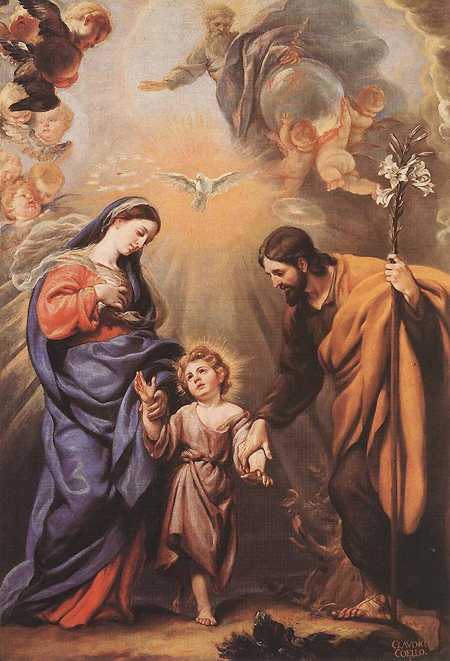
Claudio Coello: Holy Family

Lord God, you revealed yourself as a child. As Mary wondered how God could use her in his mission in the world, so do we wonder how it is that you involve us in your mission. As Joseph’s plans were interrupted with an unexpected pregnancy, so will our own ambitions evolve and shift with the presence of a new life, a tiny life dependent entirely on my wife and me. As our child depends on us for life and sustenance, teach us to recognize more deeply how our sustenance is entirely dependent on you. As our child learns and grows and matures, grow us and teach us and bring us to greater spiritual maturity. Merciful God, just as the news of Jesus’s birth came to humble shepherds, so does the news of your kingdom continue to invite us–the marginalized, the weak–to behold the depth of your love and us. Humble us and shepherd us, that we might recognize how, in your kingdom, you use the weak to lead the strong. Give us grace to lead our child in your way, and in turn be led, through our child, to you.

5 Things I Pray for as a Soon-to-be-Dad.

rabbit family


My wife, Kaile [pronounced Kay-lah for those of you who do not know her], is in week 30 of our first pregnancy. Related to this, there are lots of new concepts and concerns that nothing but writing seems to remedy.

As you read this, you are likely judging me. It is ok! I expect that. I am not naïve enough to think all of these are going to work out just like I hope they will work out. But I do pray for these things. I do desire some iteration of each of these to be made real in my life.

Here they are:

5. Fun Times with Baby

Come on. Who doesn’t love babies? I look forward to having a little person to laugh with [eventually] or even at [more likely]. While our newborn baby thinks to him/herself “my caretakers are supremely ridiculous,” I will be having a great time making faces and cooing as our little one does the baby version of rolling one’s eyes, knowing how utterly silly we both are.

Hopefully all of us will be better off for it.

4. Stronger Connections with other Parents

As recent as this month, people have still mistaken me for a college, or even high school student. At 27, this has gotten old. Maybe it’s the hair. I should begin to comb it sometime. Point sustained. The reality is, I am married. We own a house and a couple cars. We travel. We chose, together, not to have a dog [aha! maybe that’s why it’s hard to imagine me as an adult?].

I look forward to having that connection with others who are currently raising or have already raised children. To experience a significant change in the life journey is to enter into the process of sense-making with others. We will soon be able to compare the narrative of family life with others who are doing the same thing. Eventually, Kaile and I will be able to say, “yeah, that’s great insight on how you disciplined your child,” even if that technique didn’t work for ours. We’ll be able to say to others, “yeah, little [insert name] did okay with potty-training, but junior high was pretty rough.” You get the gist; we will be able to relate in new ways with billions of people.

Oh-it will also be nice to get a little bit more respect about my age.

3. A New Process for Spiritual Formation

For 25 of these 27 years, I have done spiritual formation as a single person. My journey as one of Jesus’s millions of disciples had been done in a certain single kind of way. That changed once when I got married, and will soon change yet again. Soon, I will need to recognize new ways of understanding the journey. This will likely consist of whispering prayers over our child as she/he sleeps. It will involve learning how to apologize to a 7-year-old. It will involve answering questions not as an absolute authority, but as someone who has experienced the hope of God.

It will also surely involve attempting to spiritualize diaper changes.

2. Stronger Bonds in My Marriage

Kaile and I know a new child will bring stress into our marriage. This, I think, is entirely unavoidable. However [go ahead-judge me!], there is also an opportunity to grow. Even writing the previous sentence fills me with wonder. How will Kaile and I learn to depend on one another? How will the challenge of rearing a child bring us toward a greater sense of purpose? How will we come to understand, in a new way, how God blesses the poor in spirit [Matthew 5:3]?

I imagine sitting next to Kaile on a park bench or, heaven forbid, airplane, trying to hush our screaming child. How can we weather that experience and learn to trust one another and receive one another’s input?

For the record, I do not know the answers to these questions. But I think they’re worth asking.

1. A Deeper Knowledge of God’s Love

I still remember a pastor in Chicago sharing a story about his three-day-old son. He reflected on how little the infant had done: “…my son hasn’t done anything! But that’s not why I love him! I love him because he exists!” He went on to make a joke about his son’s breastfeeding tendencies and how that was affecting his [cough cough] intimacy, a joke that he immediately regretted. Needless to say, it was a stressful week for him.

The point about his son stuck with me, though. God does not love us because we enter into the world and cause all kinds of transformation. Most of us are not bubbling fountains of kindness, and we wouldn’t hold a candle to the saints of old. But God didn’t love Mother Teresa or John Wesley or the new pope because of their good deeds. He created us out of love, and he keeps loving us because… well… he just does. He’s God.

I don’t know how my parenting abilities will play out when the rubber meets the road. But I do know that I’m committed. If our child grows up and becomes a promiscuous drug addict, I have to hope that God teaches Kaile and me more about his love, his unconditional, “it’s because I’m God” kind of love. Because we exist, he loves us. He’s God, and he just does that.

To hold a child-our own child-could drive this point home.

Hospitality: A Lesson in Christian Practice.

Night in Chicago

The above picture invites consideration of human relationships. We, the builders of massive cities, complicated technologies, and intricate transportation infrastructure, are still trying to understand our own interpersonal workings. We still struggle with our sometimes unquenchable pursuit of power. Whether we communicate with an iPhone 6 or through the mail, we still seek relational fulfillment and meaning. We desire to make some small difference in the world, no matter how many billions of people live in it.

Almost 20 years ago my dear friend’s family made the decision to leave a very oppressive, controlling community in the American northeast. Improperly calling themselves Christians, they functioned hierarchically under a dictatorial leader, building furniture and other wood products for income. As massive financial profits for the community leader became increasingly evident [he traveled in a Learjet], the desperate need to start afresh galvanized in the family. Because of the abuses of power, they felt forced to leave. In leaving, they left a toxic system, but carried with them a massive frustration with what they had understood to be Christianity. They also leaned into a life of scarcity, for their skills in woodworking did little for them outside the tiny community from which they had come.

After a move to a Midwest city, they struggled to find meaningful employment. Amidst the chaos, a small community church reached out, offering meals, job opportunities, childcare for the four young ones, relational support, and spiritual encouragement. They offered simple, honest, timely hospitality. Because of how God had offered them his overwhelming hospitality, this church had become willing to step in and offer hospitality to a poor, displaced family. It was not from guilt, but from an overflow of love.

I believe it was Shane Claiborne who said that our American problem is “not that we don’t care for the poor, but that we don’t know the poor.” I added the emphasis at the end because that is exactly the problem. It is distraction too that keeps us from acts of hospitality. Possessions, projects, and concern that we are in the right school district also keeps us insulated from the poor. We know how Jesus sent away a young man in Mark 10:21-22 because he had “many possessions,” but somehow we imagine distance from this waffling young man and ourselves. Jesus’s command to leave his possessions behind was a tall order; it was too difficult for this man, to be sure. It seems the command is often too difficult for us as well.

If we take an introspective look in our own lives, it is impossible for many of us not to relate to this fellow. Getting personal here is necessary; excuse my boldness. But honestly, how many poor people do I know? How many do you know? This is a reality check, because we live in a culture that has segregated itself de facto based on income and political affiliation. I’ll leave it to you to read the studies, but most of American society is stratified across these lines. Consider who you live close to: how similar to you are they socioeconomically? Religiously? Ethnically? These factors keep us knowing the poor among us. We are often physically distant from the people who are in desperate need.

The goal here, as stated in the title, is finding ways to show Christian hospitality in a neighborhood. Often it is best to start simply. As a disclaimer, it is important for you to know that my wife and I am not very good at this. However, we are trying. It is also important for you to know that we happen to live in a lower income neighborhood [and we fit right in!]. Over the past year, Kaile and I have been getting to know our next-door neighbor, Rina. We have had lots of conversations, and she has been over for a meal. As our relationship has progressed, I have noticed that she is extremely busy with simply making ends meet. She has little time for taking care of her home. Recently, she received a notice from the City of Grand Rapids that she was required to paint her entire home within 3 weeks, lest fees accrue for “property mismanagement.” Lacking the time and money to hire painters, she has made efforts to complete the project. She will not make the deadline. I offered to get together a few people from my church during an evening chat outside her home. She accepted. Rina does not have a relationship with God. She is not living into her baptism, now many decades ago. I pray our church’s small act of service will plant another tiny seed within Rina, and that God would nurture that seed over the years to come.

Christian hospitality takes many forms. But I am not going to list the various forms it can take; that is something that you must discern within your own context. I desire to simply speak on the subject and to describe how God has worked in my life and in the lives of people around me. I really think the way of Jesus is a pathway to peace and forgiveness in neighborhoods, and that we who are called by Him are called to offer others the deep hospitality that God offers us.

Continuing the opening story will help connect some of the dots here. My friend is now in his mid-twenties. His parents divorced early in life, and both his parents and his siblings have rejected Christian faith in large part because of their negative formational experiences with a corrupt community masquerading as Christians. But my friend has given the church a chance. And amidst the church experiences, he has given Jesus a chance. During several years of living in a home that practiced prayer together, he was offered the hospitality of heart-friends who listened to him and invited him to participate in Christian hospitality. What was the catalyzing factor? It is not clear. Maybe it was meals together in the home with neighbors. Maybe it was afternoon conversations after work. Maybe it was the closeness that comes because of being around others who are practicing their faith actively, who are constantly searching for ways to offer the hospitality Jesus offers us. To be sure, the Holy Spirit is greatly at work when you, as John Wesley said, “do all the good you can, by all the means you can, in all the ways you can, in all the places you can, at all the times you can, to all the people you can, as long as ever you can.” Maybe this is the best definition of hospitality.