On May 22nd I wrote a post on how I had lost my job, but not my calling.
On June 22nd I accepted a new position at Palo Alto Vineyard Church, doing almost the same stuff I had been doing at City Church. I’ll be doing ministry with young people, plus some design/visual storytelling/social media/communications/outreach/fill-in-the-blank.
Below are a few of the folks I’ll be working with [though I’m replacing Matt-red shirt].
My calling continues.
A lot has happened over the past 7 weeks, needless to say! On May 8th, I was laid off, and over the weeks since, there has been a lot of wondering going on in our home-and some stress for sure.
The peace I had been experiencing as I discovered my job was expiring was held right alongside the tensions stemming from the myriad concerns about possible transition. We had plans to consider the possibility of a move back to Michigan slated for July 15th, meaning we intentionally did not talk about this at all even though we planned to begin that conversation mid-summer.
But we are staying here, and it seems things are simply rearranged. We believe God is working through the din and confusion and change, bringing us through to something good and right, to a place where we will learn, contribute and lead.
That place is Palo Alto.
Palo Alto is rather unique in a number of ways. Similar to San Francisco, it has a fascinating history. But instead of the Summer of Love, cable cars, and sourdough [ok, I know there’s a lot more!], Palo Alto has a different edge. Palo Alto, Mountain View, Sunnyvale [where we will likely be living], and their surrounding towns are part of what is referred to locally as “the peninsula.”
Tesla is headquartered here.
The Googleplex, Google’s headquarters and largest campus, is in neighboring Mountain View, where our church office is located.
In Menlo Park, which is adjacent to Palo Alto to the northwest, sits a little [big] campus to a little company called Facebook.
Oh-and just slightly south of Sunnyvale in Cupertino you’ll find Apple’s headquarters. You know how iPhones have a default weather setting for Cupertino? Here’s why!
There are plenty more world-shaking companies around, lots of economic activity, and some strange things I’ll take plenty of time to get used to.
But within all the craziness, within the bubble that is Silicon Valley, people are still interested in Jesus. No matter how advanced the cars and phones and apps, there are still many who are drawn to this ancient Jewish peasant we believe to be God’s son.
It’s fascinating to find ourselves part of a new tradition of Jesus followers. So it’s a Vineyard church, which means they take the Holy Spirit pretty seriously. If you aren’t familiar with Christianity, it’s essentially a greater expectation for God to be at work, a great interest in finding God’s leading.
Coming down to brass tacks, my job will be a bit different than my role at City Church. With more volunteers and a history of lots of volunteer leadership, I’ll be doing far more collaborating and much less spearheading. At the same time, there is a bigger group of students, so I’ll be doing more guiding than building. Finally, the roles I’ll be taking on apart from student ministry will feel new and I think I’ll be challenged in good ways.
We are excited to be staying in the Bay Area; this is what we wanted, and I am pleased to see things unfolding as they are. There are plenty of new challenges, of course. The median income in Palo Alto is $127K [keeping all things in perspective, nearby Atherton’s median income is several times that]. We will be farther from Kaile’s graduate school. Though we found a good deal on a place to live [again, if it works out!], it’s still about 11% more per month.
And yet, we choose to trust that God is at work, bringing us forward in the right paths, walking with us through the ups and downs. Funny, I received this study book on the New Testament book of James right after I was laid off, and it emphasized the key text of the book, verses 2-4 of chapter 1, encouraging readers to commit these words to memory:
Consider it pure joy, my brothers and sisters, whenever you face trials of many kinds,because you know that the testing of your faith produces perseverance.Let perseverance finish its work so that you may be mature and complete, not lacking anything.
Weird, right? So was God the one who laid me off, testing me to see if I was faithful enough? If you read on, you’ll learn that the text emphasizes how trials teach us lessons; yet God isn’t some kind of weird cosmic puppet-master, tugging the strings of human existence and testing us. Instead, God walks with us through trials, challenges, temptations. God’s plan is not around pain, and God’s goal isn’t avoiding loss or grief.
James emphasizes in verse 17 how God gives good gifts:
Every good and perfect gift is from above, coming down from the Father of the heavenly lights, who does not change like shifting shadows.
Simply, when good things happen, we credit God.
When bad things happen, we search for God’s leading and healing.
And in all things, we give thanks. This is really hard for me-I’m the first to admit it. Yes, we have total permission to be frustrated about things, to be mad, to doubt, to get upset with God even [a great place to go for this is the Psalms!]. And yet, we are invited to trust, enjoined to search for the Spirit of God which is at work in us.
Today I’m on the other side of the crazy, floating feeling I had after being laid off; I’ve got a job to do and connections to make. Tomorrow holds, well, who knows what. I can’t be in control of that or worry about it, for I am alive right now.
And today, I say thank you to the Father of the heavenly lights, who does not change like shifting shadows.
I came across a WWII helmet at a local shop here in San Francisco, and I bought it.
Then I gave it to someone I love.
And today it’s July 4th, 2017, the United States’ 241st birthday. It seemed like a good time to write you.
Was this helmet yours?
[I know that would be wild, right? What are the chances?].
If not, does it at least bring back memories?
Where did you fight?
Did you live a post-war life filled with the painful memories that went unprocessed?
Did you struggle to reconnect with the civilian world when you go home from war?
Are you hispanic?
Are you descended from one of the people groups already living in this patch of land when Europeans showed up out east?
Are you descend from African parentage?
Are you white like me?
Now I need to be honest for a minute.
I’m not the most patriotic American. For a long time I have been pretty critical of the United States. In fact, I have gone so far as to write, at length, on how I actually disapprove of a huge portion of our this nation-state’s decisions. I agree with some, sure, but I’m outraged by others. I have boldly critiqued the president, and spoken out using the rights and privileges that became my own when I was born into a American family in South Bend, Indiana.
And, getting honest, I’m a situational pacifist.
[There. I said it].
I grew up with guns, then sold my 12 gauge hunting piece a few years ago to buy baby gear.
[We have two tiny boys in our house whom we love dearly].
Actually, WWII is the only war I have found to be historically necessary amidst the many wars America has fought over the centuries. With the history I have studied, I can’t figure out another way around it.
If I had been forced to serve, I would have hoped to have served as a chaplain or medic. My training is within the world of Christianity; I went to a Christian college and completed a Master of Divinity program at an Evangelical seminary. During those years, I learned that my allegiance is not primarily to a nation, but to Jesus. And the call of Jesus is all-inclusive! It goes beyond the internal life of a person.
But that doesn’t mean at all that I don’t appreciate you, and I hope you understand that. You gave up so much. And it might not have been your idea at all to serve! You may have been just like me-a pacifist forced to do something they would never have wanted to do.
So… are you a pacifist?
Were you drafted?
Or did you sign up willingly?
And what did you do, sir, if I might ask?
Were you in the Pacific theatre, or Europe?
I guess if you’re still around you were probably in the Pacific.
Did you drive an amphibious tank?
Did you storm a beach and duck bullets?
Are you one of my two grandfathers?
I have so many mixed feelings about our country, I do; we have a deep history of oppression and segregation, of displacement and exclusion. Goodness, African Americans couldn’t even vote until my parents’ lifetimes, in the mid-20th century! And women only gained the right at the beginning of your lifetime.
Progress is slow!
And yes, other countries have plenty of maladies, and every nation-state has evils to renounce and genocides of their own to confess. The world is full of evil. Comparing the sins of the United States to other nations may have its place, but for now I guess we can conclude that we can critique our own because of the kind of democracy we set up in the beginning.
We can speak freely because we set up our system that way.
We can critique and protest because this is how our Constitution was designed.
A couple more questions for you, if I might.
Did you have to pull a trigger?
If so, did you regret it?
Are the memories painful?
[I’m so sorry if I’m digging too deep, I just want to know what you went through].
Did you wonder if God would forgive?
[My answer is a big *yes* to this one, even though I would never want to kill].
Did your kids suffer from post-war difficulties?
If so, was it hard to see that?
I’m sorry, I’m done. I know this is tough stuff to talk about.
You gave up a lot, and you may not have even signed up to be in the military. That’s wild. You sacrificed your time, energy, family [did you have a wife at home? kids? I do, and I’d never want to leave them].
Even more so, you sacrificed your God-given instinct that told you it isn’t right to kill. You set aside that intrinsic sense to preserve life because the world is a messed up place to be. Forces much bigger than you or I had joined hands, and you were part of an enormous resistance to the united Axis powers.
Was there another way? Maybe. Maybe not. It can’t be changed now, I guess.
Regardless, you still sacrificed-or were forced to sacrifice-a LOT.
I hate that the 20th century was soaked in blood, genocide, exclusion.
I hate that this new century contains the same.
I pray for a world that is different.
I am trying to be a part of that.
It’s often difficult.
Ok, anyway, I just wanted to say thanks. I know it’s a round-about way to say it, and I felt like I had to get honest about where I’m coming from. Again, please know that I’m not thankful that people died. I lament all of the loss. But from me to you, for all that happened that was or wasn’t right or good, you objectively gave up a lot.
I pray you find rest and contentment in your old age, that you find hope in the resurrection of Jesus and how God’s making all things new.
Jesus said there’s no great love than when someone lays down their life for a friend. Did another solider do that for you? Did they take a bullet for you-or shrapnel? I’m sorry, I’m doing it again-it’s a lot of questions. Forgive me. War is so absolutely hellish, yet you endured it, not knowing what would come in the years that would follow.
I’m done with my questions, and I’ve tried to make sure you know how it is that I’m saying this [as a pacifist Christian who isn’t super supportive of US policy and who is fairly critical of our history].
Psalms always get me. Literally, they get me: I don’t think I’ve ever felt an emotion that isn’t contained in one or many psalms. We Christians are privileged to have these ancient prayer poems as part of our sacred text.
They’re honest yet stubborn.
They’re raw yet reverent.
They’re earthy yet transcendent.
Over the past week, my wife Kaile and I have both meditated on Psalm 44. It’s this sweeping Psalm that covers a massive swath of not only the human soul but also a stubborn theology of protest toward God, referenced here as Elohim:
אֱלֹהִים
What a gorgeous word, isn’t it-this word to name our strong, creator God?
Our Psalm kicks off with a delightful nod to God’s past work within the people of Israel. Once slaves, they were delivered from Egypt. Once foreigners, they had received a place to call their own:
…for not by their own sword did they win the land, nor did their own arm save them, but your right hand and your arm, and the light of your face, for you delighted in them [v. 3].
For the first eight verses, we have a soaring poem of praise. It is a communal sense for the first three verses, as the psalmist writes in the plural [we have heard with our ears!] but quickly becomes personal too, shifting between the sense of personal trust and a tone of thanks for God’s acts among the community, the ancestors and current people of Israel [bolded emphasis mine]:
You are my King, O God… [v. 4]! …In God we have boasted continually, and we will give thanks to your name forever [v. 8]. Selah.
The psalmist is remembering. Clearly this psalmist has experienced God, and he understands that God has been at work in history. This, in and of itself, is the resounding point of large swaths of Scripture: remember God’s actions in the past! In remembering God’s actions in the past, we become increasingly attentive to God’s activity in the present.
So, the opening salvo of our Psalm reveals God to be faithful in the past. But after a *Selah* which is essentially a brief pause in the flow of the psalm, the writer launches in at God with a string of epithets, calling out God for God’s apparent inactivity:
But you have rejected us and disgraced us [v. 9]… You have made us a byword among the nations, a laughingstock among the peoples [v. 14].
The Psalmist begins to bargain in verse 17, petitioning God and taking note of how he had been taking God’s covenant[s]/promise[s] seriously:
All this has come upon us, though we have not forgotten you, and we have not been false to your covenant.
Finally, as the Psalmist attempts to keep everything in perspective, he leans into God’s covenant-faithful love at the end:
Rise up; come to our help! Redeem us for the sake of your steadfast love!
By speaking out the kind of love that God promises people, it seems the struggling psalmist reminds not only God, but himself about the promises. He clearly feels that God is distant, yet also knows in his soul that God is love. The phrase “steadfast love” comes from the Hebrew word hesed:
חַסְדֶּֽ
Much scholarly discussion exists regarding the sweeping meaning of this concept, but it all centers around God’s never-fading love and faithfulness to his covenants/promises.
So let it be known, God is indeed faithful to promises.
Now let’s turn a corner: what about those moments when we aren’t so sure what will come? What about God’s goodness amidst the loss of a friend, the loss of a life, the loss of a job? Our psalmist is putting God on the hook for a list of overwhelming difficulties, but is God responsible?
I think not.
There is theological determinism, the belief that God willed everything that will ever happen, including all the bad things.
But that’s not what we learn in the book of James. The book starts off with a challenge:
Count it all joy, my brothers, when you meet trials of various kinds, 3 for you know that the testing of your faith produces steadfastness. 4 And let steadfastness have its full effect, that you may be perfect and complete, lacking in nothing.
Ok, so who’s doing the testing? Is God the agent?
According to James, nope:
Let no one say when he is tempted, “I am being tempted by God,” for God cannot be tempted with evil, and he himself tempts no one. 14 But each person is tempted when he is lured and enticed by his own desire.
He goes on to write how good things come only from God:
17 Every good gift and every perfect gift is from above, coming down from the Father of lights, with whom there is no variation or shadow due to change
God is good. He is not on the hook for every difficulty that besets us. He gives good gifts; we reap the pain and suffering of our forbears, traced back all the way to Genesis 3 and the great rebellion of humanity from God. Scot McKnight has done good work along these lines in A Long Faithfulness, taking a serious look at the book of Hebrews and the more determinist strands of theology that exist.
To sum it up, God isn’t giving us cancer.
God isn’t strategically taking away loved ones.
That terrible thing that happened isn’t God’s fault.
God isn’t sending trials and difficulties our way because they’re some kind of divine litmus test of our faithfulness and trust. They come our way regardless, yet God walks with us through those dark times.
We can learn to grow closer to God, and maybe even experience joy amidst trials [James!] because we know God is at work in a much larger sense [see the very last two chapters of the Bible!].
And all good things come from God. Whether we believe God is at work or not, everything from hugs to good food, everything from meaningful relationships to economic progress: it’s all from God.
God’s not on the hook for every difficult and painful experience, even when we pray to him with frustration like in Psalm 44, wondering how we can make sense of his leading in our lives. Instead, we’re on the hook for clinging to God in the strength of the Spirit that Jesus gave in a new way at Pentecost.
We can cling honestly, like the psalmist, putting God on the hook for our pain. I think there’s a place to get honest like that, and the psalms give us permission.
But we still cling to God’s bigger goals for the cosmos.
A number of years ago, I was chatting with a friend about the military. Even then, I was a pacifist, but I still admitted that if I were forced to enlist via a hypothetical draft, I’d comply. I’ve become even more of a pacifist since then, but I’ve been mulling over what it means to be an American Christian.
There’s a wide chasm, I think, between American Christians and Christian Americans. Recently someone I follow on Twitter compared the “America First” brand of American Nationalism to an alternative kind of worship, an alternative to the worship of Yahweh, the God who we know best through the Son, Jesus.
There are Americans who baptize their unwavering nationalism with Christianity, seeing at as a means to support American ideals. Conversely, there are Christians like me who try to somehow make sense of their nation-state in regards to their faith. I realize this is a gross oversimplification of the matter, but it’s a starting place nonetheless.
With the premise that every nation-state is merely a construct, an invention, and that the red/white/blue flag represents a narrative that means very different things to different people groups-allow me to attempt to navigate the intricate link between Christian faith and identity and one’s sense of place within the world as it is currently divided into continents, countries, and districts.
I remember one Thanksgiving when we went around the table, naming one thing for which we’re thankful. Various siblings, aunts, and uncles, named things like freedom, enough food, a solid job, education.
When it got around to my grandmother, her answer came without pause: “I’m thankful to be an American.”
I was not yet twenty at the time. Now I’m 30. And yet, as I relive the moment, her words strike me in a very similar way. How many people sacrificed for her to be able to be thankful to be an American?
Native Americans immediately think about a long history of displacement.
African Americans may think about slavery and the civil rights era, and maybe about police violence toward young black men, or about the centuries of marginalization that underlines their American experience.
Japanese Americans might think about the not-so-distant American internment camps where Japanese families were sent during WWII.
Mexican Americans may think about the 8 US states that were formerly territories of Mexico, then again about the irony of “crossing the border” to get “into” the United States. I’m typing this article in formerly Mexican land.
European Americans‘ thoughts might drift naturally and ethnocentrically toward Washington, Jefferson, JFK, Lincoln, or other celebrated American leaders who happen to be white.
Any one of these people groups could recall family members who served in the military at any stage of American history. This applies to my own family, and I’m thankful for the sacrifices both my grandfathers made to serve during WWII-an important war even from the vantage point of my pacifist sensibilities. But that is only one dimension of the multitudinous sacrifices made by numerous ethnic groups.
If we’re really honest, we might all be just a teensy bit ethnocentric-and that can be just fine or it can really fog our vision. But my point in bringing up the various ways various ethnic subgroups might understand American history is simply to note how much has happened in this swath of land over the millennia.
So many people have lost their rights, their dignity, their lives in the long journey toward America becoming the nation it is today. So many have gained unfathomable riches from the systems that exist in our nation-state. And yes, of course, the United States has participated in some very good things too-of this there is no doubt at all.
In full disclosure, I benefit greatly at a personal level from the personal and systemic losses of many other people groups. I benefit from the gains too. But at this point, I’m trying to figure out how to be thankful for what I have inherited while rejecting oversimplification and glamorization of the American story.
It’s in only seeing one side of the American story that we become complacent, self-righteous, and unhelpfully angry.
Now, I want to attempt to make a connection. How does allegiance not to country but to Jesus calls us out of this slough of ethnocentrism and national identity? How do we quell the tandem voices of racism and xenophobia? How can live and participate in the world’s unfolding narrative as Americans even as we’re confronted with the bloodshed that laces our history?
I believe transformation comes when we hear our deepest identity: we are sons and daughters of God [Galatians 3:26], made in God’s image [Genesis 1:26-28], sisters and brothers with Jesus himself [Hebrews 2:11]. More than Americans, more than members of a particular demographic, more than members of a particular orientation, we are united in Jesus.
Whether or not we believe this matters, I think. It’s too easy to get swept up into the push and pull of nationalist political rhetoric if we lack a deeper spiritual foundation. We Christians believe God has extended us a massive amount of grace and that Jesus has paid an extremely high cost-his life-to conquer death, create reconciliation between God and humanity, and atone for sin.
If we genuinely believe God is at work in the world, and that God invites us to partner with him in renewing the earth, matters of American identity quickly fade in terms of importance.
This isn’t to say our national stories are unimportant or trivial. There are very meaningful narratives that can give Americans a sense of togetherness and build bridges of solidarity.
Just a couple weeks ago I was at the DeYoung museum here in San Francisco. On the second floor, there is a room filled with American art. One piece is especially moving to me. It features John Brown, a radical abolitionist who was on his way to execution for leading a slave rebellion, kissing a child, presumably his own.
That day a couple, presumably from another country [they were not speaking English], were observing the piece. I certainly could be wrong in my language-based assessment. Ostensibly, they misunderstood the gravity of the painting, for they proceeded to take smiling pictures in front of it. As they continued taking smiling pictures, the woman backed right into the painting, her hair and shoulders brushing up against it, moving its frame against the museum wall.
Soon, the museum security was on the scene, firmly admonishing her to maintain at least 24 inches between herself and the art.
Of course they gently complied.
The feeling within me as I observed was a mixture of incredulity and frustration. It seems that a middle-aged couple would know typical rules for an art museum. Much more, taking these kinds of pictures in front of a painting that features an execution is simply disrespectful. And the content of the painting made the picture-taking even more unnecessary.
All of that aside, the narrative of John Brown reminds us Americans of the suffering endured by generations of African American slaves. Yes, John Brown was violent, and we can sit comfortably and have a conversation about how he could have responded, but history is history and this is the desperation Brown felt. Some vilify him as an unthinking terrorist; some consider him a hero and martyr. But regardless, he is an important character in the drama of our nation-state.
In that moment, I felt very American. But I didn’t sense that American sentiment because I’m adoring the image of a country that stands as a shining beacon of hope for the rest of the world to see. I felt American because I have a unique personal connection to the people, places, and experiences of this country; I have lived here, loved here, and am raising my family here. And I don’t think I should be faulted for appreciated the country that has shaped me so deeply.
It’s romantic, this grouping of mountains, rivers, plains, fields, and deserts! The contours of my childhood included the vast forests, fields, and rivers of Northwest Michigan. I remember family trips to Colorado, Washington, Pennsylvania, and the Carolinas. I dated an African American for a couple years and felt the tangible difficulty of the American story as our relationship eventually faltered. I live in an area now where one can procure food from just about any remote corner of the world including Eritrea [and there are numerous Eritrean restaurants, not just one!]. This reminds all of us that America can indeed support and include people groups that differ from the earliest European settlers that have culturally and governmentally stayed in power.
As the current political season wanes on, as we do our best to shape our country into the kind of place we think it should be, I pray we remember our long and violent history. And there is no need to compare America’s violent history to other nations, this is unhelpful. Looking past our nation’s many sins can quickly lead us to an unchecked and one-dimensional nationalism that turns us into automatons who worship at the feet of the leader with the most braggadocio. Focusing too much on America’s many problems, on the other hand, can overwhelm us and turn us into self-righteous sidewalk prophets with no sense of gratitude for the good that is, by default, mixed with the bad.
It’s better to know the American stories of heartache and loss, of overcoming and transforming, commending them to honest, realistic memory while searching for true and lasting hope from our Lord, Savior, Brother, and Teacher: Jesus.
I have been thinking for some time about how faith slowly wears, breaks-in, over the life journey. Much like a favorite piece of clothing that is well-loved, our faith in Jesus often grows as life causes our souls to fray and discolor. Throughout our life journey, we are constantly thrown about, fraught with frustrations that God simply isn’t hearing us, filled with fears about God abandoning us, upended by trials that overwhelm us.
This is the human story.
Then there’s the larger world God presents us with in the written word of Scripture, carried to us through generations of spiritual risk-takers and written on our hearts through the Spirit. Often, biblical writers have a way of making a case, then allowing us to be made by the case. It’s unforced, it’s genuine.
Luke’s studied account of the life of Jesus begins with this, just two verses in:
…I decided to write it all for you, most honorable Theophilus, so you can know beyond the shadow of a doubt the reliability of what you were taught [MSG].
So far, so good; our enlightened minds are happy to hear Luke’s intentions are we prepare for him to make his logical case. He then goes on to tell the winding tale of a man, born of a virgin and of God, who slowly comes into his own. Jesus is eventually propelled into healing ministry, fulfilling prophecies and making tangible the presence of the God who spun the universe from nothing at all.
Surprising newcomers to the Christian faith, at the very end of the Gospel of Luke, Jesus dies. Then we’re told how he rises from the dead. Soon, we’re taken to the story of how a couple folks who had known Jesus are walking along when Jesus suddenly appears. But they don’t recognize him-their eyes are closed to him.
What? Luke, didn’t you say you wanted to show us beyond the shadow of a doubt the reliability of this whole story?
Didn’t they know what Jesus looked like?
Did he shed a beard? Or grow one in the grave?
Had resurrection changed his physical appearance?
Anyone honestly taking inventory of this biblical account must reckon with the strangeness of these purported events. And, quite honestly, with a lot of other things. Our Scriptures are utterly perplexing at times, perfectly suited for much questioning along with some appropriate pushback.
In Luke 24:36-41, we read how Jesus, now resurrected from death, appears to some of his most devoted followers:
Jesus appeared to them and said, “Peace be with you.” They thought they were seeing a ghost and were scared half to death. He continued with them, “Don’t be upset, and don’t let all these doubting questions take over. Look at my hands; look at my feet—it’s really me. Touch me. Look me over from head to toe. A ghost doesn’t have muscle and bone like this.” As he said this, he showed them his hands and feet. They still couldn’t believe what they were seeing. It was too much; it seemed too good to be true.
I bolded the last two sentences. If you’re ever stuck doubting your faith, doubting the story of Jesus, doubting God’s good purposes for you, then you’re in good company!
The disciples who followed Jesus around for three years even doubted him, even when he was right in front of them. If this doesn’t strike us as bizarre, well, maybe we’d need to re-read.
And yet, these women and men who “still couldn’t believe what they were seeing” went on to tell the known world about Jesus. Now, in 2017, about 1 in 3 people worldwide adhered to the Christian faith.
Apparently they got past their doubts.
Or did they?
They certainly took Jesus pretty seriously, but we are left wondering what was the turning point for each person. Did they struggle in the moment then reconcile things later on? Did the Pentecost event in Acts 2 [Luke’s sequel to his Gospel account] convince them? Or were they ready for action by the close of the gospel’s final chapter, where Jesus led them away, blessing them before being carried into heaven?
We don’t really know.
All I know, at this point, is that we’ve got a lot of people that have some serious confidence in Jesus. These are the women and men who went on to carry the message of a risen Jesus to the known world.
But hold on. What about their doubts? And our doubts?
Well, I’ve come to see it like this: just like the earliest followers of Jesus who doubted, ourowndoubt reveals that our faith is functioning.
Think about it: what if they didn’t push back on this testimony? What if they didn’t ask the tough questions? What if Luke left out the details about their struggles-might that have pushed a powerful story into the realm of the mythical? What if we, reading in our own era, blithely pressed on, ignoring difficulties that stymie the faith of so many?
Doubt is a companion to faith, keeping us spiritually honed and grounded, preventing the kind of faith that forgets what it might be like not to believe-that forgets that at one time we ourselves didn’t believe.
When we acknowledge our doubt to ourselves and to others, no longer is the doubt left stirring within our souls, unheard within our community, but it’s brought out into the light and its latent toxicity can be abated.
Consider this honest dad in Mark 9:23-25. He wants his son to be healed, and desperately, but his faith is incomplete. The son has some kind of issues:
[Jesus] asked the boy’s father, “How long has this been going on?”
“Ever since he was a little boy. Many times it pitches him into fire or the river to do away with him. If you can do anything, do it. Have a heart and help us!”
Jesus said, “If? There are no ‘ifs’ among believers. Anything can happen.”
No sooner were the words out of his mouth than the father cried, “Then I believe. Help me with my doubts!”
Jesus says here in the Message version of the Bible that there are no ‘ifs’ among believers. He also goes on to heal the boy after the father’s moment of pure and unadulterated honesty [help me with my doubts!].
Rather than ignoring the questioning that was happening within his soul, this father brings his doubts to God, seeking transformation and a renewed faith.
Snap back to the story about Jesus showing up in Luke’s gospel account. Might the disciples have also personally asked Jesus to help them with their doubts? What happens between verse 41, where they are caught in unbelief, and verse 53, where they are continually blessing God in the temple?
I’ll bet they got honest with Jesus.
I’ll bet they asked a lot of questions about why he had to die, how he was raised, and what they were supposed to make of it all.
In my last post, I talked about vintage faith-time tested commitment, resilient trust in a risen Savior that stands the test of suffering and loss. Here are some ways to broaden the picture I attempted to paint in that post.
If faith is a leather belt, doubt is its wearer, stretching and shaping it and causing it to fit more naturally and honestly, taking it from stiff and unyielding to flexible, broken-in.
my favorite belt [I actually inherited it from my dad!]If faith is muscle, doubt is the mountain journey that first makes the hiker sore, but later conditions that same muscle into steely resilience.
If faith is a vehicle, it’s less likely that brand new model with the new car smell and shiny paint and more likely that tried and tested station wagon that carried you across your city and country more than a few times. But you’ve come to trust it, scratches, spills and all.
If we are but willing, God is ready and able to take our doubting, prideful, recalcitrant spirits and breathe new life into us, revealing that we are indeed temples for God’s spirit [I Cor. 6], reflecting God’s very image [Genesis 1:26-28].
Psalms do a great job at shaping how our faith makes its way into the context of the real, and it’s not by ignoring our perceptions and feelings. Instead, as we pray the poetry of the Psalms, we find ourselves caught up with a host of human beings who have been faith-ing long before us, even as they continue their worship in the throne room of heaven.
Eventually, we take on a new kind of vision of the world in which our doubts and questions and difficulties with God are no longer enemies to faith, but helpers along the great journey with Jesus. May we imitate him in all we do, with his Spirit helping. And may our steps this Holy Week lead us closer to him with doubt as our companion in faith.
If you know me, you know I probably care way too much about aesthetics. In the Videtich home, we argue far more about where to put our beloved art and how to set up [well designed] knick knacks on a shelf or credenza than we argue about politics or money.
But it’s more than aesthetics; it’s more of a lifestyle of paring down on things we don’t need while making sure the things we routinely need are appropriately priced according to their usefulness. I’m not about to spend money on a haircut [my hair often looks disheveled because I’ve cut it myself for the past several years] or get crazy with the latest gadgets on Amazon, but I’ll pay a bit more for a few select things.
I am not quite a minimalist; I feel like I want the *right* things, not too many of them, and they need to last. I only need a few pieces of clothing, but the *right* clothing-preferably well broken-in denim and cotton or flannel. I only need a few pairs of shoes, but they must be the *right* shoes. We only have one car, but.. well, you get the idea.
And it’s really bad when it comes to my bike.
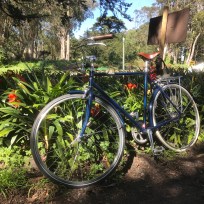
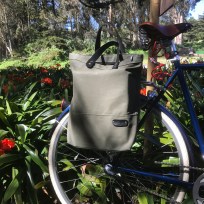
A while back I bought a beautiful navy blue 3-speed commuter bike complete with fenders, a bell, and a rack. Naturally, because I ride many miles per week, I felt compelled to complete the outfit and get a leather saddle-which is actually quite comfortable, and should last for decades. For my 30th birthday my parents bought me a pannier bag made of waxed military-grade British canvas, leather, and brass rivets. Hopefully it’ll last as well.
Speaking of things that will last, I am reminded of my hymnal collection-some of my most treasured possessions.
I’ve got old Free Methodist, Lutheran, and Episcopalian hymnbooks dating back to the early 20th century, each containing songs from long before then. And each one was part of the order of worship for unique communities centered in Jesus, each serving a special role at a particular time in history. They remind me of the large communion of saints I’m part of worldwide, both in heaven and on earth. They also evoke a sense of the eternal aspect of hymnody, for we know not whether we’ll sing Be Still My Soul when heaven fully meets earth.
I guess you could say those hymnals are vintage.
Now, the turn: just like the material things that serve me, I want my spiritual life to consist of lasting, core ideas. Like my leather bike saddle, tested by time, I want to rest in vintage teachings that have stood the test of time and sustained other folks who have, over the centuries, taken Jesus seriously. I also want to continue to be challenged by the teachings of Scripture, to ultimately receive comfort and challenge according to God’s timing.
From my earliest growing up years, there are vintage concepts that stick with me that will forever shape how I approach God. These ideas won’t ever wear out:
Love your enemies; pray for those who seek to do harm against you.
God works all things together for the good of those who love him and who are called according to his purpose.
…continue to work out your salvation with fear and trembling, for it is God who works in you to will and to act in order to fulfill his good purpose.
By grace you have been saved through faith-and this is not from yourselves, it is the gift of God-not by works, so that no one can boast.
For God so loved the world that he gave his only son so that whoever believes in him will not perish but have eternal life.
The Lord is my shepherd-I shall not be in want.
For you created my inmost being; you knit me together in my mother’s womb. I praise you because I am fearfully and wonderfully made; your works are wonderful, I know that full well.
Look-I am making all things new!
[When praying ] The Lord be with you [and also with you!]
[When beginning a prayer] Strong God, through your Son and in the power of the Spirit…
Be still my soul, the Lord is on your side!
Be thou my vision O Lord of my heart.
I could go on. So, in a world that fancies all things cutting-edge, I am increasingly of the mindset that a large majority the most important wisdom is already quite available for me, whether in the pages of Scripture or in the narratives of saints who took Jesus at his word long before I was around.
Not to sound like a luddite, but my canvas, leather, and denim seem to be performing sufficiently well; I don’t feel compelled to pursue the next new-wave thing. And yet, I’m not pining for a time when things were supposedly better [the ’50s?] and I don’t at all accept the mythology of Golden Age thinking. But I do want to live into an authentic, tactile, worn-yet-functional kind of faith.
I want my faith to be resilient. God loved us enough to send Jesus in the world to put to death the powers that continue to keep us in bondage, and he’s inviting us into a kingdom where our old and damaging patterns are insufficient. In response, I want a faith that’s as worn in as an old leather boot-and also as supportive when God doesn’t feel as close to me.
And yes, sure, if we take the analogy too far, I admit that I’m a total hypocrite as I preserve certain technologies. I admit that I enjoy my little fruit-branded computer, phone, and tablet. Maybe it’s the world we live in. Maybe I’m compromised.
Yes, I sometimes romanticize this ideal in my head that leans toward the timeless. Instead of typing on a Remington typewriter I’m typing on a keypad and watching its digital results on an LCD screen. But in my soul and in my gut I want, God helping, to embody a clean, genuine, time-worn yet glowing, vintage faith.
Of course the tough part is just that-living into these lofty ideas and living into our baptisms and communal professions of faith. It’s tough to follow through in my daily practices on this rich inheritance that has been given to me from God’s Spirit, through the church mothers and fathers, communicated over many generations to many people groups, that has resonated within me.
Here’s to living out a down-to-earth, connected life of *vintage* faith in the merciful Jesus who loved us before we knew ourselves.
Some reading this blog will know my sitz im leben, my “life setting,” others won’t. For those of you who don’t know me quite as well, I’m a follower of Jesus, a husband to Kaile, and a father to Silas and Maelin, 2 years old and 4 1/2 months old respectively.
Maelin is dreadfully sick at the moment, still recovering from his infants’ case of RSV [look it up]. Silas has a terrible rash on his back and legs, and he’s rather cranky on account of it.
Ok, so that’s the background. Oh, and for fun here’s a picture of them in one of their happier moments:
Because it’s tax season, I recently became aware of the need to get Maelin’s social security card. It’s one of those chores that’s really hard to fit in amidst the busy and tiring stream of life. But on Monday, I had finally found time, and I took my documents to the social security office downtown here in San Francisco. We used to live in the building next to it, but it’s well out of the way now, even though I was headed to my office next.
Arriving at 9:10am, I took my tab at the kiosk: A465. The room was suffuse with the emotions one might expect: anger, boredom, nerves. After all, we were all waiting, all attempting to get the task done that we need done, be it social security payments, food stamp renewal, whatever.
It was close to 11am by the time my number was called. “A465, A465, window number 7,” came the voice over the PA system. I was there in an instant, reporting to the quiet Asian man who was there to serve all of us. “Do you have your insurance card?” “No, but I have a picture of it right here.”
Pause.
When we got Maelin’s birth certificate during another frenetic trip downtown, they put together a package of *everything* we needed. “Just take all this to the social security office,” they said, “and you’ll be all set.” Well, turns out that wasn’t the case. I wasn’t “all set.” Apparently I now needed original copies of the insurance card.
“Look, man,” I said, feeling that inner burn, “it’s right here on my phone. I took time off work to come down here and I’ve been in line for close to two hours, can we make this happen?” And there he was, quietly doing his job. “I’m sorry, sir, we have to have the original copy. If you come back tomorrow right at 9am the line shouldn’t be too long.”
After two hours of waiting, this isn’t what I wanted to hear.
I glared at him, stuffed all my documents back in the folder, and bolted out of there, overwhelmed with frustration at the wasted time. I may as well have been getting work for the week accomplished. Or I could have stayed with my family. Two hours, wasted!
The next day I returned, following the tip about coming at 9 sharp. A356 was my number. I glanced over to window 7, noticing it was the same gentleman. And, 40 minutes later, just like I dreaded, his voice came over the PA system: “A356, A356, window number 7.”
It was the same guy.
OF COURSE IT WAS THE SAME GUY!
For the first half of our conversation I was cordial. I tried to ignore the voice within. We Christians sometimes talk about the Holy Spirit speaking or comforting or challenging us. This time around, the Spirit was challenging me. I knew an apology was in order, yet I resisted for as long as I could.
Finally, toward the end of the conversation, I couldn’t resist any longer.
“Look man, I was rude yesterday. I’m really sorry,” I blurted. “It’s ok, it’s frustrating to wait for that long only to find out you’re missing a document.” Not having expected him to remember me, I shot back: “Yeah, but it was still rude. I’m really sorry.” “It’s ok, don’t worry about it!” he answered, smiling. “Take care!”
Almost every night I read a book about Jesus to our toddler, Silas, and one of the pages features Ephesians 4:32:
Be kind and compassionate to one another, forgiving each other, just as in Christ God forgave you.
The illustration is really cute, two girls wearing clothing from bible times [because the book is about Jesus I guess?]. They are holding candles and smiling at each other.
Every night I read that book, yet in the grit and grind of life, those massive ideas are hard to embody. They are hard to live out. Saying sorry is hard for this proud, rushed, often-overwhelmed dad.
And yet, God is teaching me about the depth of his forgiveness for this [and all my other issues] not only in my family, my work relationships, my church, my memory, but also through a kind Asian social security office worker.
I’m humbled but thankful that God is patient with me, even when I’m not patient with his other children.
So.. I’m a youth pastor. With that comes a particular set of preconceived notions, at least for a lot of people. There is an archetype for who and how youth pastors are and how they act.
Annoying t-shirts.
Frosted tips [ok, in like.. 1999].
Bro-ey guilt-inducing talk: “yo, Jen, you should totally swing youth group tonight. Jesus is gonna be there, so, I mean..”
Ok, so maybe that’s somewhat of a start. Now let’s think for a second about the purpose of ministry that is specific to young people. We need to ask the question, “what is our goal?”
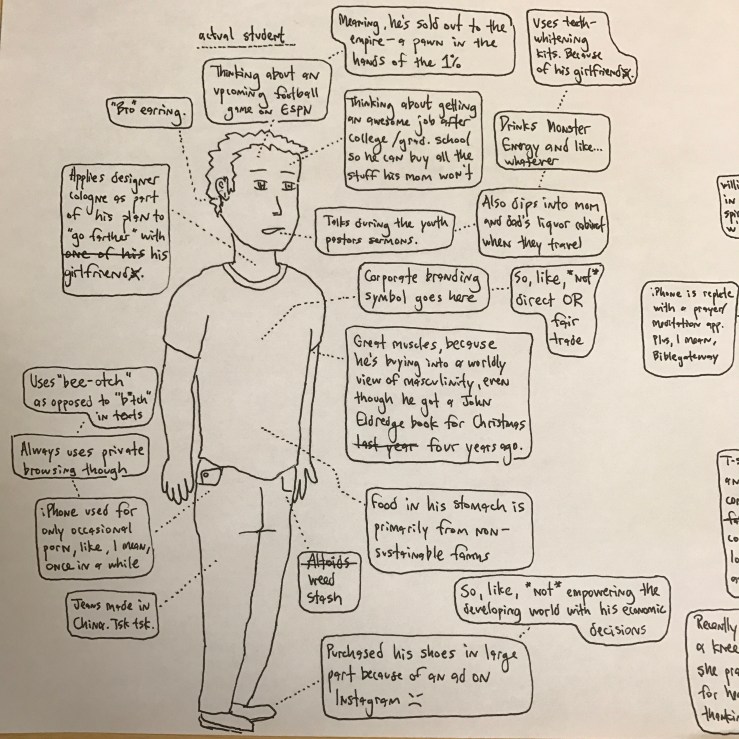
I’ve got some answers to that, but sometimes what happens in my brain is I imagine all the various ways a deep and resonant faith in Jesus can affect someone’s life. So, to allow you in on it, I created a diagram of what sometimes comes to mind as I think about work with students here in San Francisco.
First, the “Model Student.”
Next, the “Actual Student.”
You have now entered my brain. Thanks for coming. If you’re curious where this is going, finish up. If not, have a quick laugh if it tickles you then find something else to read.
Ok, so there are some really impactful ways a genuine and authentic faith in the risen Jesus can change a person. I have written not a few blog posts on how my faith intersects with my life, and Christian practice is a subject that looms large in our culture.
Now, the point: is it really this simple?
These silly comics point to actual truths, but I think what is most ridiculous is the thought that a model person or model student is actually as pure/spiritually wonderful as the comics suggest. In other words…
I’m afraid we’re all a bit more complicated.
Right? I mean, come on. Yes, there are spiritual greats, there are saints. But each of us is internally mixed and our loves aren’t quite 100% pure. Do we all genuinely love our neighbors-and our enemies-as ourselves, like Jesus teaches? Or do we secretly harbor quiet judgment about folks who think [or vote?] differently than we d0?
People of faith fall into this trap.
People without faith do too.
And what’s the difference? I’d advocate that Christian faith does a pretty good amazing job at revealing the honest truth about our true selves. We’re all failing to fully love others-neighbors and enemies-as God loves us. We’re all failing to fully care for creation in all the ways we can [and yes, the Toyota Prius uses fossil fuel. And so do fully electric cars-they have to charge, after all].
The honesty about how we really are at the deepest level reveals that we are all a mixed bag. We do the right thing, we do something that compromises our values. We make progress, we relapse. This is the journey of faith.
But that Christian honesty is backed up with an action plan: repentance, forgiveness, and a lot of grace for when we don’t measure up to the high standard of loving God/others deeply.
God’s grace, shown in Jesus, floods the scene. Jesus models forgiveness to the folks gathered at his execution: “father forgive them; they don’t know what they’re doing [Luke 23:34 MSG].”
Following Jesus is no path for the faint of heart. Yes, Jesus comforts-but he challenges us too. That’s where my little “model student” diagram falls hopelessly short. All the things are important, but I left out the deepest aspects of faith: love for God and love for neighbor/enemy.” After all, you can’t really separate those two concepts anyway.
That is what I yearn for in the model student.
And that is what I, though I so often fail to embody it, strive for as well.
There’s this part of the 1963 I Have a Dream speech where Pastor King rolls into a lilting, homiletical refrain: “I have a dream…” He talks about a dream that “one day” his “four little children will live in a nation where they are not judged by the color of their skin but by the content of their character.” He finishes some of these refrains with biblical precision, tying ideas together by bookending phrases with “I have a dream today.”
Pastor King’s roots in the Baptist church become so apparent as his speaking verges on a kind of improvised singing. It’s not quite singing per se, but it’s certainly not mere speaking either. A few churches still exist that hold the “whooping” tradition as dear, and for that I’m thankful; it stirs the soul to hear the artistic convergence of Pastor King’s incarnational faith and political passion. The I Have a Dream speech is equal parts biblical homily and civic prophecy.
Appropriately, he closes with an old Negro spiritual:
“Free at last, free at last; thank God almighty, I’m free at last!”
As an American, I have been moved by the life, testimony, and legacy of Dr. Martin Luther King, Jr. During a turbulent political season, I am reminded why his contributions are so enduringly significant.
Pastor King’s speech continues a legacy that reaches back into the Bible’s Old Testament and forward into the now and even, I think, into the future of our world as we move deeper into the 21st century. His imagination was shaped by the likes of the prophet Amos, who confronted unjust rulers on their tax codes and court systems, calling for justice in unapologetically poetic fashion.
Another Jewish man, Jesus, who I believe to also be the Son of God, was the absolute height of the biblical prophetic tradition. He spoke truth to power in his Sermon on the Mount, recorded in Matthew chapters 5-7. Instead of merely prohibiting murder, Jesus [God’s Son] explains how God is even interested in our innermost attitudes toward one another. It’s not just about getting along! It’s about honoring one another deeply and from the heart.
This kind of religion gets to our motivations, to our core identity, reaching right into our attitudes toward one another.
In the recent political season, we are reminded that hateful words and actions are as common as the air we breathe. Politicians, pundits, reporters, and casual social media users seem freer than ever to let their opinions fly.
I came across an example of such vitriolic anger when I read a “comic” on Instagram related to the Black Lives Matter movement. It featured comic versions of various events specific to the movement such as brick throwing, cop shooting, and Trump voter assault.
I replied to the man who posted it, asking him to consider taking it down. First, he said a rude version of “no.” When I warned him that I might report him to Instagram, he told me off again, taking me as a religious nut of some kind. It was something along the lines of, “go read your f*****g Bible you [oblique gay reference].” I hadn’t mentioned anything about my faith or religious convictions, but I guess he was right about how this was my motivation.
Racism is alive, friends, along with the ravaging attitudes and predispositions that it carries with it, and it’s much closer to all of us than we sometimes realize. It’s on social media, on the lips of people around us, in quiet corners of the internet, in politics. But most jarringly, it’s often occupying space in the hiddenness of our hearts.
The smallness of my recent brush with racism paves a way for us to consider folks who are truly hurting. Blacks, the working poor, Muslims stuck in airports, religious minorities, marginalized groups of every kind. Surely you have heard the stories, as have I, and I pray we not only hear but also listen.
Back to Pastor King.
Dr. Martin Luther King, Jr. spoke in line with not only the explicitly biblical tradition, but also in line with the trajectory we all follow if we take the time to listen to the voice of God speaking to us within our souls [the Holy Spirit, to use biblical terms]. If we all search ourselves, quiet ourselves, then listen and imagine with our God-given imagination, we all yearn in our own way for a world that is free from hateful speech and violent actions. If we continue to listen, we learn that we are called to, in the words of Jesus, love our neighbor-and even our enemies. And in so doing, we love God, for every person bears God’s image.
I speak from a position of much privilege as I relay these ideas, and I acknowledge this freely. I was born into a ethnic group, nation, and individual family that received an enormous amount of vocational, educational, personal, and economic opportunity in large part because of injustices. Tracing the exact details is difficult, but our privilege comes from African Americans, Native Americans, and even to a far lesser degree from certain groups of European Americans.
As I write, I can almost hear the pushback: “but Ben, all of that is in the past!” “Come on Ben, none of that was your fault!” “Ben, guilt isn’t getting us anywhere!” Well, I get it. Yes, the systems preexisted us. But once we learn about the power of the systems, we are confronted with the choice of either perpetuating their heinous power or taking steps toward freedom. For our privileged selves this may mean leveraging our positions of power and influence and even our circles of friends and family to help one another know about said privilege.
Pastor King’s legacy helps impel even privileged imaginations to see a world free from the racism, bigotry, sexism, and prejudice that pervades every facet of life, from our personal conversations to our civic discourse.
Speaking alongside the law, the prophets, and also along the trajectory of the New Testament’s Christocentric pathway, Pastor King shows us what it means to be free:
Free.
Free to love;
Free to forgive;
Free to extend grace;
Free to heal divisions;
Free to practice generosity;
Free to exist as we were created to be.
And in the words of the old Negro spiritual:
“Free at last, free at last; thank God almighty, I’m free at last!”










 ben videtich