It happened so suddenly.
My spouse, Kae, and I had just enjoyed a meaningful silly, much-need date night. We walked down the street to Taco Borracho where I had an amazing Puerto Rican steak sandwich. Kae enjoyed vegan tacos which, by the way, were surprisingly good, muy sabroso.
On the way there, we talked about how aggressive drivers have seemed to become in the past few years. Perhaps it’s coupled with larger shifts in American and global cultures, maybe pent-up feelings that folks take out on their vehicles. On the ground level, it just seems as if there’s more rage in the air than 8 or 10 years ago.
I joked that not only do we need to be defensive drivers, but defensive walkers as well [this is called foreshadowing].
On the way home, I was feeling even more defensive as the sun had mostly set. As we walked north toward our home, we had to cross the exit ramp from I-196. Vehicles were waiting to turn right on our street, College Avenue, to head south. Bye bye red hand and hello little glowing guy walking. I never trust those signs.
We looked at each individual driver as we gingerly crossed the road, hoping for eye contact. There were three or four vehicles idling, waiting for a break in traffic.
I was almost across when I heard the pickup’s engine roar.
Because I’m a polite Midwesterner, “WHOA WHOA WHOA” were the only words I could form. I felt the Silverado’s headlight on my left palm, and pushed against it while simultaneously jumping forward and out of the truck’s path. I had been clipped, as they say. The driver must have heard me yell, and stopped after only making it a few feet.
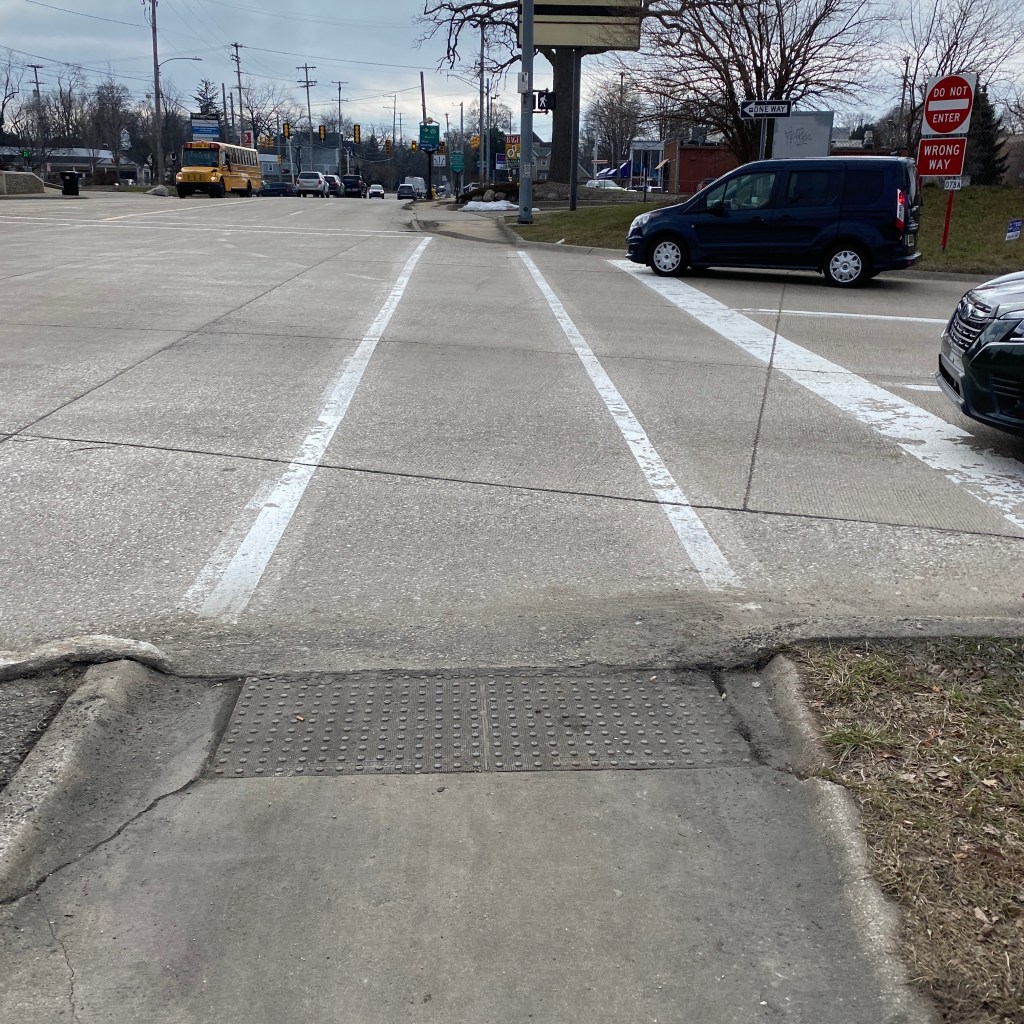
the road where it happened
By that time, everyone in the intersection is staring at us. He was staring at me staring back at him in equally potent though different shades of shock. He avoided manslaughter, I survived another day. Who was more relieved may be an applicable question.
I had the traffic sign, and I was being vigilant. And I still got clipped. Had he punched the gas two seconds earlier, he would have driven directly into me. And wouldn’t that be awkward to have an unexpected passenger!
Perhaps he checked more thoroughly for the next few days minutes.
As my adrenaline slowly receded, I shared [vigorously] with Kae about the injustice of it all. It’s unjust to be constantly on one’s guard when simply walking. And this isn’t my first rodeo. I’ve had other experiences of being ignored, threatened, and injured by vehicles. Drivers in Grand Rapids routinely hit 40, 50, even 60 miles per hour in 25-30 mph zones. Some corridors are worse than others: Fuller north of Fulton, Michigan, Burton, certain stretches of College on the north side.
Kae heard me out. But they shared a perspective: consider the injustice everywhere! At the moment, the deadly October, 2023 Hamas attacks in Gaza have been answered with an even-more-deadly war. Children are without their parents. Families are being destroyed. Lives are being upended.
Outright violence rages in 110 distinct locales around the world, from Syria to Sudan, from Ukraine to Cameroon, according to the Geneva Academy.
There is also violence enacted toward the natural world. Creation seems to groan under the weight of it all. We read it in the news. I can smell it in the air: diesel fumes, factory exhaust, wildfire smoke.
Dr. King said injustice anywhere is a threat to justice everywhere. Indeed, the smoke that affected much of the United States was from Canada, our neighbors to the north. We share one large global ocean. Air is universal. People are interdependent. We pass along justice – or injustice.
There’s an old revival song that goes like this:
***
It only takes a spark to get a fire going, and soon all those around can warm up in its glowing
That’s how it is with God’s Love: once you’ve experienced it
Your spread the love to everyone; you want to pass it on
***
As a practicing Christian, the song rings true. Unfortunately, the passing-on phenomenon happens conversely: once you’ve experienced trauma, it can be hard not to pass it on. Once you’ve experienced violence toward your mind, body, or identity, it can be hard not to pass on violence to others. Love and hate alike are passed on. Only when trauma and pain is processed and metabolized can it be kept from endangering others.
Injustice, too, is passed on. During the 1930s, Hitler’s regime took ample notes on American racism. In particular, the Nazis found Jim Crow laws to be particularly inspiring. Read more on that here or here.
When a gardener plants seeds, they grow. This, the unstoppable way of all creation. As a tree grows in one place, so grows a thorn elsewhere. As a loving exchange transpires in some relationship, so does a traumatic, rageful belittling in another.
The biblical author and apostle, Paul, writes this in his letter to the Galatians:
Remember this: Whoever sows sparingly will also reap sparingly, and whoever sows generously will also reap generously.
Jesus, speaking earlier, said it this way:
…give, and it will be given to you. A good measure, pressed down, shaken together, running over, will be put into your lap, for the measure you give will be the measure you get back.” Luke 6:38
This morning I read in the NYT The Morning, which I have read almost-daily since the pandemic days, about the alignment of global powers: Iran, China, Russia, North Korea, and the various groups these countries support [for example, Iran’s support of Houthis, Hamas, and Hezbollah, or China’s support of Russia]. On the other side, it’s the United States, Japan, South Korea, Western Europe, etc.
When countries sow seeds of destruction, we see how Jesus and Paul’s words continue to ring true, but on a much larger scale. Whether it’s small acts of rage and violence or carelessness, the world is duly affected.
And yet, I’m glad the converse is also true:
Every small act of generosity, compassion, and kindness matters. All conversations and words shared in a day matter. Every prayer uttered to God matters. How I treat my fellow humans, how I treat the natural world, it matters. Every little action matters.

I tried to talk to a bongo at the zoo.
It didn’t work but it was worth the time. We seemed to bond.
Whether it’s pausing to notice a pedestrian, thanking your mail carrier or Amazon driver, or sending a little encouraging text, every little action matters. Awareness of this adds complexity and depth to all interactions. Instead of coasting along, carried by the winds of culture and advertising and wherever life has taken us, we can intentionally take control of the small decisions, the little acts that bring about great things.
We can slow down if we choose to drive. We can pause and count to five before we respond in our conversation or hit send on our device. We can slowly learn to see all people, plants, business decisions, and conversational exchanges as sacred.
Because what if, after all, they are sacred?
As I look back, there was something sacred about the interaction on College Avenue when that driver clipped me. For me, I had a new sense of gratefulness for my own life, my family, my friends, my congregation. For him, I’m less sure. Maybe he was just happy not to have flattened me. But maybe, just maybe, it was a moment to slow down and consider that I, just like him, am a fellow human being with needs, aspirations, kids, etc.
It all matters.

 ben videtich