one afternoon i was picking up my kids from school when i heard seething words from a pink-faced man who – evidently – wasn’t a fan of cyclists.
he angrily scolded me from his truck sitting in traffic: i bent one little rule and he wasn’t havin’ it.
in that moment i paused. whatever my pink-faced future friend believed about me, we are still part of my same human family.
whatever one’s identity, we’re all under the same umbrella, each crowed with God-given dignity. perhaps we live [or vote] differently, pink-faced man and i, but if i try could i find common ground with this guy?
i ask: why?
there’s a big election in a couple of months: it’s kamala harris or donald trump. we hinge our hopes on our favorite one. big data algorithms confirm what we chose two decades ago; there’s no questioning what we [think] we know.
Growing up in Christian circles, I often heard the phrase, “it’s not a religion, it’s a relationship.”
Empty religion was problematic. At our church, we wanted to embody a vibrant, meaningful faith that impacted Monday through Saturday. For us, the spiritual journey involved all of life. It wasn’t merely a Sunday experience.
The emphasis on relationship was perhaps helpful in some ways. As a Christian, I am in relationship to God through Jesus and the Spirit, and thereby also bonded to fellow human beings who are also children of God [even if sometimes we don’t yet know it!].
If someone were to refer to me then as a religious person, something inside me would react. I had an allergy to being an adherent to a religious tradition or a religious person.
These days I claim the title, whatever that comes with, and I don’t mind.
During my college years I attended a lecture. The simple idea that reminded with me was to always celebrate all that is good.
Why do my tiger lilies smell so unfathomably delicious? How is it that a hug from my spouse lifts my spirits – even if nothing [the financial decision, the difficult news, etc] is objectively fixed or solved? Why does a staring contest with my child always make me laugh? How can a simple ride on my bike feel transformational, like a winding journey with God? How can roasted fingerling potatoes from Bar Sótano literally change the course of an evening with Kae in Chicago? Why does it feel like I’m more deeply connected with God when I have a meaningful interaction with a friend or neighbor?
I’m happy not to have answers to these questions. But I’m delighted to live in these moments and slurp up every drop of joy they offer.
In one sense love and everyday beauty are counterpoints to pain, loss, and suffering. Wise older people have told me to count my blessings, and they’re absolutely right. It makes a difference.
And yet, I want to go further and suggest that love [and perhaps the celebration of all that is good] is not only resistance to the normal suffering and difficulty of human life; beyond that, love is participation in the life of God.
1 John 4:7-21 is love’s canonical zenith. No other passage offers as rich an explication of the meaning of intertwining divine and human love, except maybe 1 Corinthians 13. But 1 John 4 links love to God and other human beings like no other text anywhere, in the biblical canon or beyond.
Verses 11-12 read as following in the NRSV:
Beloved, since God loved us so much, also ought to love one another. No one has ever seen God; if we love one another, God lives in us, and his love is perfected in us.
So you’ve never seen God? Me either. But have you seen another person? That person bears the image of God. Express love to them links you to God. Practicing good religion, for Christians, means simply loving all people. Jesus tells us to love even our enemies [but that’s a long story worth another blog post!]. Don’t believe in God at all? Perhaps you’re doing the same thing when you care for a stranger. God loves you, even if religion has been used maliciously against you.
According to John, when we love one another, God lives in us. Imagine that – God alive in you. Not only that, but God’s love is perfected in us.
This is our participation in the very life of God.
Snap back to reality, as somewhere in the void a voice says, “hey there Ben, you don’t know what I’ve been through. I don’t think God would ever let [x] happen to me. Maybe God is love but it sure doesn’t feel like it.”
Just like I can’t answer why love is such a profound experience, like being united with God, I can’t say why such difficulty exists. With many throughout history, I lament* the reality of pain, loss, suffering. Theologians talk about suffering it a lot, with some helpful answers, but from most measures, it’s the most difficult theological problem for Christians. Nihilists conclude that nothing matters anyway, but Christians insist somehow God is good despite the suffering allowed.
Hope triumphs in the long view: God has a beautiful future for all people in the New Creation where all will be restored.
Until then, the best path forward is leaning into love: loving my neighbor; choosing to care; celebrating goodness and beauty.
I lost a mentor a few years ago to cancer. It was far too early. There was suffering. Fred died within a few short years of the diagnosis, despite some excellent medical interventions. I don’t think he reached 70 years old. But the whole time, he insisted God had given him “bonus time” to finish some projects he hoped to complete before his death: full-ride college scholarships for his many grandchildren, an endowment for church planting, care and support for his spouse, lots of final conversations with people he loved.
Fred and all those around him lamented the suffering which led to his death. Even still, he himself found beauty amidst the pain. He chose love.
In death, he continues to offer life to me and to many.
A few days ago my daughter fell and sliced her lip deeply on a bench. She lost a lot of blood before making it to the emergency room, all thanks to my mother-in-law, Stacy, and brother-in-law, Luke. Why did she fall? It was no one’s fault. It just happened, like accidents do. I lament the pain she experienced.
And yet, I rejoice to see healing taking place, and I thank God for the surgical team at Helen DeVos Children’s Hospital. What choice is there anyway?
Yesterday, like every Tuesday, I cared for Junia all day [working only 4 days a week has its perks!]. In the morning she wanted to listen to music and dance, so I turned on the Bluetooth speaker and we found some tunes on YouTube. “Pick me up! Twirl me!” she insisted. How does a father say no to a three year old’s request to dance?
I picked her up, and we twirled to the beat. At first I held her arms and she swung wide. But she wanted to be closer, so I held her tight and twirled. She stared up at me with her lovely blue eyes, then curled in tighter as we spun.
She closed her eyes and leaned on my chest, safe and loved.
Tears of joy spilled as I realized the utter sacredness of that moment with Junia. I won’t likely forget that moment; it will always be a part of who I am as a father. I cannot un-live the joy of the experience, the twirling, the weight of Junia’s head on my ribcage.
I, as an imperfect parent, love Junia a whole lot. Bucketsfull. To the moon and back, as I tell her.
After all this I’m now left with more unanswered questions:
How much more does my perfect, infinite creator God love me?
How can I then share that love – the love of God dwelling within?
What can God’s love perfected in us mean?
Perhaps each moment, each conversation, each dance with kids, each card that I write, each offense I forgive, will help me understand.
***
*The Hebrew Scriptures feature a Psalter full of laments. Sometimes they feature individual lament, other times it’s the lament of a whole community. Lament – even rage – is only ever totally safe in God’s ears.
I am writing about love and beauty in this post, but I want to be clear that there are hosts of reasons to feel and express anger toward God. There is no safer place to lament pain and suffering than with God, through Jesus, in the power of the Spirit,
Hilariously, as a kid I’d mistake the word “seminary” for “cemetery.” Naturally, later in life, there was the mental connection that ensued: were these two terms more similar than different?
Theological studies may not sound exciting, just like chemistry or math or art history may sound boring. This all depends on the hearer. I have a relative who is fairly wealthy on account of his recording studio. His studio does jingles and background pads for the likes of Apple, McDonalds, and Kelloggs. This may sound boring to some. But it may sound exciting to others. It’s all in the hearing.
Whether or not theological studies has its share of excitement is beside the point. What I want to get at is this: can theology professors profess both academic biblical knowledge and spiritual vivacity?
My answer is an unequivocal yes.
Though I cannot speak for every seminary out there, I can speak from my own observations during my six years at Grand Rapids Theological Seminary.
One professor I had was very heavy-handed about his beliefs. He respected the people with whom he did not see eye-to-eye, but he had a very strong opinion on all things theological. Another professor had a lot of baggage from his ultra-conservative background, and at times it showed.
Each professor had their share of difficulties. But even the professor with the strong opinions and the professor with the ultra-conservative background clung tightly to the message of Jesus. They really do seek to love their neighbor, and their enemy too. They really do seek to bring every action into alignment with their heartfelt beliefs.
The modeling I saw during my seminary years was probably more important than the content of the teaching. I saw women and men teaching who genuinely and passionately pursued the holiness of God made clear in Jesus.
I recall often the phrase my spiritual formation professor would use. She said, “spiritual practice is getting up to see the sun rise; it’s happening whether or not we take the time to see it.”
Indeed this is the case. When it comes to knowing God, there is a seeking involved. My professors understood Matthew 7:7-8:
“Ask and it will be given to you; seek and you will find; knock and the door will be opened to you. For everyone who asks receives; he who seeks finds; and to him who knocks, the door will be opened.”
That’s Jesus speaking.
There is a whisper of Paul’s example found in I Corinthians 11:1:
“Follow my example, as I follow the example of Christ.”
Something powerful, something resonant, exudes from those living the kind of life that is worth being imitated. I thank God for the women and men who, in the beginning of the 21st century, have sought to follow Jesus.
Especially, today, I thank God for my seminary professors.
We live in a culture that exalts power. We may dream of influential positions in global corporations or long for a bigger voice in our local community. We Americans, of all people, delight in the possibilities that exist in the individual.
At the beginning of the 20th century, rags-to-riches novels impressed on the culture a sense of dramatic optimism. Suddenly it seemed as if anyone with the will power could rise through the ranks in commerce or industry and command armies of workers.
As history tells, this is not the case for everyone. Opportunity exists to gain power and influence, but acquiring it is difficult.
Within all this, God sees weakness differently. He sees it as strength.
If one reads any of the New Testament accounts of the death of Jesus, it is apparent that he was not exalted by his own power. Instead, God the Father gave him strength through the Spirit. John 16:5-16 describes the closeness of the three. Verse 15 reads: “All that belongs to the Father is mine. That is why I said the Spirit will take from what is mine and make it known to you.”
After three days, God glorifies Jesus, raising him from the dead. The first book after the four Gospel accounts is Acts, and at the very beginning of this book Jesus is witnessed ascending into heaven.
Weakness is strength.
Just like Jesus, we are strong when we are weak. When we lean into the grace of God, we find ourselves giving him glory.
Paul, one of the most committed early followers of Jesus, explains how this works in a letter, 2 Corinthians 12. God explains to Paul that, “My grace is sufficient for you, for my power is made perfect in weakness.”
When Paul attempted to do things in his own strength, it did not bring God honor. It probably didn’t bring Paul that much honor either. Instead, glorifying himself likely just made other people irritated. The same principle goes for all of us.
God is interested in doing incredible things [just look at the miracles of Jesus and of the Old Testament that preceded him!]. God also wants people to know him.
Let’s put this into contemporary context. It’s meaningful when people serve other people. Right? It’s so cool to see businesses and churches and individuals serving the common good. Now here’s where the weakness/strength paradigm is vital. For the person or church or business who does something meaningful, that can inflate the ego. Very easily can doing good cause us to think we’re ok.
But when we do good through weakness, there is only one option for others to believe: God is at work.
The natural world understands this concept. Annie Dillard talks about this in Pilgrim at Tinker Creek. The fecundity of nature, she says, is indomitable. A farmer somewhere thought squash were especially powerful, and he used a scale to test how much pressure these seemingly insignificant and feeble vegetables could exert. They pushed the scales to the thousands of pounds as they slowly grew, cell by cell, fueled by the growth of God. Weakness is strength.
In the human world, when someone is unexpectedly kind, it’s striking. When someone really seems to have the right to be vengeful and maintains tranquility, it’s noticeable. When a family loses one of their own to violence then responds with forgiveness, it speaks. It spoke in October 2006 in the wake of the Lancaster County shootings. A man brutally killed 10 young girls in a one room Amish school. The response from the Amish, even amidst their mourning, was forgiveness. Leaning into the strength of God, they never said it was ok or justifiable, but they forgave. Ironically, the man who killed the girls couldn’t forgive someone for having killed his own daughter.
God’s world is different. In God’s world, weakness is strength.
My wife, Kaile [pronounced Kay-lah for those of you who do not know her], is in week 30 of our first pregnancy. Related to this, there are lots of new concepts and concerns that nothing but writing seems to remedy.
As you read this, you are likely judging me. It is ok! I expect that. I am not naïve enough to think all of these are going to work out just like I hope they will work out. But I do pray for these things. I do desire some iteration of each of these to be made real in my life.
Here they are:
5. Fun Times with Baby
Come on. Who doesn’t love babies? I look forward to having a little person to laugh with [eventually] or even at [more likely]. While our newborn baby thinks to him/herself “my caretakers are supremely ridiculous,” I will be having a great time making faces and cooing as our little one does the baby version of rolling one’s eyes, knowing how utterly silly we both are.
Hopefully all of us will be better off for it.
4. Stronger Connections with other Parents
As recent as this month, people have still mistaken me for a college, or even high school student. At 27, this has gotten old. Maybe it’s the hair. I should begin to comb it sometime. Point sustained. The reality is, I am married. We own a house and a couple cars. We travel. We chose, together, not to have a dog [aha! maybe that’s why it’s hard to imagine me as an adult?].
I look forward to having that connection with others who are currently raising or have already raised children. To experience a significant change in the life journey is to enter into the process of sense-making with others. We will soon be able to compare the narrative of family life with others who are doing the same thing. Eventually, Kaile and I will be able to say, “yeah, that’s great insight on how you disciplined your child,” even if that technique didn’t work for ours. We’ll be able to say to others, “yeah, little [insert name] did okay with potty-training, but junior high was pretty rough.” You get the gist; we will be able to relate in new ways with billions of people.
Oh-it will also be nice to get a little bit more respect about my age.
3. A New Process for Spiritual Formation
For 25 of these 27 years, I have done spiritual formation as a single person. My journey as one of Jesus’s millions of disciples had been done in a certain single kind of way. That changed once when I got married, and will soon change yet again. Soon, I will need to recognize new ways of understanding the journey. This will likely consist of whispering prayers over our child as she/he sleeps. It will involve learning how to apologize to a 7-year-old. It will involve answering questions not as an absolute authority, but as someone who has experienced the hope of God.
It will also surely involve attempting to spiritualize diaper changes.
2. Stronger Bonds in My Marriage
Kaile and I know a new child will bring stress into our marriage. This, I think, is entirely unavoidable. However [go ahead-judge me!], there is also an opportunity to grow. Even writing the previous sentence fills me with wonder. How will Kaile and I learn to depend on one another? How will the challenge of rearing a child bring us toward a greater sense of purpose? How will we come to understand, in a new way, how God blesses the poor in spirit [Matthew 5:3]?
I imagine sitting next to Kaile on a park bench or, heaven forbid, airplane, trying to hush our screaming child. How can we weather that experience and learn to trust one another and receive one another’s input?
For the record, I do not know the answers to these questions. But I think they’re worth asking.
1. A Deeper Knowledge of God’s Love
I still remember a pastor in Chicago sharing a story about his three-day-old son. He reflected on how little the infant had done: “…my son hasn’t done anything! But that’s not why I love him! I love him because he exists!” He went on to make a joke about his son’s breastfeeding tendencies and how that was affecting his [cough cough] intimacy, a joke that he immediately regretted. Needless to say, it was a stressful week for him.
The point about his son stuck with me, though. God does not love us because we enter into the world and cause all kinds of transformation. Most of us are not bubbling fountains of kindness, and we wouldn’t hold a candle to the saints of old. But God didn’t love Mother Teresa or John Wesley or the new pope because of their good deeds. He created us out of love, and he keeps loving us because… well… he just does. He’s God.
I don’t know how my parenting abilities will play out when the rubber meets the road. But I do know that I’m committed. If our child grows up and becomes a promiscuous drug addict, I have to hope that God teaches Kaile and me more about his love, his unconditional, “it’s because I’m God” kind of love. Because we exist, he loves us. He’s God, and he just does that.
To hold a child-our own child-could drive this point home.

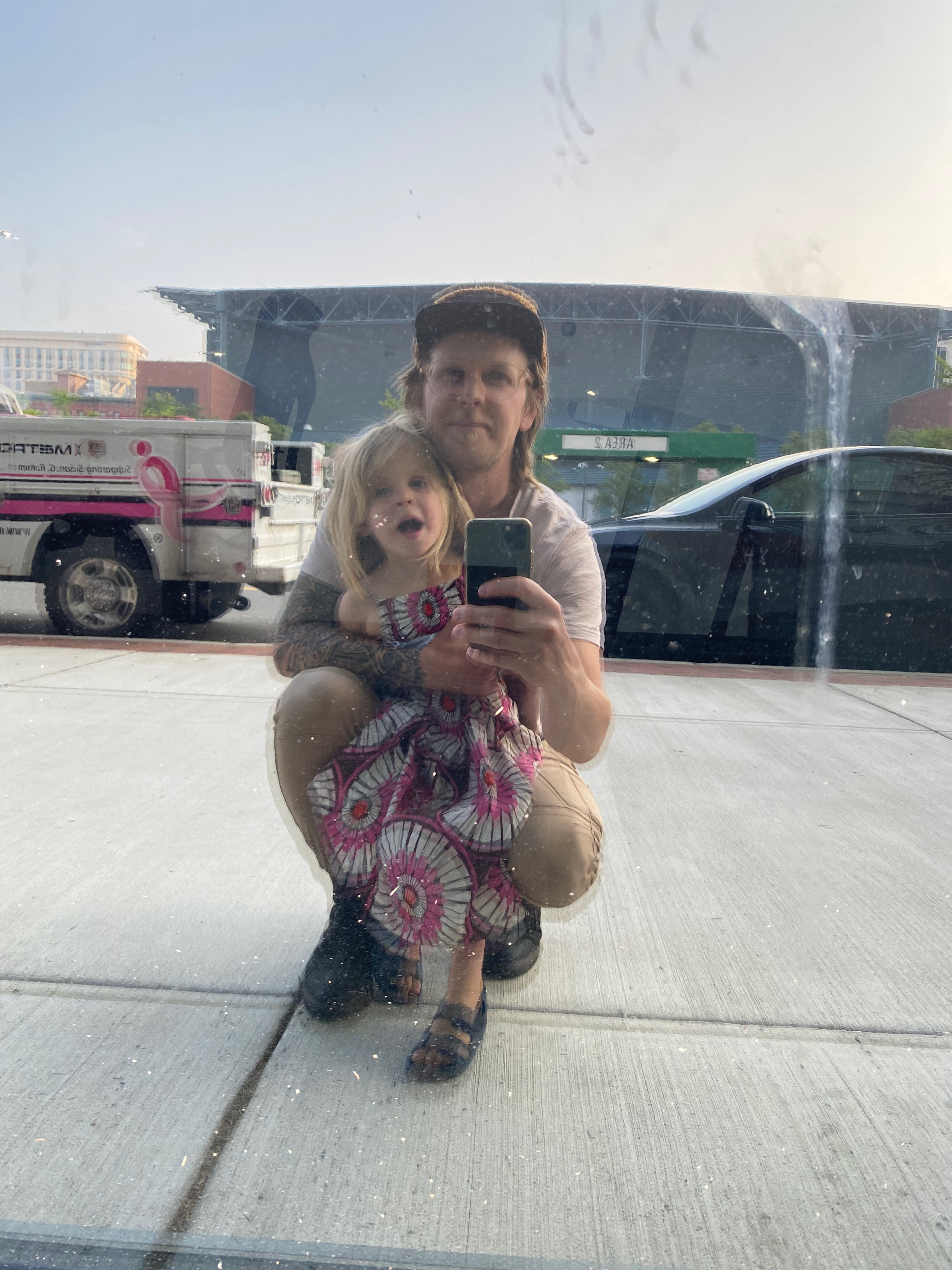


 ben videtich