city anxiety

The other day I took my two older children, Silas and Maelin, up to Bills Lake in Newaygo to celebrate my nephew’s 1st birthday. On the way, I felt a pinch of anxiety. My extended family are exclusively Republican, and my brother’s in-laws, who own the cabin on Bills Lake, are also rather right-leaning.

Passing a number of what I’ll call “political embellishments” throughout the countryside didn’t help curb the gut feeling.

Upon arrival, I realized I was likely the sole left-leaning guest.

Thankfully, having grown up in a red county, I know how to code switch. We talked about hunting, fishing, food, all the fitting topics of the idyllic setting. It was a lovely time.

At one point, I was talking to one of Phil’s brothers-in-law, and he talked about how he had moved from the city of Grand Rapids out to a quiet three-acre country lot. He missed some things about city life, but seemed to enjoy the bucolic setting where his family now resides. I too grew up on 3 acres.

During the conversation he voiced his experience of returning to the city for events: “when I go into the city, I start to feel anxious because of so and so [can’t remember everything he listed]”

I was immediately grateful to hear this honest sentiment, and responded quickly: “well, as the token Democrat here, I have the same thing in reverse when I come to the countryside!”

We both laughed.
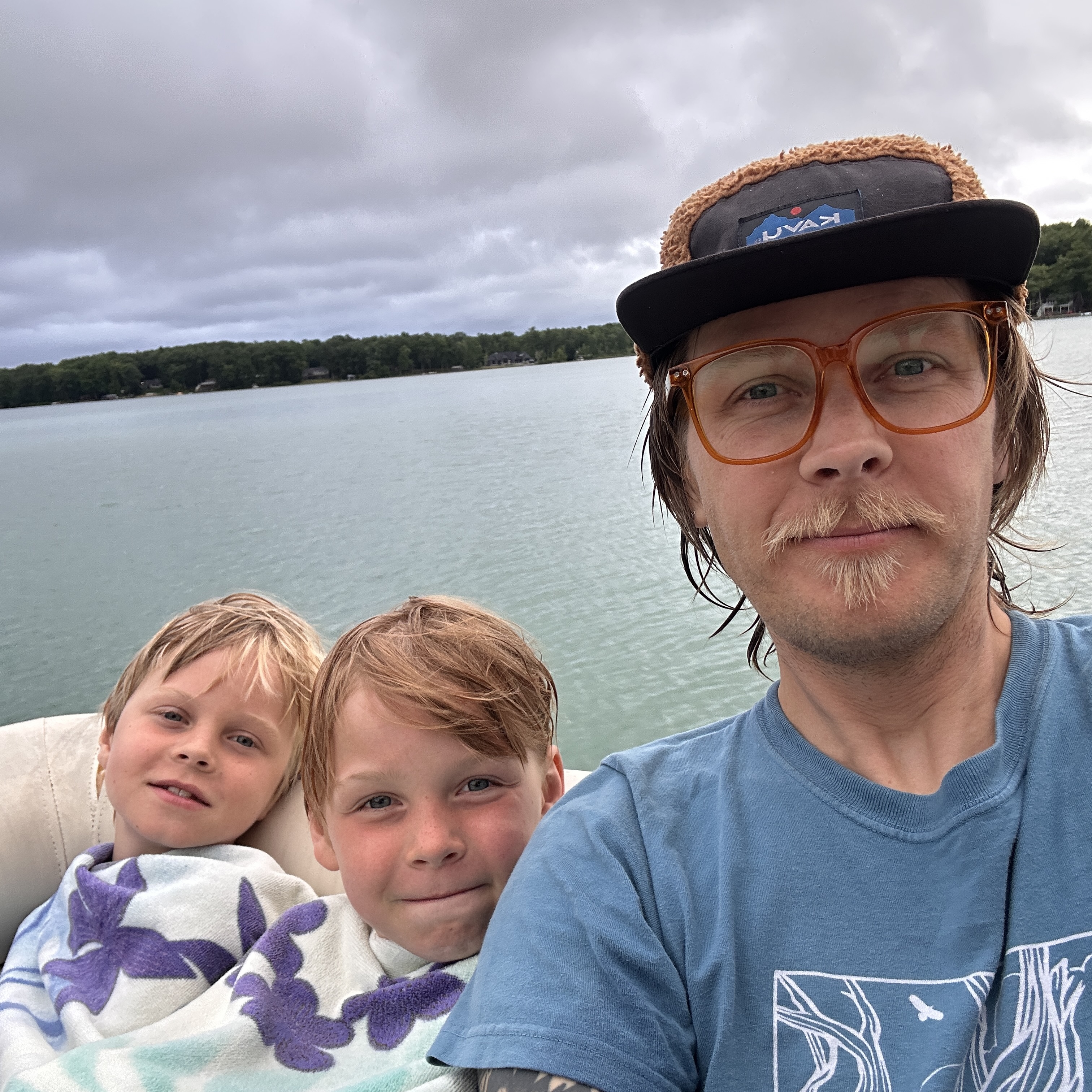
Bills Lake with Silas and Maelin ^

Life in America right now is truly polarizing. ICE raids, detention facilities [concentration camps?], tariffs, international conflicts, domestic policy, it’s putting all of us in a state of alert. And it’s exhausting to the point where we can literally feel anxiety going to the places where we’re the minority.

Here’s the good news: we are not enemies.

Ideologically, we may be coming from different vantage points, but that’s nothing new. Every era of American history – and world history for that matter – contains disagreement. Here in the US, we enjoy the freedom of living according to what we believe, and others to live according to what they believe.

Sometimes I long for more freedom, because it can feel as if my freedom is being impinged upon by others. For example, drivers making their way through my neighborhood happen to have 18 feet of lane, wider than two semi-tractors wide, in each lane. Yes, 36 feet of road. So they speed. How fast? I’ve seen 70+mph, though thankfully not often.

Driving is one of the spheres in which freedom is tricky. We all seem to think we’re great drivers, and it’s the other guy who is going to make the mistake. Is this fully true though? Probably not quite. I include myself in the hypocrisy, even if I don’t drive much anymore [I hit nearly 100mph on the freeway on the way to Bills Lake, for example].

I don’t have any masterful solutions to the large issues endemic to the United States, but I do have some moral and spiritual insights that I find helpful when navigating the polarization of the current era, mostly from my religious tradition. Here’s a working list:

1. We are all in this together, and we are ultimately accountable to God.

Whether we’re talking about a smaller Christian community such as Paul wrote to in the first century or whether we’re talking about a whole country, we all need one another.

Paul wanted the young churches he planted to flourish and to help their communities flourish, so he wrote this: Why do you pass judgment on your brother or sister? For we will all stand before the judgment seat of God. …So then, each of us will be accountable to God.

Apart from Christian tradition, most folks would say something along the lines of “whatever floats your boat” or “you do you.” Why get anxious about what someone else thinks or believes if it doesn’t affect you?

2. Every person matters. Really, every person.

Jewish and Christian traditions emphasize that every human is created in God’s image and likeness. Islam contains a similar teaching, even if it’s less of a personal likeness. To say we’re all reflecting God in some way, even despite our brokenness, is no small statement. Whether someone is wearing a MAGA hat or a pride pin, they are made in God’s image and likeness – kind of a big deal.

3. Disagreement can produce incredible results.

Some of the best ideas come when people disagree on the best path forward. Just today I had a conversation with a coworker about building use policy. She was looking from one angle and I from the exact opposite. Together we [somehow] came together with some promising ideas about how to protect and steward the building on the one hand and share generously to our community on the other.

This isn’t to say disagreement always produces net positive results. There are spheres in which some of us may remain at an impasse, and that is the reality of human life. There are times in human relationships, it seems, when it’s wise to “turn up the volume” on commonalities, to use the analogy of a radio.

If you have other wisdom to pass on, please do so in the comments section.

Peace be with you, dear friends.
why? a spoken word poem for a polarized world


one afternoon i was picking up my kids from school when i heard seething words from a pink-faced man who – evidently – wasn’t a fan of cyclists.

he angrily scolded me from his truck sitting in traffic: i bent one little rule and he wasn’t havin’ it.

in that moment i paused. whatever my pink-faced future friend believed about me, we are still part of my same human family.

whatever one’s identity, we’re all under the same umbrella, each crowed with God-given dignity. perhaps we live [or vote] differently, pink-faced man and i, but if i try could i find common ground with this guy?

i ask: why?

there’s a big election in a couple of months: it’s kamala harris or donald trump. we hinge our hopes on our favorite one. big data algorithms confirm what we chose two decades ago; there’s no questioning what we [think] we know.

Continue reading “why? a spoken word poem for a polarized world”

Getting Around Grand Rapids: 5 tips for Safe Bike Commuting in a Midwest City

[Note: I usually devote my blog posts to spirituality in the Christian tradition, and there is deep spirituality within cycling; but today I’m focusing on a few simple aspects of biking in my area. The content will apply, to some degree, to many cities in North America that are slowly building out infrastructure for cycling].


Like most American cities, Grand Rapids has developed since at least the mid-20th century with cars at the center of the transportation grid. Over the past several decades, however, there have been meaningful efforts at integrating cyclists into the flow of city transit.

For an inside look at how the Grand Rapids community is embracing bike culture, check out Greater Grand Rapids Cycling Coalition. For an inside look at my personal experience over my decade of cycling experience in this city, read on!

There are a host of ways to enjoy a safer, healthier, cheaper lifestyle in West Michigan, and for residents of Grand Rapids, bike commuting is somewhere near the very top of the list. Our city is, in many ways, rather bike-able. This of course depends on where one lives. These maps are profoundly helpful in getting an overview.

On to the juicy part : the 5 tips!

1. Enjoy the Journey [and Smile!]

Biking is pure joy. Is it the rush of air, the smell of fresh-fallen leaves on a Fall ride, or the energy of the city that gives the most pleasure? The answer depends on who’s riding! I love the social dimension of cycling, the fun of exchanging a smile or conversation with fellow cyclists and pedestrians – and drivers too. It’s a little more difficult with drivers because of the separation that doors and windows cause, but most of the time my interactions with drivers are positive.

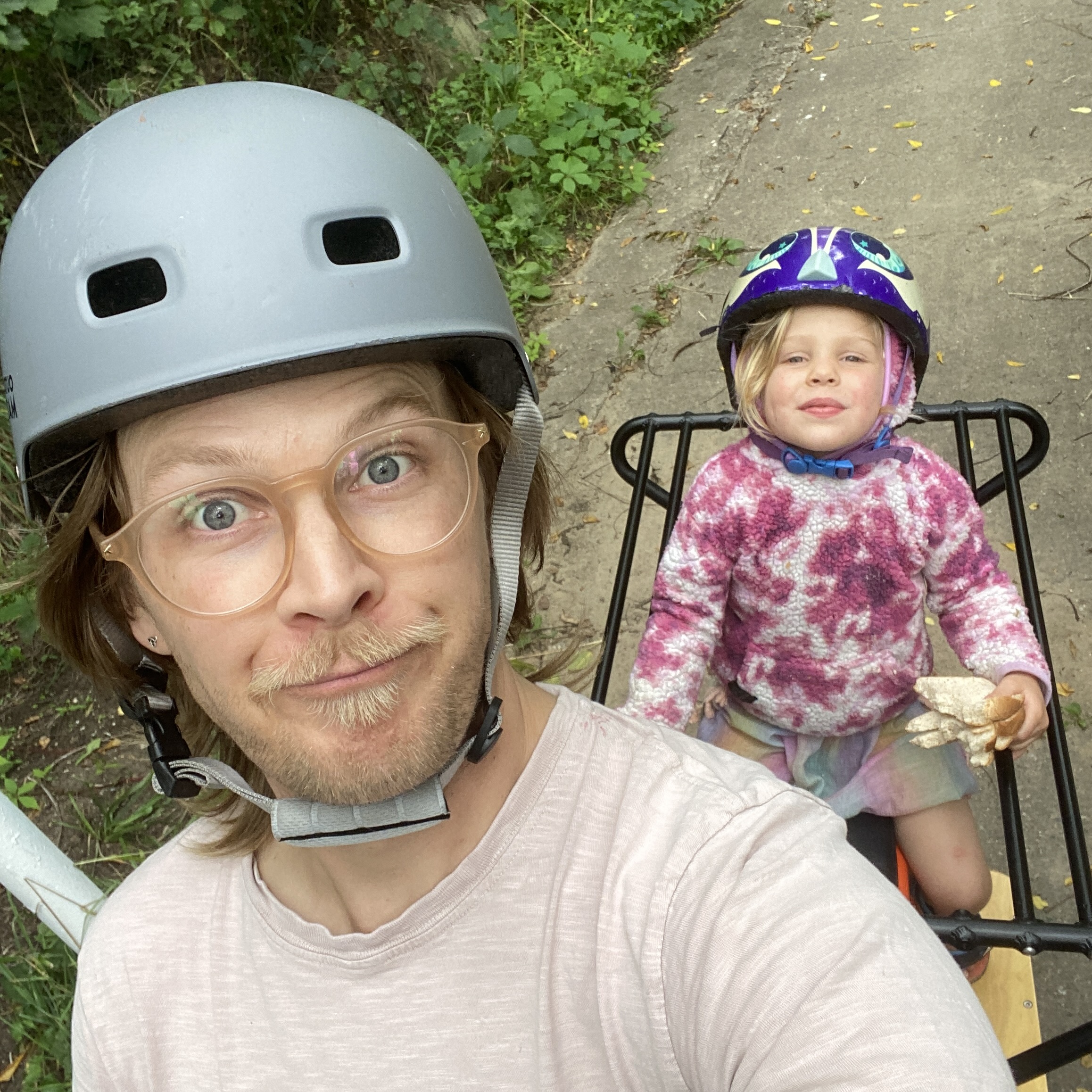
Goofy picture with our youngest kid, Junia

At intersections, especially 4-way stops, there is a routine opportunity to kindly wave a driver on, smile gently, and inject common humanity into the daily commute. According to research, bike commuting is extremely good for our mental, vocational, and financial health too. Just saying.

If American culture has the chance of evolving to genuinely embrace [or even accept] cycling as mainstream, the best advertisement is you and me. Our job is to have fun [getting in shape is the bonus!]. When drivers see us in the open air and sense how much joy is to be found on two wheels, who knows – some might want to join in on the fun.

Continue reading “Getting Around Grand Rapids: 5 tips for Safe Bike Commuting in a Midwest City”

Almost Hit by a Truck [Plus Some Thoughts on Justice and How the Little Things Matter]

It happened so suddenly.

My spouse, Kae, and I had just enjoyed a meaningful silly, much-need date night. We walked down the street to Taco Borracho where I had an amazing Puerto Rican steak sandwich. Kae enjoyed vegan tacos which, by the way, were surprisingly good, muy sabroso.

On the way there, we talked about how aggressive drivers have seemed to become in the past few years. Perhaps it’s coupled with larger shifts in American and global cultures, maybe pent-up feelings that folks take out on their vehicles. On the ground level, it just seems as if there’s more rage in the air than 8 or 10 years ago.

I joked that not only do we need to be defensive drivers, but defensive walkers as well [this is called foreshadowing].

On the way home, I was feeling even more defensive as the sun had mostly set. As we walked north toward our home, we had to cross the exit ramp from I-196. Vehicles were waiting to turn right on our street, College Avenue, to head south. Bye bye red hand and hello little glowing guy walking. I never trust those signs.

We looked at each individual driver as we gingerly crossed the road, hoping for eye contact. There were three or four vehicles idling, waiting for a break in traffic.

I was almost across when I heard the pickup’s engine roar.

Because I’m a polite Midwesterner, “WHOA WHOA WHOA” were the only words I could form. I felt the Silverado’s headlight on my left palm, and pushed against it while simultaneously jumping forward and out of the truck’s path. I had been clipped, as they say. The driver must have heard me yell, and stopped after only making it a few feet.

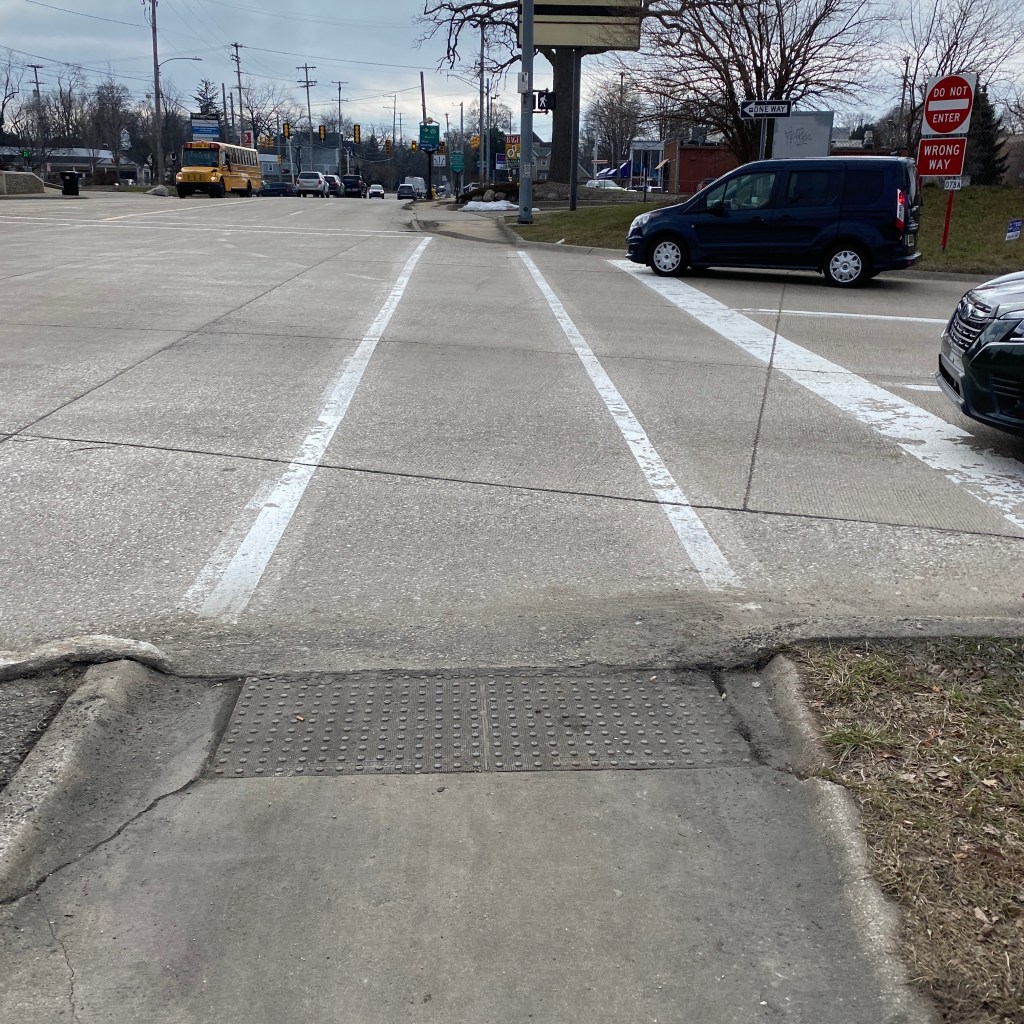
the road where it happened

By that time, everyone in the intersection is staring at us. He was staring at me staring back at him in equally potent though different shades of shock. He avoided manslaughter, I survived another day. Who was more relieved may be an applicable question.

I had the traffic sign, and I was being vigilant. And I still got clipped. Had he punched the gas two seconds earlier, he would have driven directly into me. And wouldn’t that be awkward to have an unexpected passenger!

Perhaps he checked more thoroughly for the next few days minutes.

As my adrenaline slowly receded, I shared [vigorously] with Kae about the injustice of it all. It’s unjust to be constantly on one’s guard when simply walking. And this isn’t my first rodeo. I’ve had other experiences of being ignored, threatened, and injured by vehicles. Drivers in Grand Rapids routinely hit 40, 50, even 60 miles per hour in 25-30 mph zones. Some corridors are worse than others: Fuller north of Fulton, Michigan, Burton, certain stretches of College on the north side.

Kae heard me out. But they shared a perspective: consider the injustice everywhere! At the moment, the deadly October, 2023 Hamas attacks in Gaza have been answered with an even-more-deadly war. Children are without their parents. Families are being destroyed. Lives are being upended.

Outright violence rages in 110 distinct locales around the world, from Syria to Sudan, from Ukraine to Cameroon, according to the Geneva Academy.

There is also violence enacted toward the natural world. Creation seems to groan under the weight of it all. We read it in the news. I can smell it in the air: diesel fumes, factory exhaust, wildfire smoke.

Dr. King said injustice anywhere is a threat to justice everywhere. Indeed, the smoke that affected much of the United States was from Canada, our neighbors to the north. We share one large global ocean. Air is universal. People are interdependent. We pass along justice – or injustice.

There’s an old revival song that goes like this:

***

It only takes a spark to get a fire going, and soon all those around can warm up in its glowing

That’s how it is with God’s Love: once you’ve experienced it

Your spread the love to everyone; you want to pass it on

***

As a practicing Christian, the song rings true. Unfortunately, the passing-on phenomenon happens conversely: once you’ve experienced trauma, it can be hard not to pass it on. Once you’ve experienced violence toward your mind, body, or identity, it can be hard not to pass on violence to others. Love and hate alike are passed on. Only when trauma and pain is processed and metabolized can it be kept from endangering others.

Injustice, too, is passed on. During the 1930s, Hitler’s regime took ample notes on American racism. In particular, the Nazis found Jim Crow laws to be particularly inspiring. Read more on that here or here.

When a gardener plants seeds, they grow. This, the unstoppable way of all creation. As a tree grows in one place, so grows a thorn elsewhere. As a loving exchange transpires in some relationship, so does a traumatic, rageful belittling in another.

The biblical author and apostle, Paul, writes this in his letter to the Galatians:

Remember this: Whoever sows sparingly will also reap sparingly, and whoever sows generously will also reap generously.

Jesus, speaking earlier, said it this way:

…give, and it will be given to you. A good measure, pressed down, shaken together, running over, will be put into your lap, for the measure you give will be the measure you get back.” Luke 6:38

This morning I read in the NYT The Morning, which I have read almost-daily since the pandemic days, about the alignment of global powers: Iran, China, Russia, North Korea, and the various groups these countries support [for example, Iran’s support of Houthis, Hamas, and Hezbollah, or China’s support of Russia]. On the other side, it’s the United States, Japan, South Korea, Western Europe, etc.

When countries sow seeds of destruction, we see how Jesus and Paul’s words continue to ring true, but on a much larger scale. Whether it’s small acts of rage and violence or carelessness, the world is duly affected.

And yet, I’m glad the converse is also true:

Every small act of generosity, compassion, and kindness matters. All conversations and words shared in a day matter. Every prayer uttered to God matters. How I treat my fellow humans, how I treat the natural world, it matters. Every little action matters.

I tried to talk to a bongo at the zoo.

It didn’t work but it was worth the time. We seemed to bond.

Whether it’s pausing to notice a pedestrian, thanking your mail carrier or Amazon driver, or sending a little encouraging text, every little action matters. Awareness of this adds complexity and depth to all interactions. Instead of coasting along, carried by the winds of culture and advertising and wherever life has taken us, we can intentionally take control of the small decisions, the little acts that bring about great things.

We can slow down if we choose to drive. We can pause and count to five before we respond in our conversation or hit send on our device. We can slowly learn to see all people, plants, business decisions, and conversational exchanges as sacred.

Because what if, after all, they are sacred?

As I look back, there was something sacred about the interaction on College Avenue when that driver clipped me. For me, I had a new sense of gratefulness for my own life, my family, my friends, my congregation. For him, I’m less sure. Maybe he was just happy not to have flattened me. But maybe, just maybe, it was a moment to slow down and consider that I, just like him, am a fellow human being with needs, aspirations, kids, etc.

It all matters.

Love: Participation in the Life of God

During my college years I attended a lecture. The simple idea that reminded with me was to always celebrate all that is good.

Why do my tiger lilies smell so unfathomably delicious? How is it that a hug from my spouse lifts my spirits – even if nothing [the financial decision, the difficult news, etc] is objectively fixed or solved? Why does a staring contest with my child always make me laugh? How can a simple ride on my bike feel transformational, like a winding journey with God? How can roasted fingerling potatoes from Bar Sótano literally change the course of an evening with Kae in Chicago? Why does it feel like I’m more deeply connected with God when I have a meaningful interaction with a friend or neighbor?

I’m happy not to have answers to these questions. But I’m delighted to live in these moments and slurp up every drop of joy they offer.

In one sense love and everyday beauty are counterpoints to pain, loss, and suffering. Wise older people have told me to count my blessings, and they’re absolutely right. It makes a difference.

And yet, I want to go further and suggest that love [and perhaps the celebration of all that is good] is not only resistance to the normal suffering and difficulty of human life; beyond that, love is participation in the life of God.

1 John 4:7-21 is love’s canonical zenith. No other passage offers as rich an explication of the meaning of intertwining divine and human love, except maybe 1 Corinthians 13. But 1 John 4 links love to God and other human beings like no other text anywhere, in the biblical canon or beyond.

Verses 11-12 read as following in the NRSV:

Beloved, since God loved us so much, also ought to love one another. No one has ever seen God; if we love one another, God lives in us, and his love is perfected in us.

So you’ve never seen God? Me either. But have you seen another person? That person bears the image of God. Express love to them links you to God. Practicing good religion, for Christians, means simply loving all people. Jesus tells us to love even our enemies [but that’s a long story worth another blog post!]. Don’t believe in God at all? Perhaps you’re doing the same thing when you care for a stranger. God loves you, even if religion has been used maliciously against you.

According to John, when we love one another, God lives in us. Imagine that – God alive in you. Not only that, but God’s love is perfected in us.

This is our participation in the very life of God.

Snap back to reality, as somewhere in the void a voice says, “hey there Ben, you don’t know what I’ve been through. I don’t think God would ever let [x] happen to me. Maybe God is love but it sure doesn’t feel like it.”

Just like I can’t answer why love is such a profound experience, like being united with God, I can’t say why such difficulty exists. With many throughout history, I lament* the reality of pain, loss, suffering. Theologians talk about suffering it a lot, with some helpful answers, but from most measures, it’s the most difficult theological problem for Christians. Nihilists conclude that nothing matters anyway, but Christians insist somehow God is good despite the suffering allowed.

Hope triumphs in the long view: God has a beautiful future for all people in the New Creation where all will be restored.

Until then, the best path forward is leaning into love: loving my neighbor; choosing to care; celebrating goodness and beauty.

I lost a mentor a few years ago to cancer. It was far too early. There was suffering. Fred died within a few short years of the diagnosis, despite some excellent medical interventions. I don’t think he reached 70 years old. But the whole time, he insisted God had given him “bonus time” to finish some projects he hoped to complete before his death: full-ride college scholarships for his many grandchildren, an endowment for church planting, care and support for his spouse, lots of final conversations with people he loved.

Fred and all those around him lamented the suffering which led to his death. Even still, he himself found beauty amidst the pain. He chose love.

In death, he continues to offer life to me and to many.

A few days ago my daughter fell and sliced her lip deeply on a bench. She lost a lot of blood before making it to the emergency room, all thanks to my mother-in-law, Stacy, and brother-in-law, Luke. Why did she fall? It was no one’s fault. It just happened, like accidents do. I lament the pain she experienced.

And yet, I rejoice to see healing taking place, and I thank God for the surgical team at Helen DeVos Children’s Hospital. What choice is there anyway?

Yesterday, like every Tuesday, I cared for Junia all day [working only 4 days a week has its perks!]. In the morning she wanted to listen to music and dance, so I turned on the Bluetooth speaker and we found some tunes on YouTube. “Pick me up! Twirl me!” she insisted. How does a father say no to a three year old’s request to dance?

I picked her up, and we twirled to the beat. At first I held her arms and she swung wide. But she wanted to be closer, so I held her tight and twirled. She stared up at me with her lovely blue eyes, then curled in tighter as we spun.

She closed her eyes and leaned on my chest, safe and loved.

Tears of joy spilled as I realized the utter sacredness of that moment with Junia. I won’t likely forget that moment; it will always be a part of who I am as a father. I cannot un-live the joy of the experience, the twirling, the weight of Junia’s head on my ribcage.

I, as an imperfect parent, love Junia a whole lot. Bucketsfull. To the moon and back, as I tell her.

After all this I’m now left with more unanswered questions:

How much more does my perfect, infinite creator God love me?

How can I then share that love – the love of God dwelling within?

What can God’s love perfected in us mean?

Perhaps each moment, each conversation, each dance with kids, each card that I write, each offense I forgive, will help me understand.

***

*The Hebrew Scriptures feature a Psalter full of laments. Sometimes they feature individual lament, other times it’s the lament of a whole community. Lament – even rage – is only ever totally safe in God’s ears.

I am writing about love and beauty in this post, but I want to be clear that there are hosts of reasons to feel and express anger toward God. There is no safer place to lament pain and suffering than with God, through Jesus, in the power of the Spirit,

To End All Wars

A few nights ago I had a profound dream. Today I’m haunted by its message.

Terror coursed through my veins as the dream sequence began. Hostile enemies had invaded my city, and I was busy gathering friends and family into a group to defend – or depart – depending on the outcome of the initial conflict.

I shouted from the Abrams tank I was driving: get out of your house! bring only what you need! we are under attack! People came out of their homes with whatever they could carry. Someone was passing out grenades, rifles, submachine guns, armored vests. Though I hate to admit it, there was a rush of adrenaline. Whatever was to come for us, terrifying as it might be, was also somehow exciting. After all, we had guns and tanks.

Eventually that sequence of events led us to direct, face-to-face conflict with our enemies. They looked different than us – perhaps they were Arab? – I couldn’t tell. I also noticed their faces held the same terror written on ours.

I shot my rifle into their midst, over and over, hoping desperately to get them to stop.

But the fighting ground on and on. Grenades flew in, exploding around us. I remember trying to lob one back at the enemy. The saying goes, war is hell.

This was hell indeed.

Continue reading “To End All Wars”

restraining my judgments: pandemic version

A few days ago I found myself at a new park, Calabazas, a city park in Cupertino just south of Apple’s famed headquarters.

I had been up since just after 6am with our two rowdy preschool boys. Having already coached them through a short hike at a nature preserve, this was my second stop of the day. My face held the emotional and physical exhaustion from the full day with the littles; my forehead was a knot.

As we explored the park, a small remote controlled vehicle approached, followed by a man. From behind his mask, he appeared to be within a few years of my age. Soon, another man appeared, manning the controls of another dust-spewing vehicle.

Naturally, the boys were fascinated. What 3 or 5 year old kid wouldn’t be?

I had to make sure the boys didn’t get hit; the vehicles were fairly large. As I coached the boys on avoiding them, I also had to explain that they needed to stay in a certain area – an island made up of a large tree and its roots. There was some struggle for them to listen, but for the most part we seemed to be getting along ok, the boys happily watching the small trucks as they sped around, tumbling over rocks, hopping over berms.

There was some mumbling, a sense of discontent that I began to pick up from the two men. As another joined, I could hear a few of the complaints. They were unsure whether to speak directly to me or confront my kids, but internally I realized they felt some claim over this place and that we had unknowingly impinged on a remote controlled ritual.

“Buddy, come on, that’s the only jump in the neighborhood!” one of the drivers said brusquely through his face mask, barely looking my direction. This was the first comment that clearly marked out their position.

“I understand” was my terse response.

Walking down to where the boys were, I let them know it might be a good idea to find a new place to play. It was dusty, loud, and I was feeling the awkwardness of getting in the way of their fun, their afternoon activity – driving little remote controlled cars.

87FA0CDF-9038-451F-8AF3-7A31F92B252D_1_201_a

As I walked out with Silas and Maelin, part of me was still perturbed at the man’s comment. The one jump in the neighborhood? Really? Glancing around, I noticed countless places to drive the little vehicles – and we were there first! For heaven’s sake, it’s virus season and I have three kids to raise, a marriage to maintain, and a full time job.

You’re a grown man driving a remote controlled car, and you can’t let a tired dad soak in the afternoon with his kids without verbally staving him away from your precious racetrack? 

Amidst those thoughts, I tried to imagine their situation. What are their lives like? And what is their experience amidst the pandemic?

Maybe, even though this clearly isn’t the only jump in the neighborhood, it’s the best one. 

Maybe rc cars is the primary – or only way – these guys connect as friends. 

Maybe they have no idea what it’s like to raise kids. 

Maybe they’re fighting depression, anxiety. 

Maybe they’re single.

Maybe.  

I could be totally off. Maybe they’re just jerks. But whatever made that guy want to come take over my spot at the park, they had a high value for driving their little cars.

COVID-19 related challenges also fit squarely into this interaction at Calabazas Park. If those gentlemen do indeed lead single lives, the pressures [and joys] of parenting are simply unknown to them. If my experience is, in fact, entirely outside theirs, no wonder there is confusion.

My faith tells me I’m supposed to bear with other people’s burdens. It’s right there in Galatians chapter six, go look it up. In this case, I found myself the one who needed to assess the needs of the car guys and parent accordingly.

One chapter earlier in Galatians, Paul speaks to how we can sum up God’s call on us with one simple concept: loving others as we love ourselves. Jesus takes it a step further and calls us to love even our enemies. 

Enemy love was the tipping point for me, but my spiritual guides leave me with no excuse, so I yield [even if I’m a bit resistant as I do!].

Drive on, remote controlled car guys.

***


living within my limitations

Friends on Instagram people keep sharing these 2009-2019 posts, typically featuring a picture of them then [bad] and a current pic [good]. The text reads variably, but usually people identify some significant life changes, some highs and maybe some lows.

Here’s a simplified version of what mine could read:

2009-2019: Change and stability. I started seminary and parish ministry with youth; I continued a degree program to pursue an M. Div; I traveled a lot; I met an amazing woman and we got married; we bought a house; Silas joined our family; we moved to San Francisco; I was ordained; Kaile started grad school; Maelin joined our family; I lost a job; I got a new job; we moved to the Silicon Valley; Kaile got a job and finished grad school; we prepped for baby number three. Phew! It has been a full decade!

As I reflect more seriously on what the last ten years have contained, I realize my responsibilities have increased significantly. Soon I will be bound not only to my wife and our two boys, but also to a N E W B O R N!

The more I’ve lived as a married person – and now with children – the more I’ve recognized the limitations I have. Let me break down my experience of being a dad in terms of what feels like a day of accomplishments. Continue reading “living within my limitations”

the love of friends / my new guitar

In my last post I shared about how my beloved guitar was sadly stolen from our Volvo on Thanksgiving Day in a smash-and-grab theft.

Today, I want to share about how I’ve experienced the cycle of hope that I alluded to in that post.

Not long after I shared on my blog and in social media about the smash-and-grab, a great friend, Mark Aubin, took it upon himself to act. He quickly set up a GoFundMe drive to allow folks to help me replace the guitar and cover the $290 that the window cost to repair.

Within only a few days, we covered the $1000 goal. Then, Continue reading “the love of friends / my new guitar”

science / God

Something not many people know about me is that I went to a STEM-focused high school. It was called the Math Science and Technology center, and to get in you had to write an essay. Mine wasn’t very good, and my confidence in my math skills was already waning as my pre-high school progressed.

At some point I received a letter – I was on the waitlist! 

This wasn’t awesome news, since my older brother John had already been in the program for a couple years, and he was flourishing in all subjects STEM-related and otherwise. But it wasn’t terrible either, because there was still a chance that I could join my immediate family’s new academic tradition.

Finally, a week before school started, I came home from soccer two-a-days to another letter:  Continue reading “science / God”