5 Things I’ve Learned About Communication at Age 26

1. Narrative Never Gets Old

Stories move us. They hold our attention. If you don’t believe me, ask yourself why you were up until 4am watching Breaking Bad the other week. Undoubtedly, narratives are the intersection of logic and wonder. We desperately want George to find his better self when we watch It’s a Wonderful Life, and we hold out until the end when he finally “lives again.” Ask yourself what drew you in to the books your mom read to you at age 3, and you will likely find that it’s the same things that draws you to finish a quality book even though you haven’t eaten in 8 hours: we humans long to know about each other, about good and evil, about hope, about love.

800px-It's_A_Wonderful_Life

2. Going Off-Script is Okay [At least according to MLK]

My work in communication comes from a particular field: Christian ministry. More specifically, preaching is what I’ve studied the most over the years. A rather noteworthy preacher-turned-activist, Martin Luther King Jr., employed this well in his most famous speech, “I Have a Dream.” If you click here you can read a version that shows the places he went off-script. Interestingly, the final summary–the part where he goes off-script–is the most memorable part! No one remembers, “This is no time to engage in the luxury of cooling off or to take the tranquilizing drug of gradualism” from the written script. But they probably do remember, “I have a dream that one day this nation will rise up and live out the true meaning of its creed: We hold these truths to be self-evident: that all men are created equal.” This line was off-script. If one listens to a recording of the speech, it’s easy to hear where King’s voice had begun to border on a deep-south whoop, faltering between singing and speaking. As he plowed toward the final line, each concept built on or enriched the idea before. That’s preaching. But it’s also how communication works. As a follower of Jesus, I believe God’s Spirit leads pastors, at times, to go off-script. If you’re not a person of faith, maybe you could rely on that gut feeling in you that tells you there’s a little more to be said.

3. Lose the “Ums” [and Embrace Silence]

In 2007, I took a speech class. I could make a case for doing alright in the class in terms of grades, but my speeches were awful. During one of them, I completely lost my spot in my notes. Red-faced, I desperately searched for where I’d left off after a couple awkward errs and umms. Not okay. What I have learned since is that some people are cut out for manuscript-based speaking, but most of us are doing content-based speaking. If you’re in theatre, you’re doing manuscript-based speaking. You’re saying, word-for-word, what Shakespeare wrote. That’s your role. But if you’re in business, chances are that you have a different objective. You need to tell everyone about what expanding operations in East Asia means for the quarterly earnings report [or some other equally interesting topic]. Most of us are not trying to say, word-for-word, our manuscript. Most of us are trying to relate, to interested [or disinterested] listeners, concepts. So, find a way to memorize the main ideas, then passionately convey them. You may very well find that in the process your umms and errs have conveniently disappeared.

4. Embarrass Yourself

Please don’t actually do this. What I mean by embarrass yourself is something rather different. In fact, I only wrote the title like that to get you to read this. What I want to emphasize here is that communicators must establish themselves as human, as flawed, as real. The other year I went with my fellow church-staffers to a free conference on childhood development at a nearby university. The keynote speaker came across like he knew everything. With each line, he praised his own accomplishments more and more. He was polished, he was smooth; he didn’t emit as single umm. But his final point was muddied because he was, again, the hero of his own story. I say this not to tell you that you can’t tell of your own experiences or things you’ve learned. I say this because no matter who you’re communicating to, transparency is a draw. Consider the puffed-up politician who spews forth vitriol against his opponent. Do we want to sound like that? No. I think not.

5. Craft Key Phrases with Intentionality

Forget what I said about concepts in #3. Not really. Remember it, but take it with a grain of salt. In communication, we need to articulate ideas, concepts, facts, trends. Steve Jobs needed to explain the iPod when it was first released. He could have said, “it’s a digital device enabling individuals to procure, electronically, significant amounts of media–up to a gigabyte–from the internet for personal enjoyment.” That would have done the trick I suppose. But no. He got up in front of journalists and industry reps and quipped, “It’s a thousand songs in your pocket.” That was a phrase headed for the headlines. Succinct, image-driven. One more example. John F. Kennedy delivered a sparkling inaugural address in 1961. The world may never forget his line on civic responsibility: “And so, my fellow Americans, ask not what your country can do for you, ask what you can do for your country.” Elegant. Trim. Balanced. It was headed for the headlines. Even though most speeches or sermons or boardroom presentations probably don’t require a manuscript, certain points really need to punch through afternoon corporate doldrums. Preachers, break through Sunday morning lethargy with memorable phrases that get to the heart of your main idea.

An Open Letter to Grace Episcopal Church

IMG_0574

It was a sunny April afternoon four years ago that I received an email from Steve Argue with “youth ministry opportunity” in the subject line. At that point I was finishing my senior year at Spring Arbor University, and I had the written goal of serving in a historic urban or suburban church that was effectively rooted in its community. God was faithful in granting the desire in my heart; as I read the email I could not restrain my excitement, even though I had little assurance that anything real would come from this succinct email. However, events were lining up. Already I had been considering seminary here in Grand Rapids, and now I was presented with what was, at the time, at least a strong possibility. After an interview with Father Holmgren and Tina at Rose’s on Reeds Lake, it seemed even more possible. There was a genuine need for someone with experience working with young people, and I deeply desired to offer my gifts to a community seeking to follow the way of Jesus. Plus, I was interviewing alongside a good friend.

Before I knew it, I was headed to HoneyRock Camp in northern Wisconsin in a big van, seated next to Father Holmgren, wondering what the adventure would be like. Needless to say, that first trip was enjoyable. Exploring God’s creation on a kayak alongside fellow journeyers is a recipe for joy. Indeed, this trip was relational treasure. But the journey at Grace has been beyond my capacity to describe.

As one reflects on a four-year season in life, there is an abundance of material from which to pull. Though it’s tough to know where to begin, there are some unarguably hilarious moments – like every single one of Matt Olgren’s announcements – but powerful moments too. I remember my first Harvest Dinner Basket Auction in 2009. Dale Grogan won the [expensive!] bid on Steve Sweetland’s Michigan beer basket – and gave it to John and me. What a warm welcome to the community – it communicated, at once, both trust and generosity. I also remember leading trips to Mel Trotter with our students. We sorted clothing, serving in their massive warehouse. Sheila, one of the workers there, told her story of transformation. Through the power of God manifest in the support of her companions at Mel Trotter, she had forsaken a life of prostitution and brokenness. I remember when Jack Lennon taught us all a new word in Discipleship Formation: “retrograde.” It describes planetary movement, but also related directly to our lesson from the Gospel of Luke. I just can’t remember how right now. This spectrum of hilarious to heart-wrenching is emblematic of the dynamic that I have witnessed at Grace over these years.

My work at Grace has been most closely tied, of course, to ministry with a younger demographic. Gatherings with students have taken various forms: Sunday evening worship and teaching, morning formation, Saturday projects, Thursday evening hangouts at Schulers. Throughout, students have offered their insight, patience, honesty, presence, and trust. It is not easy, much of the time, to know exactly how to communicate the reality of God into the lives of young people. But they have listened, questioned, considered, and embodied so much of the Gospel of Jesus. I remember the time in the stairwell when Colin Grogan told me he was convinced God existed and that he had assurance God was working within his life. I remember sitting at a coffee shop, listening to Emily Batdorf consider the confluence of faith and science and pondering how God has arranged our universe. I know in my heart and from their testimony that many of our students are journeying faithfully with God. I remember quiet conversations, outlandish controversies, and plenty of squirminess during our two-week series on sexuality in early 2012. It has been a quite a time.

Working with the staff at Grace has also been life changing. Tina’s honesty and consistency has helped me grow. Her challenges have worked alongside encouraging feedback. Thanks to her, I understand what a calendar is. Just kidding. Seriously though, she is a blessing to me and to all of us. Father Holmgren has been supportive and gracious at every turn. He has carefully coached me in leadership, communication, pastoral care, and thoroughly enriched my comprehension of church history. Through his example, my insight has been expanded, and my spirituality has been deeply formed. And it is the kind of formation that will remain with me, even though I am sensing that God is gently drawing me out of the Episcopal tradition. God has worked greatly through this pioneer in faith, and I will be forever changed – and forever grateful. John Hamersma and Mary Baas have been such faithful servants, also. I remember making my way to the back of our crowded nave in April of 2013 for the oratorio they coordinated with Grace’s choir and Calvin’s Alumni choir. As we welcomed in brothers and sisters from the Reformed tradition, it reinforced how God had been present in our uniquely Anglican hymnody. Tears ran down my face as I attempted to join in singing “I am the Bread of Life” and “Lift High the Cross.” These songs, through the power of the Holy Spirit and the stewardship of faithful musicians, have soaked into my soul over these four years. I am indelibly changed.

During my time at Grace, our community has been warmly blessed as we have welcomed many new families and individuals. Many of these have been younger families and students. I had the privilege of serving God alongside Kyle Bos for an extended season that came to a necessary end when he left for seminary in 2012. I remember the Easter Vigil – Kyle does too. He was sick for a week after he stayed up all night. But we served, we sang, and we grew spiritually in the relational greenhouse of our church community. Kyle pioneered hospitality afternoons that have continued in his absence. God has been present as we have come together in homes after Sunday worship. Indeed, we have a blessed spiritual family.

Indeed, there is a host of memories. It is not possible to contain them in a letter, however long. And, as always, the Grace community is left the important question of what is to come in the future. According to Revelation 21 and 22, the Scripture I had the privilege of expounding on May 5th, we have an even more exciting hope ahead. What we have to anticipate – eternity with God in a transformed world – this hope shapes our participation in the present. We must continue to foster an attentiveness to how God is leading us to love others and show compassion. We must continue offering hope to the poor and broken. We must continue to advocate for freedom from addiction, confronting the powers that be. My prayers are with each of you as the seasons come and go. And because of the hope that lies ahead, may we continue to love and serve both God and people with faithfulness and singleness of heart, through Christ our Lord. Amen.

Jesus Receives our Hospitality?

Woodcut by Rick Beerhorst

Living near Easttown in SouthEast Grand Rapids, it is nearly impossible to navigate the sidewalks without occasionally seeing Rick Beerhorst, the bespectacled artist who created the image above. It is an image that immediately evokes a sense of togetherness. Truly, the open table is a place where love abounds; both love to the familiar and love to the stranger can be manifest over food and drink. A dear friend gifted this print to my current home. It hangs on a wall still, and it prompted a reflection.

Recently, my fiance and I won the bid on a home that is for sale as a short sale. This is a simple word for a complicated concept, but suffice it to say it is likely that we will be able to move on the deal after 2-4 months. Then, after we are married and move in, we will have a place to establish a place of hospitality in a new and just-married fashion. As we approach the day, there are countless concerns and worries alongside the abounding joys and triumphs. Last night we talked about financial concerns and vocational questions. We also talked about the support and affirmation we consistently receive. Above the din, a clear concern for offering hospitality rises again and again to the surface in our conversations.

All of that aside, we, as Christians, are reminded once again presently of the most subversive event of history: the Resurrection. Indeed, Lent 2013 is over and we now rejoice in the Easter reality, the triumph of Jesus over sin and death. Interestingly, however, it just so happens that in Matthew’s Gospel, right before the narrative about the plot to kill Jesus in chapter 26, Jesus tells a story about the future. It’s the familiar story in chapter 25:31-46 about the sheep and the goats. At the end of our current age, Jesus will return, making all things right and all things good. Amidst the joy, however, there is also accountability.

Put simply, sheep did the right thing. The goats didn’t. And the consequences are significant to say the least. Here is the twofold element of what is so shocking in this story: the sheep were surprised that they were being commended while the goats were equally surprised that they had missed the mark.

The sheep had so integrated habits of hospitality and compassion that they were shocked to realize their actions were “unto me” [me being Jesus]. The goats had so insufficiently established similar habits that they were equally shocked. I can just imagine a contemporary parallel for the goats’ response: “Jesus, remember the time I cut a check to the church in 2006? I’ve even done that a couple times since!” The sheep, the ones who had been faithful stewards, are commended. They probably didn’t even remember the moments Jesus brought to light – times they faithfully gave of themselves and their resources, their time and their talent, their all. But they were rewarded greatly for this.

Hospitality matters to Jesus. Matthew records this story right before the account of Jesus’s suffering on the road to the cross. It is unfortunate that the word “hospitality” often brings to mind a lazy afternoon in Alabama on a wrap-around front porch complete with straw chairs and sweet tea. This is certainly a fine example. But it does not stop there. Hospitality can take on a very rough edge. It can demand much of us. The “least of these” often do not smell or sound particularly nice. And that’s just the beginning.

What is important to note amidst the triumph of Easter is the radical nature of discipleship in the footsteps of Jesus. We rejoice as we serve others because we are freed from being only concerned with ourselves. Jesus himself – God – was concerned for the needs of the created world. As we follow in his footsteps, we too should live lives centered not on what we gain from others, but in how we give to others – and ultimately, to Jesus himself, who somehow, according to Matthew 25, actually receives hospitality from those he created. In this we rejoice greatly.


Teaching with Imagination: Part 2

Since we can think of teaching as functioning in just two categories [I recognize this is impossible, but stick with me] let’s briefly redefine those.

Feel free to visit the post below this one if you are interested in the beginning of this two-part series.

Moving quickly ahead, the first category is deposit-making. A teacher can perceive her job to consist of depositing factual information into the minds of students. One can picture this teaching style like serving ice cream: each cup needs it, and in approximately equal amounts.

The second category is problem-posing. In essence this consists of raising awareness of problems. At first glance it may appear to lack guidance, but this is exactly the point. To establish a problem implicitly invites a solution. It invites imagination and enjoins the student’s faculties to action. According to Speech Act Theory, communication precipitates action. Let me illustrate.

Recently I listened to a man who had planted a church and pastored it faithfully for a number of years. It had grown significantly both fiscally and numerically. Many would say it grew spiritually as well. As the pastor continued, he revealed his motivation for such dedicated work. He had been cut from the basketball team in 7th grade. He tried out again the next year and failed again. After a long and difficult conversation with a coach, he was instructed not to pursue basketball: “son, it’s just not for you.”

He refused to quit. Fueled by these words and assisted by a growth spurt, he practiced unceasingly between junior high and high school. Having made the team his freshman year, he started all through high school as a center. Later he received a robust scholarship for college basketball, and he flourished in the sport.

He intimately described the motivation for his success both in basketball and then in pastoring: “I didn’t want to be told ‘you can’t do that.'” That was it. And he went on to prove them wrong. Though it eventually led to some critical errors in leadership, it was fuel sufficient for a season.

What does this mean? It means that words are extremely powerful. To instill imagination in people is to plant seeds of hope. As a Christian, the words of Jesus have sparked hope and life in me. Teachers, pastors, and leaders of every kind have the ability to invite imagination at every turn. And it is in the way we teach that we can either spark incredible change or cause irreparable damage.

Teaching is more than revealing factual information. For the Christian, it is about capturing the imagination for the sake of sustained participation in the Kingdom of God. For Christians and secular thinkers alike, though for differently ultimate purposes, teaching is about capturing the imagination for the transformation of the world.

In the illustration about the pastor, words – discouraging words – were powerful enough to, in a certain sense, drive him to both create and build, to push himself to his limits, and to react to how others had [foolishly] instructed him. May we as teachers have the courage to ask the right questions, helping listeners to better understand the haze of the world we live in. The world sees more clearly when teachers ask the better question. For the Christian mind, we live to advance the Kingdom of God. And in advancing the Kingdom of God, the world of believers and unbelievers flourishes.

blur


Teaching with Imagination: Part 1

Animals and people are similar in so many ways. We see a chimpanzee at the zoo and immediately (though subconsciously) mentally list its similarities to the last baby we saw watching the chimp from a stroller. Both have a face, though the human’s is slightly softer. Both have hands, even opposable thumbs! However, as we synthesize similarities, we also analyze differences.

This task of making this delineation is equally simple at some level. The chimp likely will probably not excel in physics, though he can likely learn to play a video game. She won’t graduate from elementary school, but she may very well flourish as a hunter-gatherer in a tropical jungle. Animals are a part of the world, immersed in the same surroundings as their human zookeepers and zoo-supporting philanthropists. But they do not seek to change their world. Rather, they simply want to survive and reproduce.

Humans, on the other hand, make a choice. They must make the choice of how they will influence the world. Every human has agency – the ability to affect change. Though humans use their agency differently, each human possesses it to some degree.

No one would argue that education is an irreplaceable aspect of human participation in the world. Educations alerts individuals and communities to the world around them, helping to guide and direct young persons in their forthcoming autonomy, their long-anticipated independence from parents.

In education, however, young people are, at times, treated as vessels for holding information. Instead of sparking the imagination of youth and inviting their participation in the world, education often trains up young ones to know every state capital and the names of all the US presidents. Of course, there are many excellent educators in our world, and they certainly don’t simply deposit facts in students’ brains. But this does happen.

Paulo Freire, a Brazilian philosopher and educator, has juxtaposed two means for pedagogy. The first, deposit-making, consists of giving information, of filling the minds of students with information. The second, problem-posing, invites the agency of the individual to factor in to the pedagogical matrix. In other words, Freire believes critical intervention in the world is essential for
thorough and meaningful education.

In my next post I’ll take a closer look at how this pertains not only to education but also to preaching, politics, government, and other spheres.

The Four Calls of a Pastor

What the heck do pastors do?

Sermons, right? That’s what they do. They sit around and think of sermons all day. Well, that is certainly a part of pastoral work, but there is more. In John Stott’s influential book on preaching, Between Two Worlds, he references Samuel Voldeba, who lectured at Calvin Theological Seminary here in Grand Rapids, MI. They were published after his death under the title, “The Pastoral Genius of Preaching.” They contain a simple yet wise explanation of the role of the pastor:

1. Feeding

Pastors are to give nourishment to spiritually hungry people, people who are suffering from a lack of direction, a questioning of identity, a concern about eternity.

2. Guiding

Pastors point the way toward the mission of God seen most clearly in the life, ministry, death, and resurrection of Jesus Christ, the Son. This is the implementation of the Kingdom of God – the tangible presence of God through the Spirit, given at Pentecost.

3. Guarding

Pastors are to name the powers that be: myths of scarcity and meaninglessness, untruths regarding money and fame as the hallmarks of success, sexuality as power over others. Pastors name evil and seek to steer faithful people away from attractive yet insidious ends.

4. Healing

Pastors attend to the many wounds people suffer in the maelstrom of human existence. People do terrible things to one another, and pastors help introduce and re-introduce the reality of God’s healing work for all people.

20130304-162643.jpg

God is Making All Things New

“Look! Look! God has moved into the neighborhood, making his home with men an women! They’re his people, he’s their God. Death is gone for good-tears gone, crying gone, pain gone-all the first order of things gone.”

-Revelation 21:5a, MSG.

People of faith in Jesus often think of this verse and it’s ramifications for the future. And how important this is! And yet, God’s work is now just as it is yet to be. Look down at your hands. Go ahead. Do it. How often are your hands used to help? To comfort? To give? You are a living answer to prayer should you respond to God’s work in you.

Certainly our best intentions are nothing apart from God’s redeeming work within us, but we can rest assured that he is using his gathered people – the church – to do his work. May we be found faithful as we seek to make our neighborhoods, our relationships, and our offices new, anticipating the full completion of these things at Christ’s return

20130301-120948.jpg

doves and serpents : the experience of evil

A while back I was hearing about a close friend’s reflections on why we experience bad things. They said, “when I go through difficult experiences, God can then use those experiences by allowing me to relate better to others.” Interestingly, the difficult experiences were of their own making. And they were self destructive habits. They chose to be involved in abuse of substance, to disregard their body as holy. Moreover, they intentionally desired to continue experiencing these things, all the while believing they could learn to guide others more effectively. They believed participating in self-destruction (can we just call it sin?) would offer new insight that they could leverage for the good of others. Specifically, this was in the arena of the use of illicit drugs.

Please note that I am intentionally leaving aside the question of how this person was formed. I illustrate with this particular case to bring to mind a lucid conception of how living in the way of Jesus calls us out of our present darkness.

I wanted to contrast that kind of predisposition with the teachings of the Christian tradition, seen clearly in a couple important texts from Scripture. Here is the first. James 1:26-27 [MSG] :: “Real religion, the kind that passes muster before God the Father, is this: Reach out to the homeless and loveless in their plight, and guard against corruption from the godless world.” I deeply value the first elements of this chapter-concluding sentence, but it’s the final sub-sentence that drives the point home: “… and guard against corruption from the godless world.” This is a broad statement. The NRSV transliterates the passage slightly differently: “keep [your]self unstained by the world.” Clearly, dabbling in evil to discover new ways of helping people is not proscribed in these passages. Damaging body and mind with drugs, treating others as sex objects, and searing others with harmful words would seem to stain a person. And while God forgives our sin through the work of Jesus, the Son, we are not created to continue in sin.

People should not walk in paths of unrighteousness so that they can relate to others.

There is a case to be made, of course, for God turning into good. Consider the inmate who, having been radically God-changed from a life of murder or larceny, finds unique ways to minister to others who have trod similar paths. Indeed, this is Romans 8:28 [MSG] entering common human reality: “we can be so sure that every detail in our lives of love for God is worked into something good.” It seems this is what the dear friend from the opening illustration was desiring all along, but misunderstanding at a subtle yet essential level. Amidst bad decisions, there was a sentiment that they had to experience evil. Only then, went the thought process, could God transform their wrongdoing into sage advice for posterity. This is simply not so.

Here is a biblical paradigm that helps one navigate the tricky path of being “of the world” [John 15:19] yet being chosen by God out of the world. Matthew 10:16 [MSG] :: “Stay alert. This is hazardous work I’m assigning you. You’re going to be like sheep running through a wolf pack, so don’t call attention to yourselves. Be as cunning as a snake, inoffensive as a dove.” Be as wise as a serpent, says Jesus.

“Cunning as a snake” is a jarring phrase to hear from Jesus as he commissions his twelve for changing and transforming their world. Numerous theologians seem to come to the conclusion that Jesus is confirming the hard-edged presence that his disciples were to embody in the world. Jesus himself spent time with rough folks such as tax collectors and prostitutes. But he also demands holiness [Lev. 20:26, 1 Peter 1:16]. Being holy does not mean being ignorant. Yet in the same breath, God redeems the wrongs of the sinner’s past. God does this.

This means we can literally participate in the life of God and become united with him while we infiltrate our culture with the love of God that has transformed us. Below we read part of a prayer Jesus himself prays for the church in John 17 [MSG]. Take the time to read the rest of it from any Bible.

I glorified you on earth
By completing down to the last detail
What you assigned me to do.
And now, Father, glorify me with your very own splendor,
The very splendor I had in your presence
Before there was a world.

I’m not asking that you take them out of the world
But that you guard them from the Evil One.
They are no more defined by the world
Than I am defined by the world.
Make them holy—consecrated—with the truth;
Your word is consecrating truth.
In the same way that you gave me a mission in the world,
I give them a mission in the world.
I’m consecrating myself for their sakes
So they’ll be truth-consecrated in their mission.

When we live as we were meant to live – holy and blameless – we change the world and build the kingdom of heaven. We do not have to experience evil, and most of us have probably already seen enough to know how bad things can be. Rather, we live as wise serpents, aware of evil and its effects. But as doves, we as followers of Jesus live changed lives that exemplify the hope of Jesus to a watching world. This is the place where the Holy Spirit continues to empower the church to establish the reign of God in Christ. Yes, Jesus is alive in the world. In us. In other words, living holy, as God created us, makes everything a whole lot better.

How the Christian Church Responds to the Adam Lanza Tragedy in Newtown

During this Advent season 2012, most of the Midwest is overcast and gray. Michigan is no exception. I was aware of this as I shuffled past Kindergartners on my way out of school at C.A. Frost Environmental Academy here in Grand Rapids. Looking forward to Science Fridays with Ira Flatow, I turned on the radio in my hatchback. Recalling a text message my girlfriend had sent me earlier during my lunch break, the shock was lessened.

The shock remained, pulsing through the minds of everyone I have been in contact with for the past several days. 26 persons, 20 of whom were young children, gone in an armed maelstrom. In presidential fashion, Obama announced, “God has called them all home. For those of us who remain, let us find the strength to carry on and make our country worthy of their memory.”

These words initially strike us as encouraging and thoughtful. I would like to deeper their meaning and do my best to speak to the situation theologically. The key question lies in discovering the response of the church, and subsequently of the faithful Christian, to the tragedy. Obama’s words help prime questioning hearts within people everywhere.

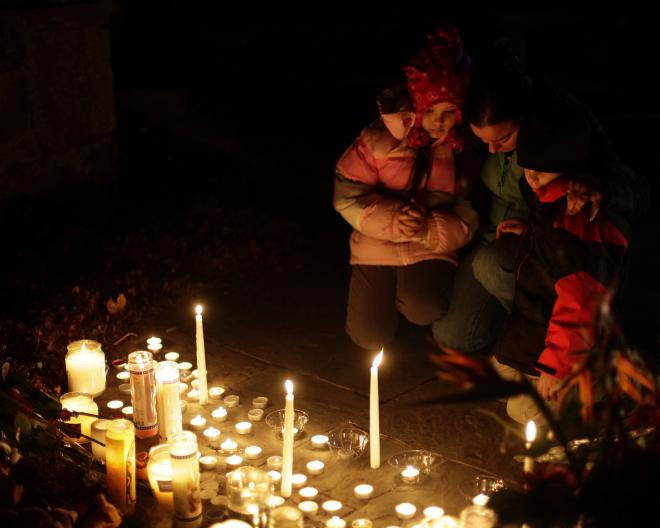
A family pauses at the vigil to remember and grieve.

Entering this quandary begins in framing how the church responds to tragedy. The church, and Israel, has always been defined by the community it consists of; Israel was identified by their communal decisions under God. The church is defined by Israel’s hope, the Messiah or Jesus, and our Christian hope is our identity. The New Testament intricately describes how the community of believers collaborates to embody the message of Jesus’s kingdom come [Acts 2:42-47]. All the while, we, the community of believers, anticipate the fullness of creation made new [Revelation 21].

Back to Obama’s words: “God has called them all home.” This statement implicitly presupposes a God who caused these deaths. A theodicy is not necessary here, but to be clear, God mourns these losses. The young man, Adam, was free to exact his own will on others, sadly, and we grieve the losses. So does God. Jesus, the Son of God, suffered with us [Isaiah 53, Gospels]. God is greatly grieved for loss of life and the wickedness that causes it [Genesis 6:5-6]. He knows the length of our days, but clearly he does not seek to shorten them.

Back to the response of the church. This past Sunday, at Grace Episcopal, the church in which I have served for going on four years, we lit a candle and prayed for the families and individuals in Newtown. We lifted up our concerns and cares before the God who comforts and heals. We did it first as a community of faith, collectively pleading for God to reach into lives. We did it also as families and individuals with varying opinions and emotions. We long for God to make all things new, and do our best to keep praying the prayer Jesus taught us, “on earth as it is in heaven.”

We desire things on earth to be as they are in heaven, but we simply do not understand the evils made explicit in the Newtown tragedy. Nor can we comprehend the systemic evils that beset the planet we share. We do what the church does best: we pray, encourage, grieve, listen, and repeat the cycle. For the children, the parents, the families, the extended families, for Adam and his mother who is also gone. May the grieving families in Newtown know that the church, the common people of faith in God throughout the nation and world, is praying. And may they know that the God of the universe is also grieving, but also making all things new in the end.

The names of the departed are below. May we continue in prayer.

The names and ages of the children are as follow:

Charlotte Bacon, 6
Daniel Barden, 7
Olivia Engel, 6
Josephine Gay, 7
Dylan Hockley, 6
Madeleine F. Hsu, 6
Catherine V. Hubbard, 6
Chase Kowalski, 7
Jesse Lewis, 6
Ana M. Marquez-Greene, 6
James Mattioli, 6
Grace McDonnell, 7
Emilie Parker, 6
Jack Pinto, 6
Noah Pozner, 6
Caroline Previdi, 6
Jessica Rekos, 6
Avielle Richman, 6
Benjamin Wheeler, 6
Allison N. Wyatt, 6

And the names, ages, and job titles of the adults are as follow:

Rachel Davino, 29, Teacher
Dawn Hochsprung, 47, Principal
Anne Marie Murphy, 52, Teacher
Lauren Rousseau, 30, Teacher

Credit for the list of people and the picture goes to International Business Times. Their article, from December 15th 2012, is here.

the destruction of human community [and where it comes from]

Two years ago I was privileged to have read, as an assignment in my systematic theology class, Not the Way it’s Supposed to Be by Neil Plantinga. Essentially Plantinga takes a hard yet enlightening look at the way sin infects the world. To a secular person this term “sin” may not resonate, and that is why I will define it. Sin is how you felt at recess when they laughed at you for dropping the ball and falling on your face. Sin is the feeling you had after you lied to your parents about the party you went to back in high school they weren’t so keen on. Sin is the reason your marriage is not better. My sin is why I don’t have the trust that I could.

Hopefully I’m not singling any one group out. I myself am personally complicit in the systematized problem of our exciting yet strange and difficult world: us. Yes, we are each contributors to the big problem. In this essay I want to propound the concept that when we read about God’s concern for the world, his glory includes the success of human community. Let me unpack that. When Christians say, “that does not honor God,” what they mean is that “that act is outlawed by God because it deeply damages people who are created in his image.” God is not, as Jim Carey in Bruce Almighty hilariously declares, the “almighty smiter.” And when John Piper talks about the glory of God, he advocates for people honoring God for his own sake as well as their own.

At this point a brief excursus is needed regarding the problem. The forces at work, the powers that be, the dark realities. These require definition. Christian Scripture, in Ephesians 6, emphasizes the need for metaphorically arming oneself for battle against the “spiritual forces of evil in the heavenly places [v. 12b, ESV].” This requires the “whole armor of God” and Paul is explicit to reference the enemy – the devil – in verse 10 also. He goes on to describe what it takes to withstand the buffeting forces of evil. So, for the Christian, people rebel, but not only because we are bent toward ourselves but because there are powers that be: namely, Satan. Epitomized in films such as The Exorcist, there is a known and felt reality of evil in the world, and Christians have a name for its leader. We rebel. We collaborate with evil.

That said, we are back to a human community, influenced by the powers that be: the spiritual forces of evil, and the self-promoting pride which we wrongly use to support our perceived autonomy and independence. Now we must must discuss the Creator, God. Christians believe there is a God who has been made known in history, most clearly in Jesus Christ the Son of God. In the first book of sacred Christian writings, the Bible, God set apart a people, the Israelites. They were fathered first by a man named Abram who changed his name to Abraham. He set them apart to be different sort of people. One document he used to set them apart was delivered on a mountain. In the second biblical book, Exodus, we read in chapter 20 about what the rules consist of exactly. The first few relate to God and how he sees his created people. The last six-seven translate much more to honoring human relationship.

All that to head back to the thesis: God’s ordering of the world for his glory includes the deep and vibrant wellness of people. Recently I was substituting, assuming for just one day the role of teacher at a high school here in Grand Rapids, Michigan. Stepping away from the desk momentarily, I returned to discover someone had rummaged through my shoulder bag and stolen my iPhone. Classes were transitioning, and by the time I realized it was truly gone, all the students had left for their next class. Accordingly, the rest of my day consisted of calls to Verizon, conversations with administration at the school, and a police report. And since then, many plans have been altered. The phone is in the process of being replaced, and I am deeply thankful for the help of Amanda, a kind woman in Charlotte who faithfully serves at a Verizon call center.

We can begin to pick this situation apart in many ways, but here is a start. Someone broke a commandment, number eight to be precise. They stole something that happened to be an integral part of my life as a member of the human community. And now, I am left with that sense of looming distrust of others. I question the motives of people I did not question before. Like ripples on a pond surface, I can list countless effects of the splash that was the theft of a mobile device. They were not so bad in comparison to many other ripples. My difficulties included inconvenience, monetary loss, frustrating conversations. A small loss. But each of us connects here; each of us has experienced loss. We have experienced loss actively and passively, thoughtfully and carelessly. A junior high boy may shrug off the insults about his weight, but he feels the ripples. A loving mother may write off her daughter’s rebellion as “just a phase” but she feels the burden of rejection. The ripples.

God’s insistence on an ordering of human community confronts our self-assertion. When we are wont to serve ourselves first, we send out ripples. Sometimes when we feel the effects, the ripples of someone else’s sin, we respond by sending ripples of our own. Insults. Gossip. Slander. People, this is the destruction of human community. We often see headlines about the amalgamation of many different ripples that create tsunamis of human conflict. Phrases are born that serve as reminders of how disordered we can become. The Holocaust. 9/11. The Killing Fields.

God grieves seeing these human realities. We are sure that he suffers in this affirmation from Romans 5:8, written by Paul: “while we were still sinners, Christ died for us.” God suffered. Ironically, the perfect Son of God was killed by a world that so desperately needed to see real and lasting hope. And in Revelation, the last book in Christian writings, we read about God’s judgment. We read about his righting of the many wrongs that pervade the world. It takes a long time to undo the many problems caused by a bitter and hateful world. But after undoing so much, heaven – the place of God – is no longer different than the place of people. The extant evil is gone, its ruler finally defeated. And people dwell in peace and safety.

So does the Christian, changed by God in Christ and continually encouraged by the community of belief known as the church, continue to send out ripples? The hope is an affirmative no. And yet, we as followers of Jesus continue to battle the powers that be, the systems and the habits that press the hope out of humanity. And we still participate in the systems at times. Maybe one way to enact change is by recognizing this simple maxim: do unto others as you would have them do unto you (Matthew 7:12). Jesus said it in his famous Sermon on the Mount. Maybe we can send ripples of hope. Maybe we, who have received so very much from a generous, extravagant, yet suffering God, can help point the way to the hope that is yet to fully come. When we are tempted to send ripples of malice and judgment and hate, we can, with the believing church, anticipate the fullness of God’s ultimate hope for the world. We know the sources of the destruction of human community. But we also know God’s response. He is on our side, searching for those who are concerned for loving him. And this is made obvious in loving others.